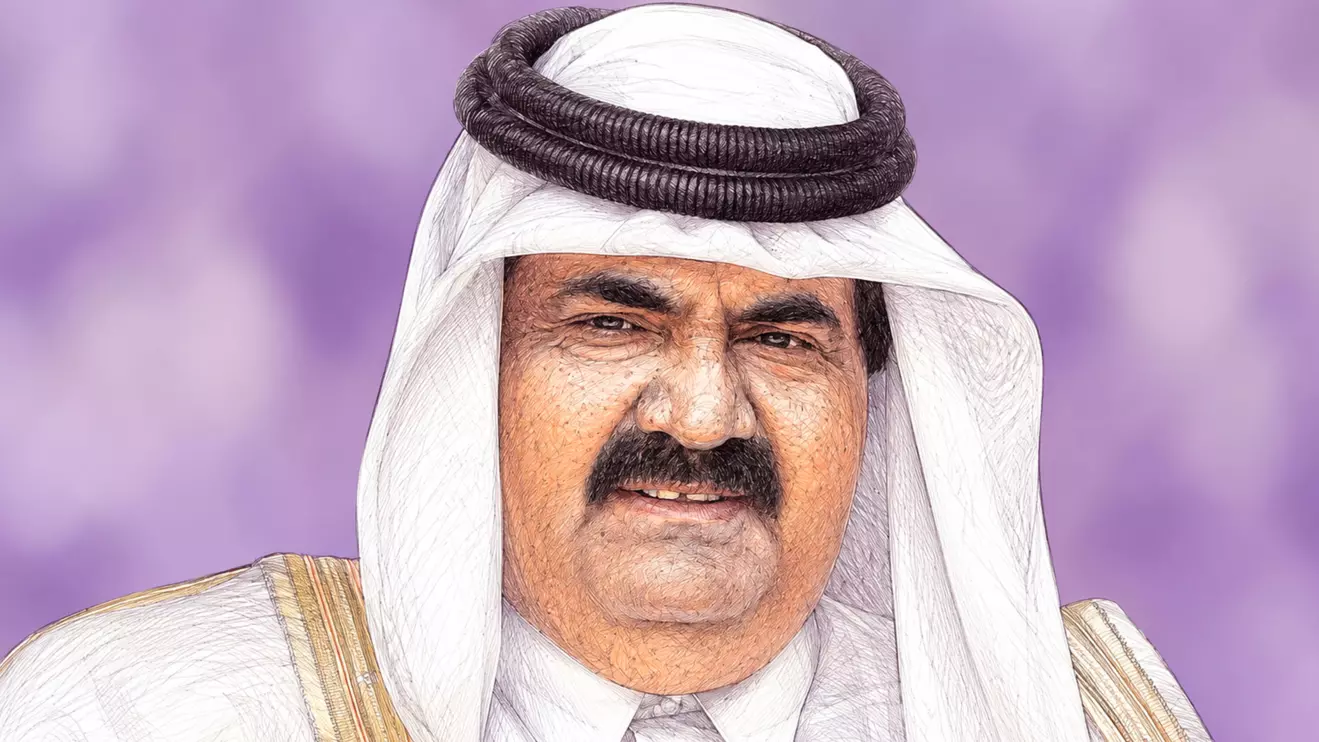
Qatar's former emir, Sheikh Hamad bin Khalifa Al-Thani, a sweeping moderniser who seized power in 1995 and broke with tradition to hand it over to his son 18 years later, has died at the age of 74.
Qatar's top government body, the Amiri Diwan, announced that Sheikh Hamad had died on Sunday morning. It did not mention the cause of his death.
The Qatar that the current Emir Sheikh Tamim bin Hamad Al-Thani inherited was already well on its way to being remade by his father.
Sheikh Hamad presided over one of the most consequential periods in the country’s history, driving a rapid transformation of the tiny desert state that reshaped its economy, global profile and political ambition.
A forceful, independent-minded personality, he explained in a speech to mark his abdication in 2013 that he wanted a new generation "with their innovative ideas and active energies" to take over.
Sheikh Hamad was the architect of Qatar’s effort to develop its liquefied natural gas (LNG) infrastructure that allowed it to get its vast gas reserves to global markets, turning the state into one of the world’s largest exporters and laying the foundations for its vast wealth.
He established media network Al Jazeera, which gave Qatar an outsized voice in Arab politics and projected its influence far beyond the Gulf. He also oversaw the successful bid to host the 2022 soccer World Cup, a move that firmly put Qatar on the global stage and accelerated a decade of infrastructure building that remade the capital Doha.
LAYING GROUNDWORK FOR QATAR'S ROLE AS PEACE BROKER
His foreign policy carved out a role for Qatar as a mediator, brokering talks in conflicts from Lebanon to Yemen and Darfur while maintaining ties with the United States — hosting U.S. Central Command — as well as Iran and groups aligned with it. That balancing act laid the groundwork for Qatar’s current role in negotiations between the United States and Iran, and in its years-long efforts to halt the war in Gaza.
Qatar under Sheikh Hamad played a prominent and controversial role during the 2011 Arab Spring uprisings, using its resources and outsized influence to back revolutionary movements and Islamist groups across the region. While Doha portrayed its policy as support for popular demands for political change, critics accused it — and Sheikh Hamad — of selectively backing factions aligned with its interests, particularly groups linked to the Muslim Brotherhood.
This put Sheikh Hamad at odds with fellow Gulf monarchs in Saudi Arabia and the United Arab Emirates, which viewed many of these movements as a threat to regional stability and monarchical rule. The activism elevated Qatar's regional profile but also deepened tensions with its neighbours and left a legacy that continues to shape Gulf politics.
COUP AND ATTEMPTED COUNTER-COUP
Sheikh Hamad’s abdication was intended to ensure a smooth succession and minimise discord within a ruling family with a long history of palace intrigue.
He himself seized power from his father in a bloodless coup in 1995. A year later, he survived an attempted counter-coup that analysts attributed to his father, who had come to power in similar fashion in 1972 by ousting his cousin.
One of Sheikh Hamad’s most consequential partners in Qatar’s modernisation drive was one of his wives, Sheikha Moza bint Nasser, who fostered a public profile that was rare for a Gulf ruler’s wife. Sheikha Moza’s influence rose alongside his efforts to reposition the state at home and abroad.
While Sheikh Hamad pushed through political and economic reforms that reshaped the country’s trajectory, she advanced a parallel agenda in education, research and social development.
When the emir took power, he was the youngest leader in the region at 44. He was viewed as less aloof than other Gulf Arab leaders, and could often be found at his favourite café in Doha's souq, talking with the patrons.