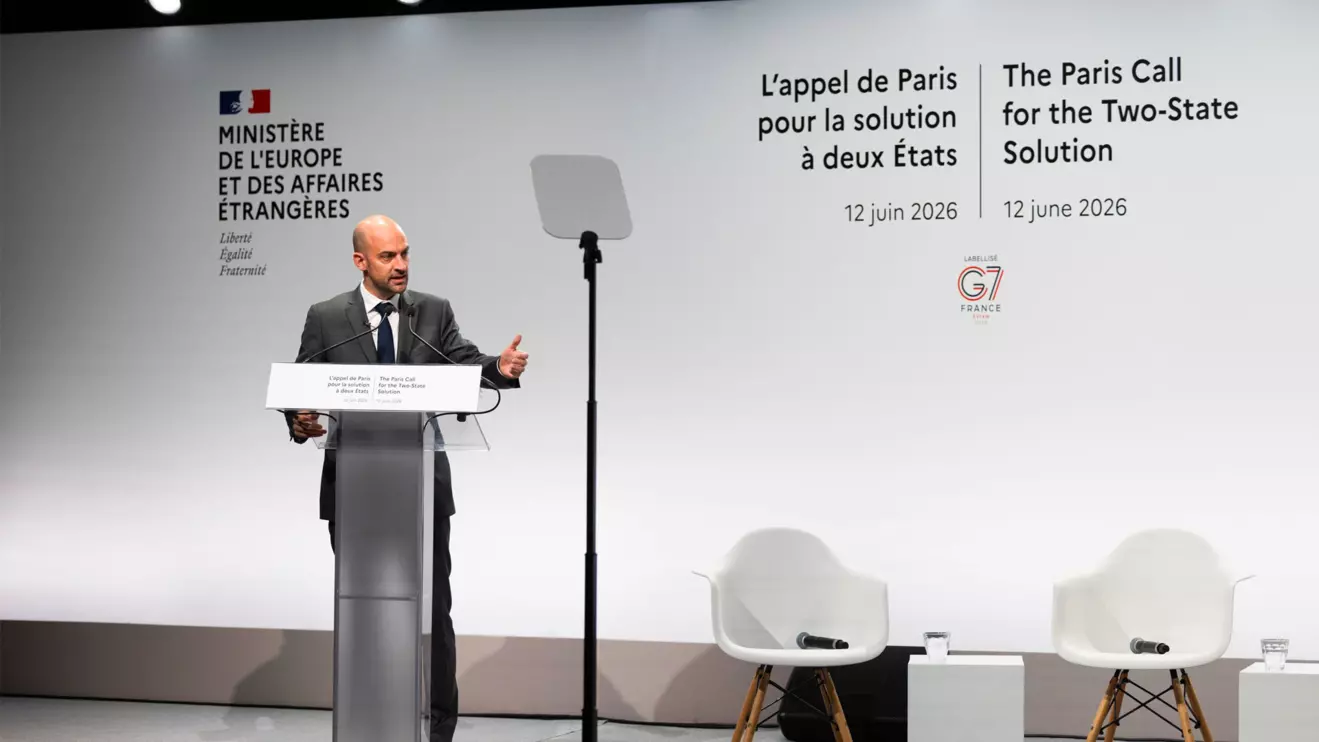
France is hosting a conference Friday bringing together civil society groups and foreign ministers from dozens of countries to push for a two-state solution to the Israeli-Palestinian conflict, timed to coincide with the first anniversary of the UN-backed New York Declaration on Palestinian statehood.
The gathering will produce an eight-point "Call for Action" urging a permanent ceasefire, a halt to settlements, Gaza reconstruction and governance reforms, a document that will be handed to G7 leaders meeting in the French Alps from Monday.
Let us be clear about what this conference actually is: a carefully staged media operation by Emmanuel Macron, designed to project French diplomatic relevance on the world stage while delivering precisely nothing of substance.
The civil society groups invited to participate are overwhelmingly pro-Palestinian in their orientation, some with ties that sit uncomfortably close to Hamas. Israeli civil society perspectives are conspicuously underrepresented, if present at all. A gathering that claims to advance peace while hearing from only one side of the conflict is not a peace conference. It is a political performance.
A Document Nobody Will Read
The eight-point declaration that emerges from Friday's meeting will be presented to G7 leaders with great fanfare. It will then be quietly noted, filed and forgotten, as have been the dozens of similar declarations, roadmaps and calls for action produced by similar gatherings over the past several decades.
The two-state solution faces real, structural obstacles on the ground: a Hamas-controlled Gaza with no intention of accepting Israel's existence, an Israeli government deeply skeptical of Palestinian statehood, and a regional environment transformed by war. None of these obstacles will be addressed by a communiqué drafted in Paris by NGOs selected for their political alignment.
Since the October 7 massacres, France has positioned itself as a champion of Palestinian statehood and a critic of Israeli military conduct. The approach has won Macron applause in certain international forums. It has done nothing to bring peace closer, and it has steadily eroded France's credibility as a genuine honest broker in the region.
Friday's conference is the latest chapter in that story. Grand in ambition, thin in substance, and ultimately irrelevant to the people whose lives depend on a real solution.