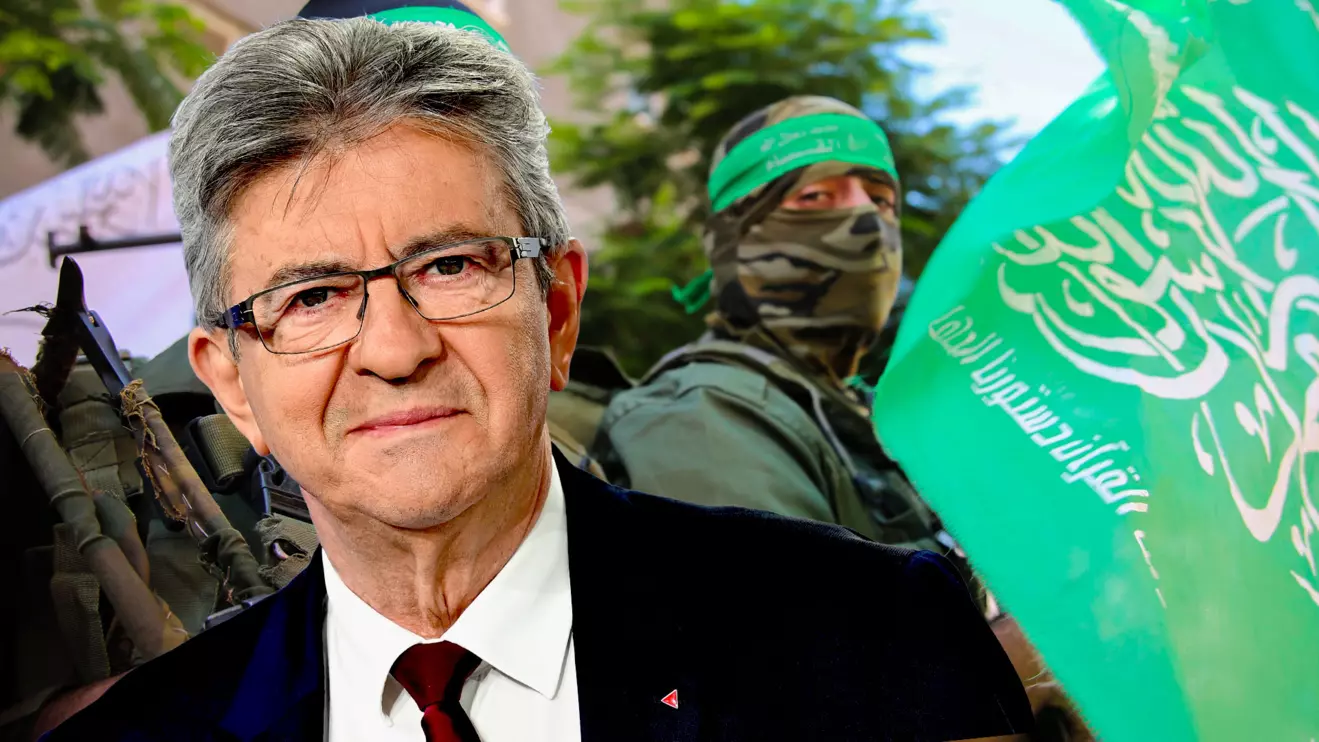
Jean-Luc Mélenchon, leader of La France Insoumise and France's most prominent hard-left politician, is now the subject of a criminal complaint for apology of terrorism filed by three French victims of the October 7 Hamas massacre.
The complaint follows remarks Mélenchon made last week at a rally in support of far-left activist Anasse Kazib, himself summoned by French justice for celebrating "Palestinian resistance" on October 7, 2023, the day Hamas murdered 1,200 Israeli civilians in the deadliest antisemitic pogrom since the Holocaust. At the rally, Mélenchon suggested it was possible to question whether the October 7 massacres constituted terrorism.
Let us be clear about what this is. Mélenchon's increasingly extreme anti-Israel posturing is not a principled foreign policy position. It is a cynical electoral calculation, a deliberate bid to capture the votes of Muslim and North African immigrant communities in France's suburban banlieues, where anti-Israel sentiment runs high and where Mélenchon sees a loyal voter base ripe for mobilisation.
His antisemitism is not a recent development or an occasional slip of the tongue. It is a documented pattern, remarks about Jewish influence, the systematic refusal to call Hamas a terrorist organisation, the equivocation over the worst mass murder of Jews since 1945, the dog-whistle rhetoric that has made his party a hostile environment for French Jews.
A Calculated Political Strategy Built on Antisemitism
The man running for the French presidency in 2027 is prepared to relativise the slaughter of 1,200 innocent people, elderly kibbutz residents, children at a music festival, families burned alive in their homes — for the sake of electoral arithmetic in the suburbs of Paris.
Three French victims of the October 7 attacks have had enough. Their complaint for apology of terrorism against Mélenchon sends a message that words have consequences, that standing before a crowd and casting doubt on whether the butchering of 1,200 civilians constitutes terrorism is not political commentary. It is, in France, a criminal offence.
Mélenchon has spent years hiding his antisemitism behind the language of anti-colonialism and Palestinian solidarity. The complaint strips away that cover and forces French justice to examine what he actually said, and what it actually means.
For the victims of October 7 and their families, it is a small but meaningful act of resistance against a politician who has chosen, deliberately and repeatedly, to stand on the wrong side of history.
By François Veltrez, Paris