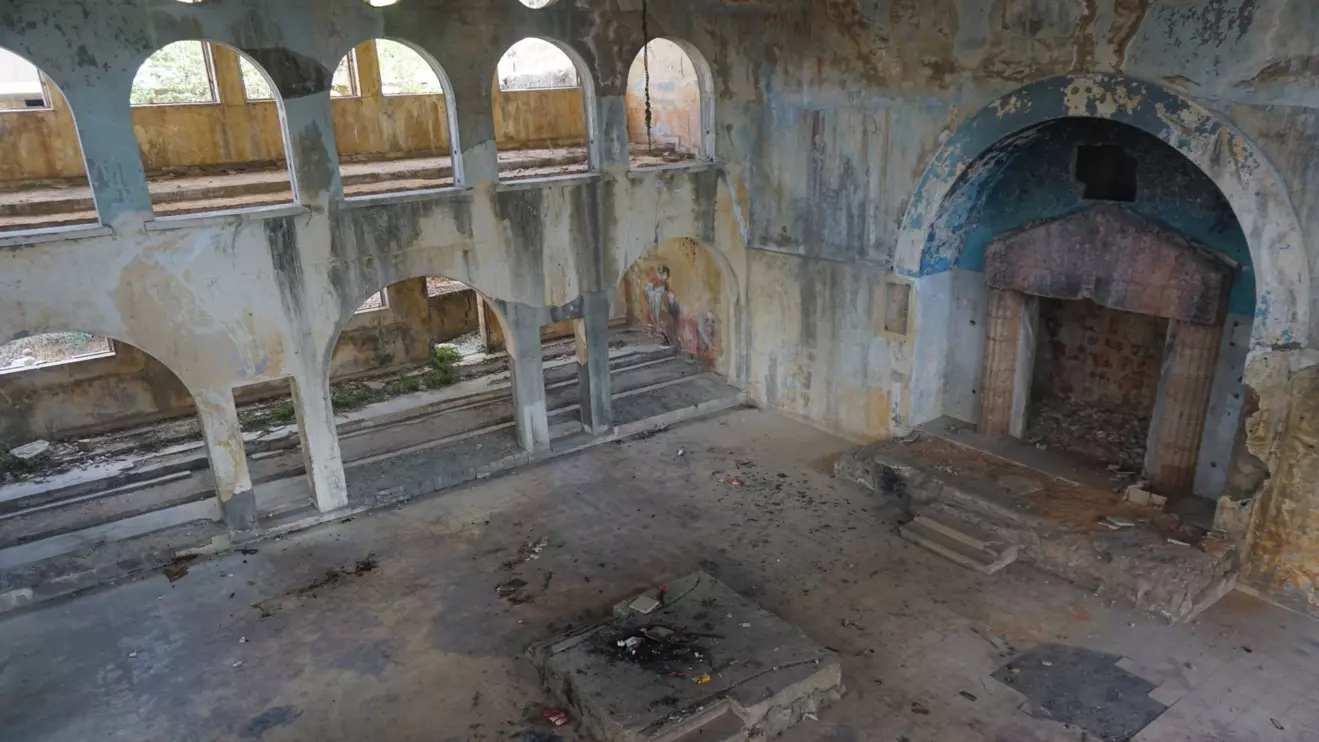
High in the hills above Beirut, where mist settles over crumbling villas and the past hangs heavier than the mountain air, stands a building that time has been unusually gentle with, even as neglect has not.
This is the synagogue of Bhamdoun, once known as the "New Temple."
Completed in 1922, it was built for the Jewish families of Beirut who, like so many of the capital's well-to-do residents, retreated each summer to Bhamdoun's cool air and fashionable promenades.
It was among the last great synagogues raised in Lebanon, and one of the largest ever built there. In its very existence lies a truth that has slipped quietly out of public memory: Judaism was never a foreign presence in Lebanon. It was Lebanese.
The synagogue stands empty now. But empty is not the same as erased.
Climb the monumental staircase toward the entrance, and the building still speaks, if you know how to listen. Inside, the bimah's raised platform recalls the chanting of the Torah.
A shallow niche marks where the Holy Ark once held its sacred scrolls. Upstairs, a gallery reserved for women looks down over a sanctuary long since gone quiet. Hebrew tablets bearing the Ten Commandments once kept watch above the door. Even stripped of its congregation, even after decades of abandonment, the building carries itself with a certain dignity, the kind that outlasts use, outlasts even memory itself.
For much of the twentieth century, Lebanon's Jews were simply Lebanese
It is a small miracle, in its way, that the synagogue survived the civil war at all.
Bhamdoun was ravaged by the fighting that tore through Mount Lebanon, and much of what stood here was reduced to rubble.
Yet somehow the New Temple remained standing. Survival, though, is a different thing from preservation. The decades since have done what the war could not: cracked its walls, opened it to the elements, let the vegetation creep in. And in that slow decay lies a quieter story than the one of stone and mortar, the story of a society that has, without quite meaning to, misplaced a piece of its own memory.
For much of the twentieth century, Lebanon's Jews were simply Lebanese. They lived mostly in Beirut, clustered around the old quarter of Wadi Abu Jamil, but also in Sidon, Tripoli, Aley, Deir el-Qamar and Bhamdoun itself.
They studied in Lebanese schools, spoke Arabic and French with the same ease as their neighbors, and worked in commerce and the professions like anyone else. To this day, Judaism remains one of Lebanon's eighteen officially recognized religious communities, a fact many Lebanese themselves have half-forgotten.
That history was never without its tensions, and it would be a disservice to romanticize it.
But it would be a greater disservice still to let it disappear. The creation of Israel in 1948, the wars that followed, the long agony of the civil war, the enduring weight of the Israeli-Palestinian conflict ,each of these, in turn, chipped away at a community that had once called these hills home, until the Jews of Lebanon became a footnote rather than a fixture.
And yet the synagogue remains, half-swallowed by the hillside, waiting.
Not as a monument to loss alone, but as a quiet, stubborn reminder that Lebanon's story was always more layered, more plural, more intertwined than the region's divisions have allowed it to remember.
In its cracked walls and overgrown courtyard, Bhamdoun's New Temple offers something rare in a region so often imprisoned by its own fractures: proof that coexistence was not always a foreign idea here. It was, once, simply how people lived.
Reporting by Antoine Tanios in Bhamdoun