U.S. President Donald Trump and Iran threatened to escalate their war, targeting energy and fuel facilities in the Gulf, which could again roil global energy and financial markets and deepen a regional crisis.
Trump on Saturday threatened to "obliterate" Iran's power plants if Tehran did not fully reopen the Strait of Hormuz within 48 hours, a significant escalation barely a day after he talked about "winding down" the war, now in its fourth week.
Iran warned on Sunday it would target U.S. infrastructure, including energy facilities in the Gulf, if Trump carried out his threat, which he made as U.S. Marines and heavy landing craft continue to head to the region.
More than 2,000 people have been killed during the war the U.S. and Israel launched on February 28, which has upended markets, spiked fuel costs, fuelled global inflation fears and convulsed the postwar Western alliance.
'TICKING TIME BOMB' FOR MARKETS
"President Trump's threat has now placed a 48-hour ticking time bomb of elevated uncertainty over markets. If the ultimatum is not walked back, we will likely see a Black Monday reopening of global equity markets in free fall and oil prices spiking significantly higher," said IG market analyst Tony Sycamore.
Tehran would likely target Gulf energy facilities in Saudi Arabia, the United Arab Emirates and Qatar, which "would deepen and prolong the pain of higher energy prices and drag the conflict into a broader regional crisis", Sycamore said.Oil prices jumped on Friday and settled at their highest in nearly four years, after Iraq declared force majeure on all oilfields developed by foreign firms, Israel attacked a major gas field in Iran and Tehran responded with strikes on neighbours, Saudi Arabia, Qatar and Kuwait.
Iranian attacks have effectively closed the Strait of Hormuz, a narrow choke point that carries around a fifth of global oil and liquefied natural gas supplies, causing the worst oil crisis since the 1970s. Its near-closure sent European gas prices surging as much as 35% last week.
"If Iran doesn't FULLY OPEN, WITHOUT THREAT, the Strait of Hormuz, within 48 HOURS from this exact point in time, the United States of America will hit and obliterate their various POWER PLANTS, STARTING WITH THE BIGGEST ONE FIRST!" Trump posted on social media around 7:45 p.m. EDT (2345 GMT) on Saturday.
Hours later, Iran's representative to the U.N. maritime agency said the strait remained open to all shipping except vessels linked to "Iran's enemies".
Ali Mousavi, Tehran's representative to the International Maritime Organisation, said passage through the narrow waterway was possible by coordinating security and safety arrangements with Tehran.
Ship-tracking data has shown some vessels, such as Indian-flagged ships and a Pakistani oil tanker, have managed to negotiate safe passage through the strait. Pakistan has good ties with Iran while maintaining close relations with the U.S. and Saudi Arabia.
Trump's idea in targeting Iranian infrastructure is to make the Hormuz blockade "economically and politically unbearable for Tehran, without destroying Iranian oil fields that would cause long-term global supply damage," Sycamore said.
Iran's Khatam al-Anbiya military command headquarters said if the U.S. attacked Iran's fuel and energy infrastructure, Iran would target all U.S. energy, information technology and desalination infrastructure in the region.
The Islamic republic's power grid is deeply intertwined with its energy sector. Striking major plants could trigger blackouts, crippling everything from pumps and refineries to export terminals and military command centres.
Iran's largest power plants include the Damavand facility near Tehran, the Kerman plant in the southeast and Ramin in Khuzestan province, all of which have much greater generation capacity than Iran's sole nuclear plant at Bushehr on the southern coast.
IRAN EXPANDS RISKS WITH LONG-RANGE MISSILES
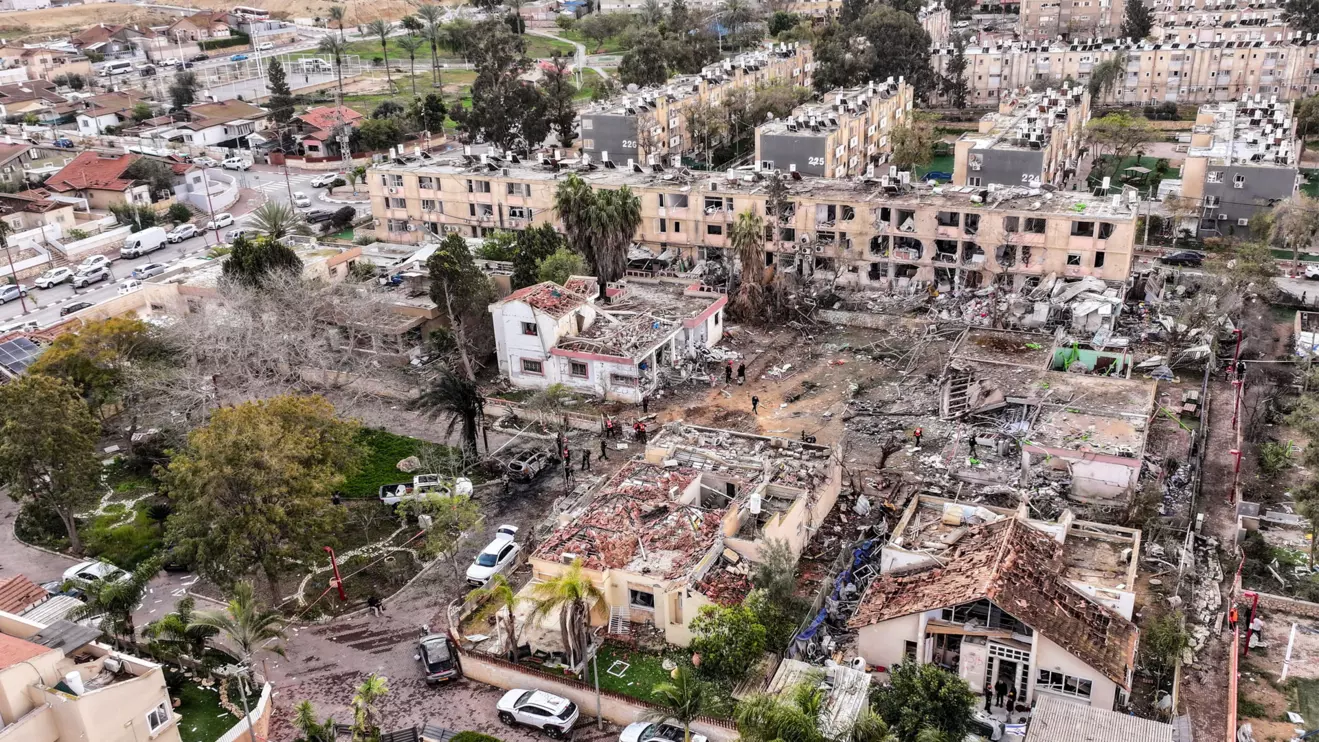
Tehran fired long-range missiles for the first time on Saturday, expanding the risk of attacks beyond the Middle East, while an Iranian strike landed near Israel's secretive nuclear reactor about 13 km (8 miles) southeast of Dimona.
Iran launched two ballistic missiles with a range of 4,000 km (2,500 miles) at the U.S.-British military base at Diego Garcia in the Indian Ocean, said Israeli military chief Eyal Zamir.
"These missiles are not intended to strike Israel. Their range reaches European capitals - Berlin, Paris, and Rome are all within direct threat range," Zamir said in a statement.
The Israeli military said on Sunday it was striking Tehran just hours after Iran's attacks on southern Israel.
Trump and his administration have sent mixed messages about U.S. goals throughout the war, leaving allies struggling to respond.
He has accused NATO allies of cowardice over their reluctance to help open the Strait of Hormuz. Some allies have said they would consider it but most say they are reluctant to join a war that Trump started without consulting them.
Japan could consider deploying its military for minesweeping in the s, if a ceasefire is reached, Foreign Minister Toshimitsu Motegi said on Sunday.
A new Reuters/Ipsos poll, conducted last week, finds that 59% of Americans disapprove of U.S. military strikes against Iran, with 37% approving.
The war has become a major political liability for Trump ahead of November mid-term elections for the Congress, with energy price shocks fuelling U.S. inflation and hitting consumers and businesses hard.