Turkey, Saudi Arabia, Pakistan set first talks under new defence pact

1 min Mena Today

Top officials from Turkey, Saudi Arabia and Pakistan will gather in Istanbul on Monday for a first committee meeting under the joint defence accord that they signed this month, a Turkish foreign ministry source said.

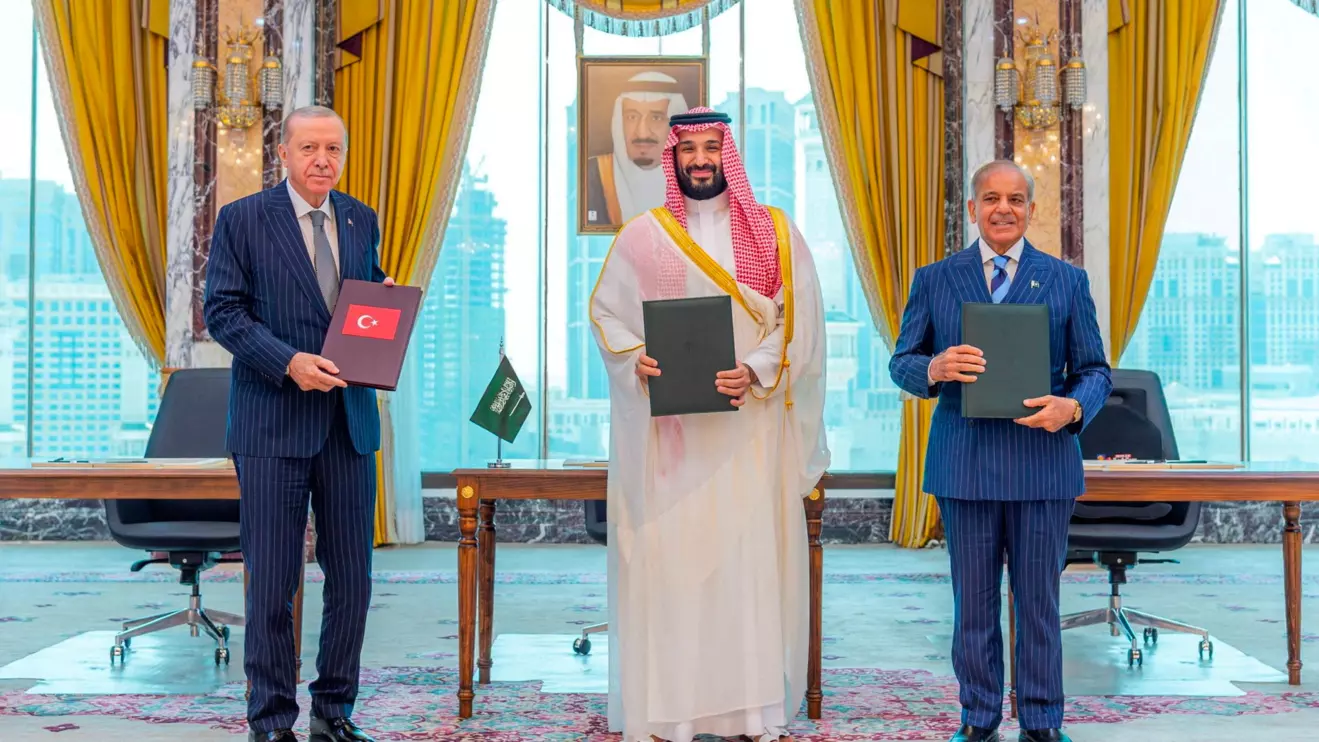
Turkish President Tayyip Erdogan, Saudi Crown Prince Mohammed bin Salman, and Pakistan's Prime Minister Shehbaz Sharif pose after signing a joint defence agreement in Mecca, Saudi Arabia, August 7, 2026. Saudi Press Agency

Turkish President Tayyip Erdogan, Saudi Crown Prince Mohammed bin Salman, and Pakistan's Prime Minister Shehbaz Sharif pose after signing a joint defence agreement in Mecca, Saudi Arabia, August 7, 2026. Saudi Press Agency

Top officials from Turkey, Saudi Arabia and Pakistan will gather in Istanbul on Monday for a first committee meeting under the joint defence accord that they signed this month, a Turkish foreign ministry source said.

The "Mecca Joint Defence Agreement", signed on August 7, brought together Sunni Muslim U.S. allies concerned by the Iran war and regional conflict that has led to Iranian missile fire on Gulf oil exporters.

It is intended to strengthen collective deterrence against any act of aggression and stipulates that an armed attack against any of the three would be regarded as an attack on all, similar to NATO's Article 5 collective defence clause.

Foreign and defence ministers, as well as the chiefs of staff, of the three countries will attend the meeting in Istanbul, the ministry source said.

"International security issues will be on the agenda," the source said, with discussions expected to cover enhancing defence capabilities, greater interoperability among their armed forces and deepening cooperation in the defence industry, including joint production and development.

The three nations share concerns about the military stances of Israel and revolutionary Shi'ite Iran, as long-time ally the U.S. struggles to contain regional upheaval that has caused a global energy crisis. 

Six months after the U.S. and Israel launched the war against Iran, negotiations are at an impasse and President Donald Trump's administration has stepped up efforts to punish Iran financially with what it has billed as an "economic D-Day".

Turkey, which has NATO's second-largest military, has said the pact with nuclear-armed Pakistan and top oil exporter Saudi Arabia was open to expansion — with Egypt as a potential candidate — and did not seek to replace existing alliances.

Reporting by Tuvan Gumrukcu

Related

Saudi Arabia

Saudi alert lifted a day after deadly attacks

Saudi Arabia's Civil Defense lifted an alert it had announced in the southern city of Khamis Mushait on Wednesday, a day after Houthi attacks there and in three other nearby cities wounded 73 people and set oil installations ablaze.

Iran

Iran retaliates after US sinks tankers

Iran's Revolutionary Guard said it fired ballistic missiles at a base in Jordan used by the U.S. military and attacked 10 ships on Wednesday, after the U.S. said it had destroyed five Iranian oil tankers, in a sharp escalation of the six-month-old war.

Israel

"Unite or lose": Netanyahu's race against the clock

Prime Minister Benjamin Netanyahu is seeking to consolidate Israel's fractious right-wing parties ahead of a Tuesday deadline in order to avoid an election loss forecast by opinion polls.

Subscribe to our newsletter

Mena banner 4

To make this website run properly and to improve your experience, we use cookies. For more detailed information, please check our Cookie Policy.

  • Necessary cookies enable core functionality. The website cannot function properly without these cookies, and can only be disabled by changing your browser preferences.