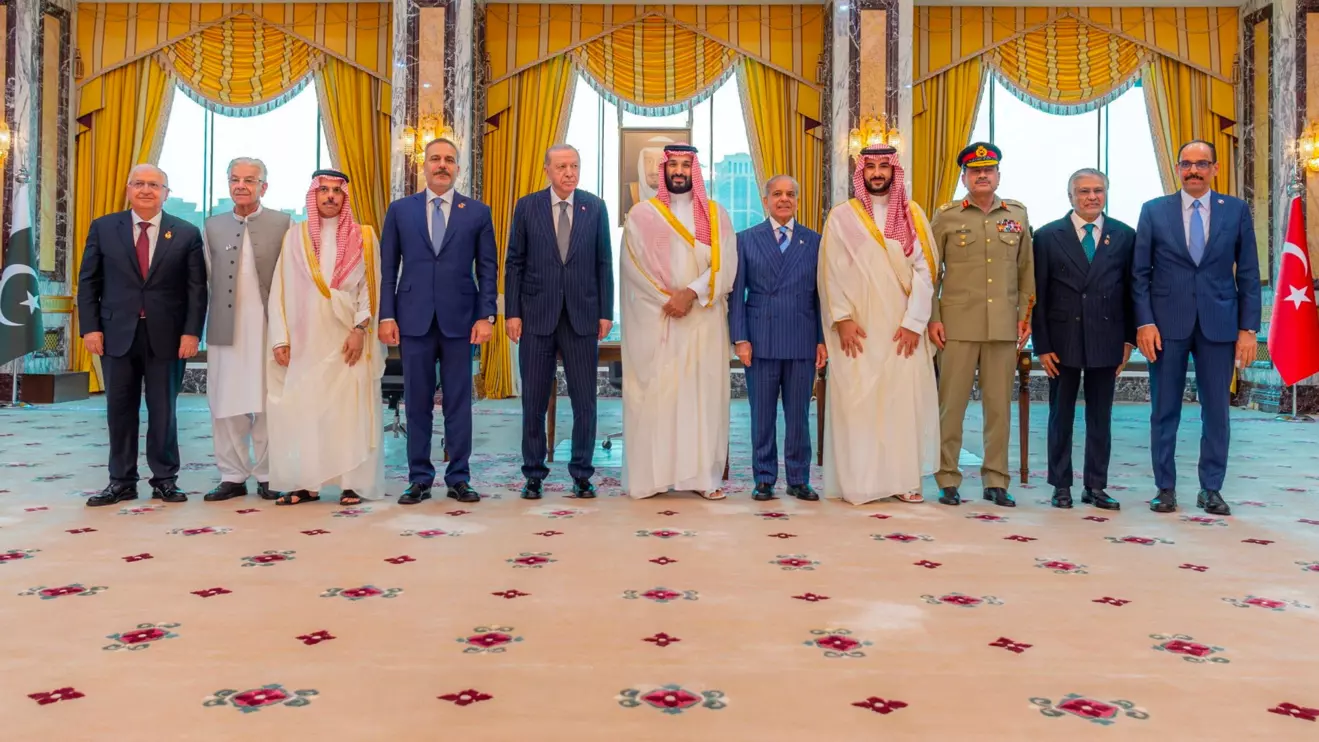
A defence pact signed between Turkey, Pakistan and Saudi Arabia is technically the same as NATO's Article 5 mutual defence agreement, Turkish Foreign Minister Hakan Fidan said on Saturday, adding the accord was not targeting Iran.
Fidan also said Turkish President Tayyip Erdogan wanted to see the alliance expand, and that Egypt was a potential candidate to join, among others.
The regional powers signed the "Mecca Joint Defence Agreement" on Friday, wedding Sunni Muslim U.S. allies alarmed at a regional conflagration that has brought Iranian missile fire onto Gulf oil exporters.
In a joint statement, they said the accord intended to strengthen collective deterrence against any act of aggression and stipulates that an armed attack against any of the three would be regarded as an attack on all.
Speaking to the state-run Anadolu news agency, Fidan said the new alliance was not directed against Iran or any other country, but rather served as a general pledge to support the three allies' security.
He added that the allies would decide through consultations what degree, form, and format of support they would ask for in the event of an attack, but that no country would be considered a threat as long as a member state is not attacked.
Turkey, which has NATO's second-largest army, has said the pact was open to expansion to other regional countries and did not seek to replace any existing alliances.
"NATO is a giant military alliance where there are 32 countries. We have started here as three countries and we have to take very humble but concrete steps," he said, adding efforts to finalise the pact had been underway for two years and eight months.
He added that a committee of ministers similar to that within NATO would be formed as part of the alliance, as well as a general secretariat based in Saudi Arabia, but that operational details would be set at the first committee meeting.
"Our president's vision is that we don't remain limited to three countries, that we grow and bring together all (regional) countries under this roof," he said, adding Egypt could potentially join the pact once certain technical matters are resolved.
In recent months, Turkey, Saudi Arabia, Pakistan and Egypt formed a group to address regional issues, namely the war on Iran. Turkey has said the group - dubbed the R4 - aims to solidify its partnership through concrete mechanisms.
Fidan also said Turkey should be involved in an international coalition to protect shipping in the Red Sea from Houthi attacks because shipping safety concerned Ankara's interests.
Reporting by Tuvan Gumrukcu