
Israel
Gaza envelope population tops pre-October 7 levels
Thousands of newcomers are joining returning evacuees, a quiet verdict on who won the southern front.

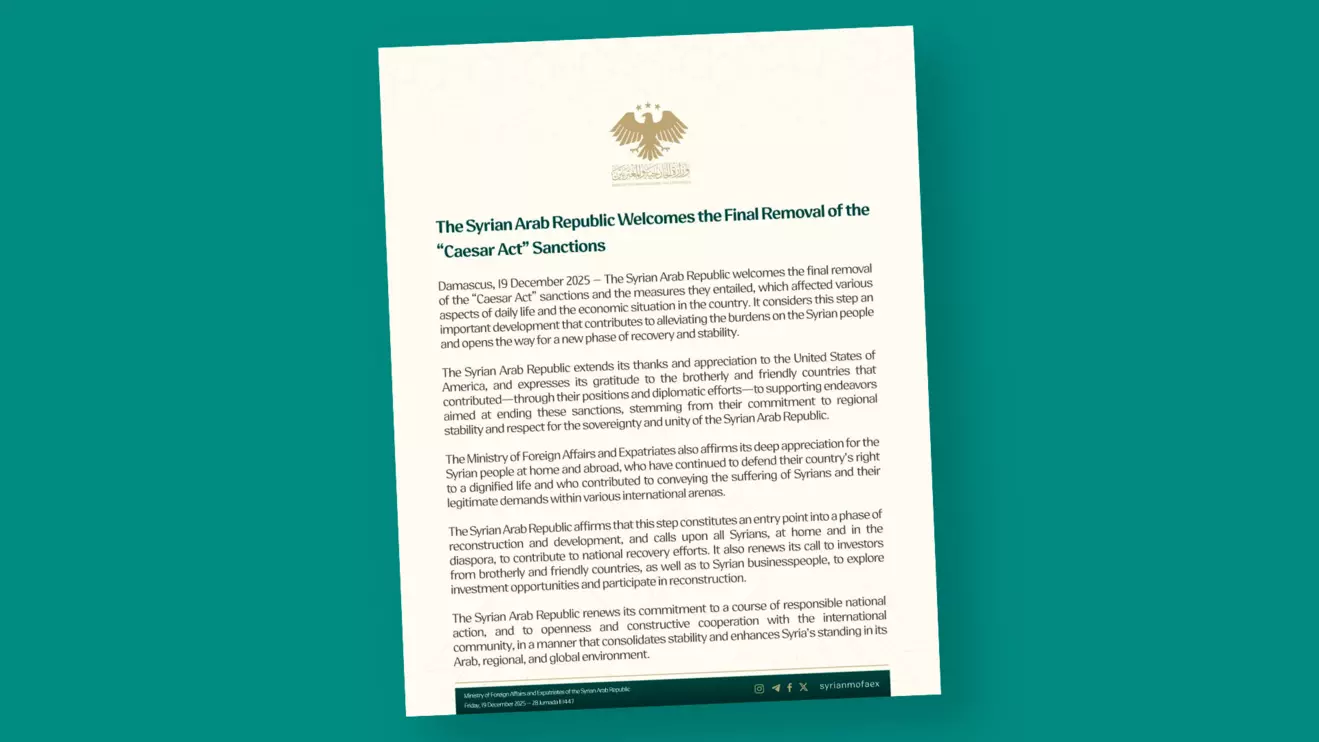
Syria’s Foreign Ministry on Friday welcomed the permanent lifting of U.S. sanctions, calling the move a key step toward rebuilding a country devastated by more than a decade of civil war.
The Caesar Act had already been suspended twice for six-month periods following President Donald Trump’s announcement in May that Washington would lift sanctions as part of a broader normalization of relations with Syria © Mena Today
Syria’s Foreign Ministry on Friday welcomed the permanent lifting of U.S. sanctions, calling the move a key step toward rebuilding a country devastated by more than a decade of civil war.
The U.S. Congress approved the repeal on Wednesday, ending sanctions imposed under the so-called Caesar Act, adopted during the rule of former president Bashar al-Assad, who was ousted in December 2024. The law had effectively cut Syria off from the international banking system and dollar-based transactions.
In a statement, Damascus said the decision marked “the beginning of a phase of reconstruction and development” and urged Syrians at home and abroad to take part in national recovery efforts.
The Caesar Act had already been suspended twice for six-month periods following President Donald Trump’s announcement in May that Washington would lift sanctions as part of a broader normalization of relations with Syria.
The move came after pressure from Saudi Arabia and Turkey, both allies of Syria’s new government led by Ahmad al-Chareh, a former jihadist leader. Al-Chareh had pushed for a full repeal, arguing that the continued existence of the law discouraged foreign investment due to legal risks.
After 13 years of war, Syria is seeking funding for reconstruction costs estimated by the World Bank to exceed $216 billion.
Thousands of newcomers are joining returning evacuees, a quiet verdict on who won the southern front.
Turkish President Tayyip Erdogan said it was unrealistic to expect all countries to make the same progress on climate policy while inequalities in access to financing and technology persisted, adding he expected support from all nations for Turkey's COP31 Climate Summit action agenda.
Turkey and Iraq agreed on Wednesday for Turkish forces to hand over a military camp in northern Iraq to the Iraqi government gradually, they said after talks in New York, adding they also agreed to end the presence of "outlawed armed elements" in northern Iraq.

To make this website run properly and to improve your experience, we use cookies. For more detailed information, please check our Cookie Policy.
Necessary cookies enable core functionality. The website cannot function properly without these cookies, and can only be disabled by changing your browser preferences.