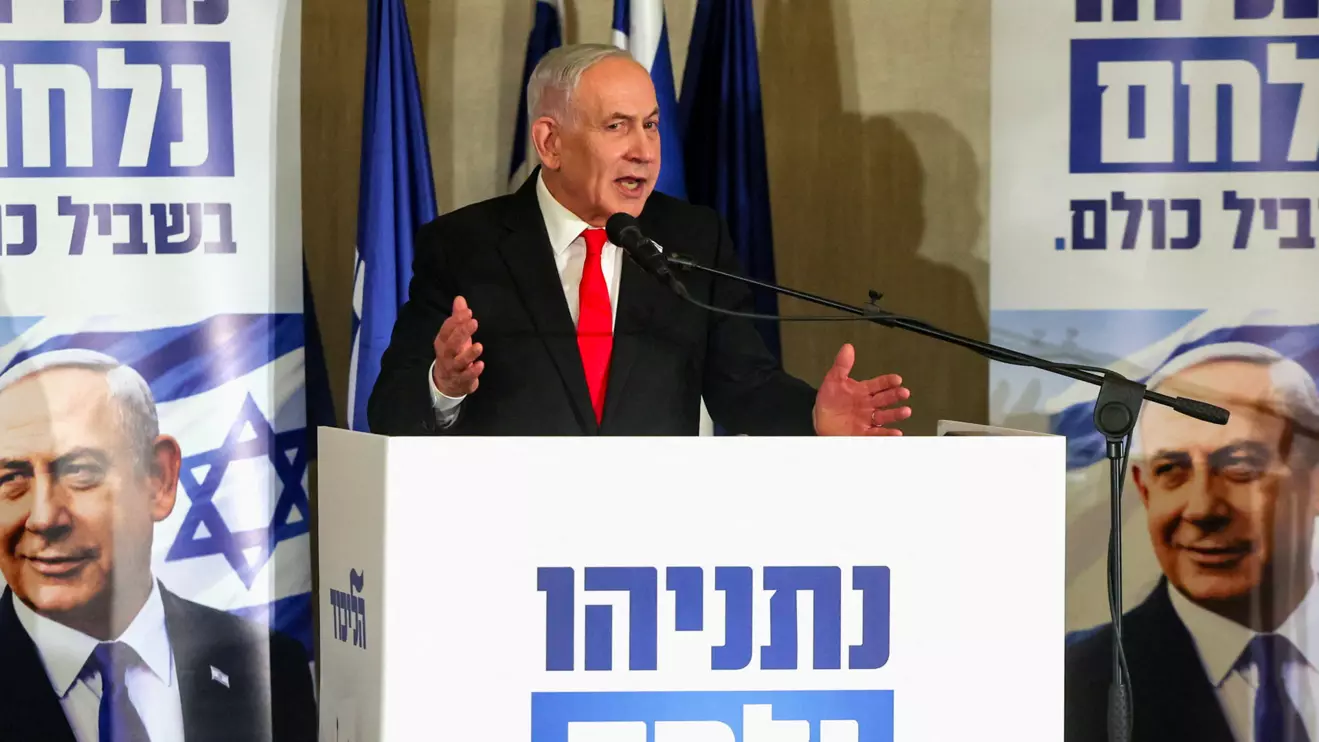
Prime Minister Benjamin Netanyahu is seeking to consolidate Israel's fractious right-wing parties ahead of a Tuesday deadline in order to avoid an election loss forecast by opinion polls.
Netanyahu, Israel's longest-serving prime minister, is seeking a record seventh term in the October 27 election, but he has faced pressure over the Hamas-led 2023 attack on Israel and subsequent wars in Gaza, Iran and Lebanon, and surveys have for months been pointing to a defeat for his nationalist-religious coalition.
Netanyahu has therefore been pressing allies to merge their candidate lists and raise their chances of gaining parliament seats, so far with only partial success.
Their deadline, when running parties must submit their final lists of candidates, expires on Tuesday night.
"When we unite, we win. When we splinter, we lose," Netanyahu said in an August 30 interview on Channel 14, a pro-Netanyahu television station. "I am doing all I can, as I did in the previous election, to unite these parties."
RIGHT-WING NEWCOMER WORRIES NETANYAHU
No single party has ever won an outright majority in the 120-seat Knesset, Israel's parliament, making coalition governments the norm and sometimes giving as many as a dozen parties a chance of winning seats.
To do so, they must pass a 3.25% vote threshold, equal to four seats, meaning smaller parties risk drawing votes without gaining a seat.
Polls suggest Netanyahu's Likud party stands to lose a third of its parliamentary power. Though it may still remain the largest party, winning 20-23 seats, Netanyahu would likely need his coalition allies including the far-right Jewish Power and Religious Zionism parties to remain in office.
Religious Zionism, headed by Finance Minister Bezalel Smotrich, has been polling between zero and six seats, down from seven currently. With Netanyahu's blessing — and his help, according to two political sources — it merged its list on September 1 with that of Zehut, a small party headed by former far-right libertarian and Likud member, Moshe Feiglin.
But National Security Minister Itamar Ben-Gvir has rebuffed Netanyahu's calls for his Jewish Power party, which currently holds six seats, to run with Religious Zionism, as it did at his behest in the last election. Ben-Gvir has argued that the parties would be stronger running separately.
Feiglin's views on the Palestinians are similar to those of Ben-Gvir and Smotrich, whose calls to annex the occupied West Bank and depopulate Gaza have drawn international ire.
Though such foreign criticism may have little impact on the vote, another worry for Netanyahu is political newcomer Ofer Winter, a right-wing former brigadier general whose views are largely aligned with those of Smotrich.
But Winter has rejected calls to merge his party, saying he will not run with anyone who may be responsible for the security failure that allowed for the 2023 Hamas-led attack.
Winter has cast the election as a protest vote and says he will draw right-wingers who are seeking a fresh start. Latest polls show him at four seats or none.
"He chose to go separately and we are now in danger," Netanyahu told Channel 14, arguing that he risks "wasting" crucial right-wing votes if he does not win enough seats to enter the Knesset.
HAWKISH IMAGE SHATTERED
The parliamentary system delivered a decisive victory for Netanyahu in the previous 2022 election, when a splintered centre-left was knocked out by a unified right-wing alliance.
Now, however, Israel's most dominant politician of his generation is in a far weaker starting position.
Netanyahu's hawkish image was shattered by the security failing of the October 7, 2023, Hamas attack, with critics angered by his refusal to take responsibility, and by wars in Gaza, Iran and Lebanon that brought military successes but no lasting victories.
"He's never faced anything like what he faces now. Everyone in Israel shares a sense of historical crisis, and his name is all over it. And he knows this," said Amotz Asa-El, a political analyst with the Shalom Hartman Institute in Jerusalem.
With Israel's military death toll at its highest in decades, Netanyahu's concessions toward ultra-Orthodox Jewish allies who want many of their men exempt from conscript military service have further alienated his traditional supporters.
Netanyahu's strongest rival at the moment is Gadi Eisenkot, Israel's former military chief, who lost a son in Gaza. His Yashar party has been on a steady rise for months, matching and sometimes overtaking Likud in the polls, though his path to power is still unclear.
Netanyahu's age is a factor too, said Asa-El.
"When he first ran in '96, he was the Israeli Kennedy. Now he's running as the Israeli Biden."