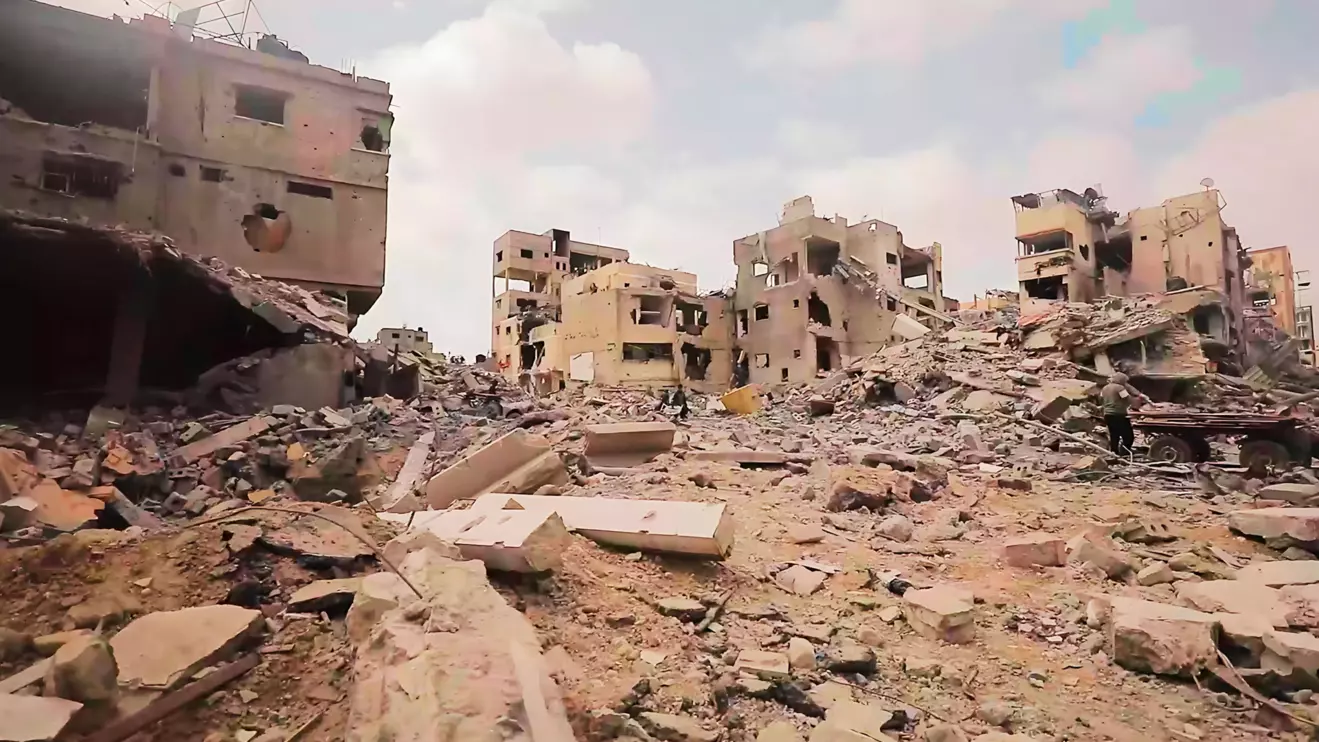
The United States has drafted a United Nations resolution that approves a two-year mandate for a Gaza transitional governance body and an international stabilization force in the Palestinian enclave, according to the text seen by Reuters on Tuesday.
The draft - which is still being developed and could change - was shared with some countries this week, but has not yet been formally circulated to the 15-member Security Council for negotiations, diplomats said. It was not immediately clear when Washington planned to do that.
A State Department spokesperson said discussions with U.N. Security Council members and other partners on how to implement President Donald Trump's Gaza plan were ongoing and declined to comment on "allegedly leaked documents."
The two-page text would authorize a so-called Board of Peace transitional governance administration to establish a temporary International Stabilization Force (ISF) in Gaza that could "use all necessary measures" - code for force - to carry out its mandate.
The ISF would be authorized to protect civilians and humanitarian aid operations, work to secure border areas with Israel, Egypt and a "newly trained and vetted Palestinian police force, which the ISF will be responsible for training and supporting.
The ISF would stabilize security in Gaza, "including through the demilitarization of non-state armed groups and the permanent decommissioning of weapons, as necessary."
SECOND PHASE OF TRUMP PLAN
Israel and Palestinian militants Hamas agreed a month ago to the first phase of Trump's 20-point plan for Gaza, a ceasefire in their two year war and hostage release deal.
The next phase of the plan, which the draft U.N. resolution would endorse, is to establish the Board of Peace and the ISF.
The Trump plan also ends Hamas governance of Gaza and says the enclave would be demilitarized. Hamas has not said whether it will agree to disarm and demilitarize Gaza — something the militants have rejected before.
The ISF would deploy under a unified command agreed by the Board of Peace and in close consultation with Egypt and Israel after detailed status of mission and forces agreements have been reached, according to the resolution.
While the Trump administration has ruled out sending U.S. soldiers into the Gaza Strip, it has been speaking to Indonesia, the United Arab Emirates, Egypt, Qatar, Turkey and Azerbaijan to contribute to the multinational force.
It remains unclear whether Arab and other states will be ready to commit troops to the international force and Israel has repeatedly objected to the deployment of Turkish troops.
The draft U.N. resolution calls on the World Bank and other financial institutions to facilitate and provide financial resources to support the reconstruction and development of Gaza, "including through the establishment of a dedicated trust fund for this purpose and governed by donors."
It was not immediately clear when the United States could put a draft resolution to a vote in the Security Council. A resolution needs at least nine votes in favor and no vetoes by the U.S., Britain, France, Russia or China to be adopted.
The draft resolution was first reported by Axios.