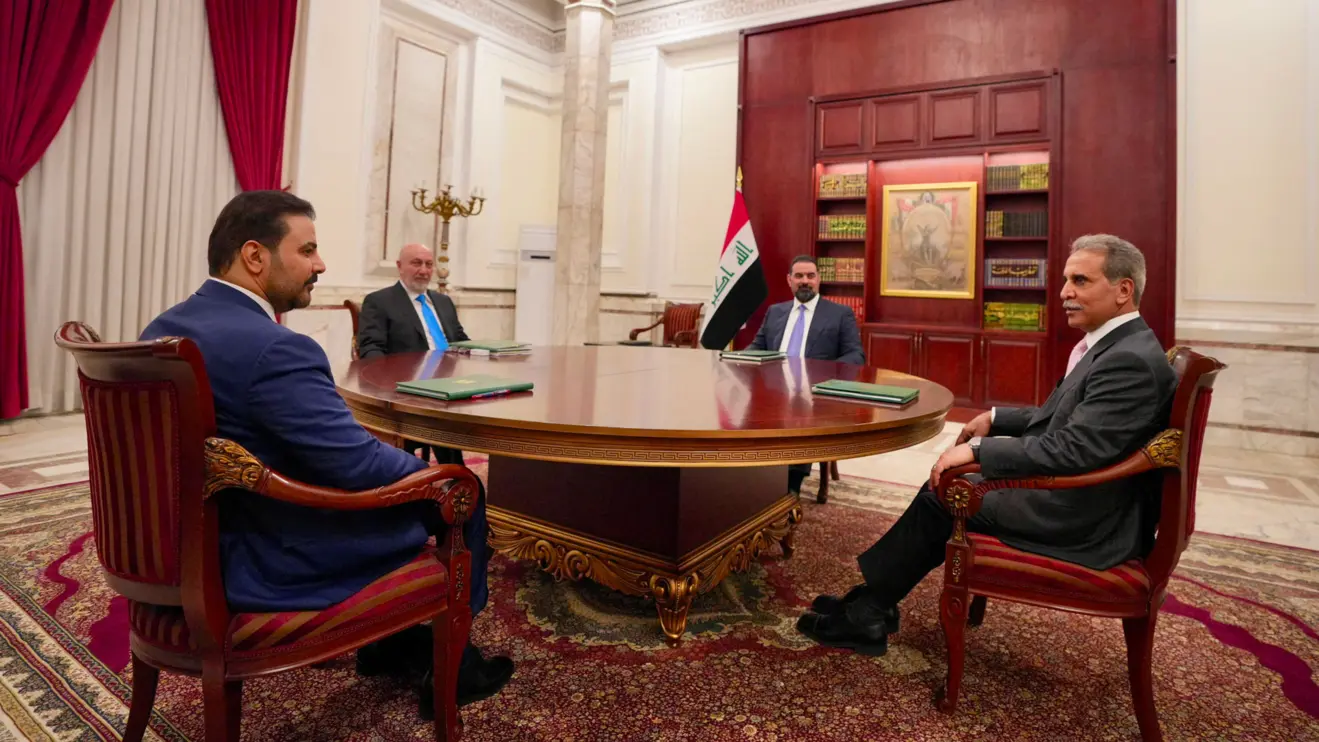
US President Donald Trump on Friday backed the Iraqi leader's drive to assert state control, including stopping the smuggling of Iraqi oil, moves that put Baghdad in direct confrontation with Iran's militia allies and Kurdish authorities.
"We support Iraqi Prime Minister Ali al-Zaidi’s efforts to assert state authority throughout Iraq, stop the smuggling of Iraqi oil, end corruption, and bring all weapons under the exclusive control of the state," Trump said in a Truth Social post.
The post appeared shortly after Iraqi government spokesman Haider al-Aboudi said Baghdad considered crude oil exports that bypass state oil marketer SOMO to be smuggling as the proceeds do not reach the state treasury, the state news agency reported.
Speaking to the Iraqi state news agency, Aboudi added that Iraq lost an estimated $100 billion to oil smuggling through its Kurdistan region from 2008 to 2025.
It was unclear how the government calculated the figure.
Iraq is hoping to attract wide-scale foreign investment in its often struggling economy.
Iraq on Thursday closed two border crossings in the Kurdistan region, one with Syria and one with Iran, after Zaidi ordered federal authorities to take control of crossings run by the semi-autonomous regional administration.
Thousands of Kurds protested on Thursday against Zaidi's moves to put oilfields under federal control and deploy federal troops along the region's international borders.
ARMED GROUPS HAVE AMASSED POWER
The moves against the Kurds, just a week after Zaidi ordered a showdown against a heavily-armed Shi'ite militia aligned with Iran, Kataib Hezbollah, put Zaidi in confrontation with two major factions in a country where armed groups have amassed power over decades of ethno-sectarian civil war. Both crackdowns have been linked to alleged oil-smuggling rings.
“We are in contact with the Kurdistan region to ensure the optimal management and preservation of our oil wealth. The oilfields in the region and Basra belong to all Iraqis and remain under the Iraqi flag,” Iraqi Oil Minister Basim Mohammed told a news conference.
Iraq's highest court ruled on Wednesday that Baghdad can deploy federal forces along all international borders, including those in the Kurdistan region.
The court decision appears to be a victory for Zaidi, a 41-year-old multimillionaire businessman and political novice who came to power in a compromise just six months ago. But political analysts say it may yet prove difficult to implement measures that challenge entrenched interests.
Ties between Baghdad and the Kurds have often been strained over control of oil, money, territory and trade. The central government responded with force when Kurdistan held an independence referendum in 2017, though relations have lately grown calmer.
The Kurdistan Regional Government on Wednesday rejected what it called the "military language and threats" used in a statement from the spokesman for the Iraqi military announcing the new steps.
It said it was working with federal authorities to combat corruption and called for an end to oil smuggling across Iraq, one of the world's leading oil producers and an ally of both the United States and Iran.
In Zaidi's other major standoff, the prime minister ordered the army last week to prepare to enter Jurf al-Sakhar, south of Baghdad, where the government accuses Kataib Hezbollah of running a smuggling operation. The group was initially defiant but agreed to let soldiers enter the city.
Reporting by Tala Ramadan in Dubai and Shubham Kalia in Bengaluru