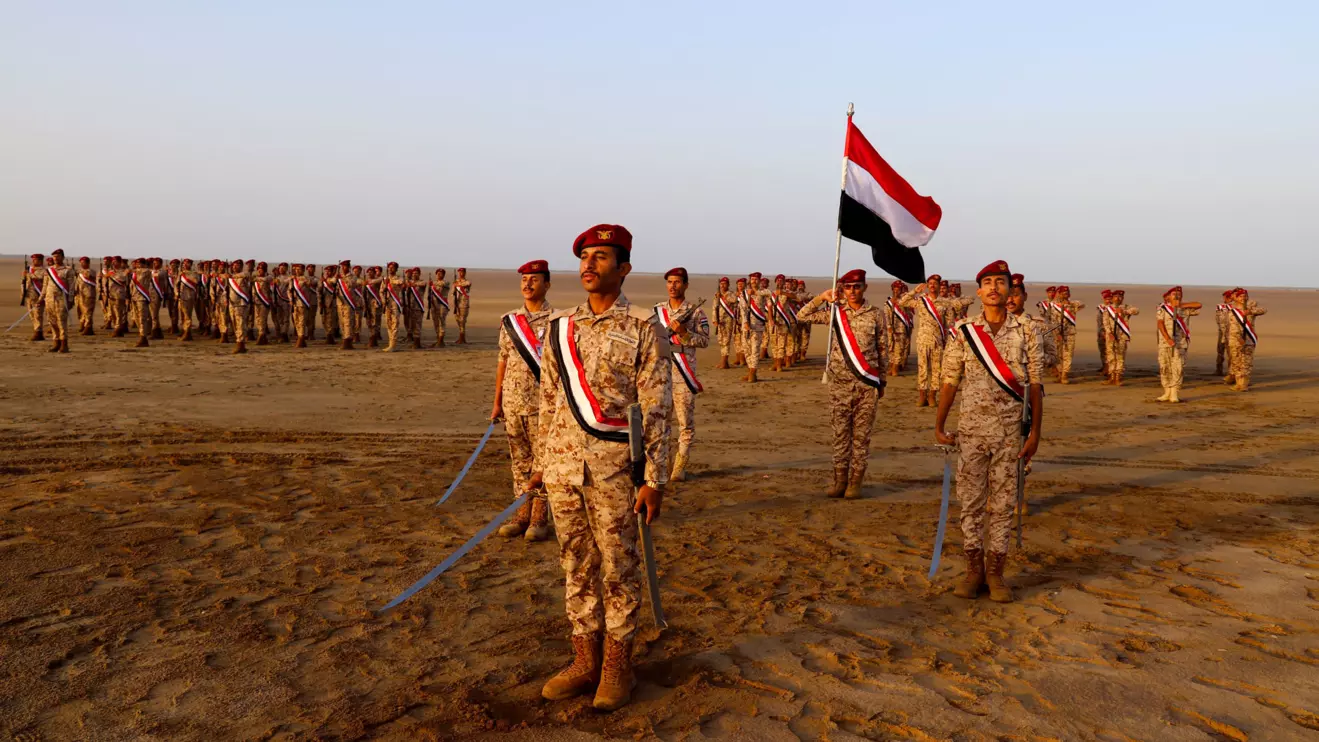
A dispute over territorial control in southern Yemen has set erstwhile Gulf allies Saudi Arabia and the United Arab Emirates against each other and fractured the coalition fighting the Iran-backed Houthis.
The separatist Southern Transitional Council, backed by the UAE, seized swathes of territory across southern and eastern Yemen last month but it has mostly been retaken by Saudi-backed fighters.
Talks in Saudi Arabia to resolve the dispute were scheduled in Riyadh this week, but STC leader Aidarous al-Zubaidi never showed up and the Saudis believe he was spirited away by the UAE.
HOW DID YEMEN END UP AT WAR?
Yemen, situated between Saudi Arabia and an important shipping route on the Red Sea, was split between a northern state with its capital in Sanaa and a southern state with its capital in Aden until 1990.
North Yemen, the heartland of an ancient kingdom, had gained independence from the Ottoman Empire. Communist South Yemen had been part of the British Empire until the 1960s.
South Yemen agreed unification with the north after factional infighting in 1986, and as its main financial patron the Soviet Union collapsed.
After unification the north dominated and the south tried to secede, leading to a brief war in 1994 that was quickly won by the north.
Meanwhile in the north the Houthi group emerged in the late 1990s fighting the government over what they saw as marginalisation of their Zaydi Shi'ite sect.
After Arab Spring protests erupted in 2011, Yemen's army fell apart and Gulf countries backed a transition with an interim government in Sanaa.
The Houthis captured Sanaa in late 2014 and the interim government fled south in 2015 with a Saudi-led coalition intervening on its behalf against the Houthis, triggering years of civil war.
WHO ARE THE SOUTHERN SEPARATISTS?
Many southerners believe the north has dominated power at their expense and were also angered by a Houthi attempt to seize Aden in 2015 that damaged swathes of the city.
Although the southern movement has appeared very popular, with the old South Yemen flag ubiquitous in Aden and other areas, it has been deeply fragmented for decades.
The UAE helped form the Southern Transitional Council in 2017 from the movement’s myriad groups, giving it training and support. At its heart is a network of powerful military and security leaders who emerged during the battle to oust the Houthis from Aden in 2015.
In 2022 it took a formal role in the government with seats on the Presidential Council and in the cabinet.
The STC describes independence as an aspiration of all southerners and last week it said it wanted a two-year transition towards a referendum on a new state of South Arabia.
But its role in the government is now in question, with Presidential Council chief Rashad al-Alimi expelling Zubaidi from the body and calling him a traitor. Its internal cohesion is in doubt too, with some STC members still involved in the Riyadh talks, raising the prospect that the southern movement is fragmenting once again.
WHY ARE SAUDI ARABIA AND THE UAE INVOLVED?
Saudi Arabia shares its longest border with Yemen and has for decades sought to exert influence, ward off potential threats, and stop other regional powers gaining a foothold. It does not want Yemen to break up.
Saudi Arabia was the prime mover in developing a transition plan for Yemen after the Arab Spring and led the assault on the Iran-backed Houthis from 2015.
The United Arab Emirates was Saudi Arabia’s main regional partner in the war against the Houthis. It has for years expanded its influence across the region, backing groups that it says combat Islamist factions.
It has supported Yemen’s southern separatists as a counterweight to Islamist groups in the anti-Houthi alliance. It has also sought maritime access in south Yemen.
Close allies for years, Saudi Arabia and the UAE had been diverging over regional policy and other issues. Saudi Arabia interpreted the STC’s seizure of swathes of territory last month as a move by the UAE.
Saudi warnings to the UAE then prompted it to pull its last troops from Yemen but Emirati support for the southern movement shows no sign of abating.
WHAT DOES THE CRISIS MEAN FOR THE CIVIL WAR IN YEMEN?
The latest crisis has fractured the coalition fighting the Houthis.
However, Saudi-backed forces have taken back most areas seized by the STC in recent days with no apparent major changes in the long-frozen conflict with the Houthis.
Any major resumption of that conflict could carry wider significance.
Yemen overlooks the Bab el-Mandeb Strait, a narrow waterway connecting the Red Sea to the Gulf of Aden and a critical maritime trade route between Europe, Asia and the Middle East.
Houthi raids on Red Sea shipping over the Gaza war disrupted global trade.