Art Paris runs through Sunday at the Grand Palais (Paris), gathering dozens of international galleries and hundreds of artists under one roof, from established names to emerging voices, from every corner of the world.
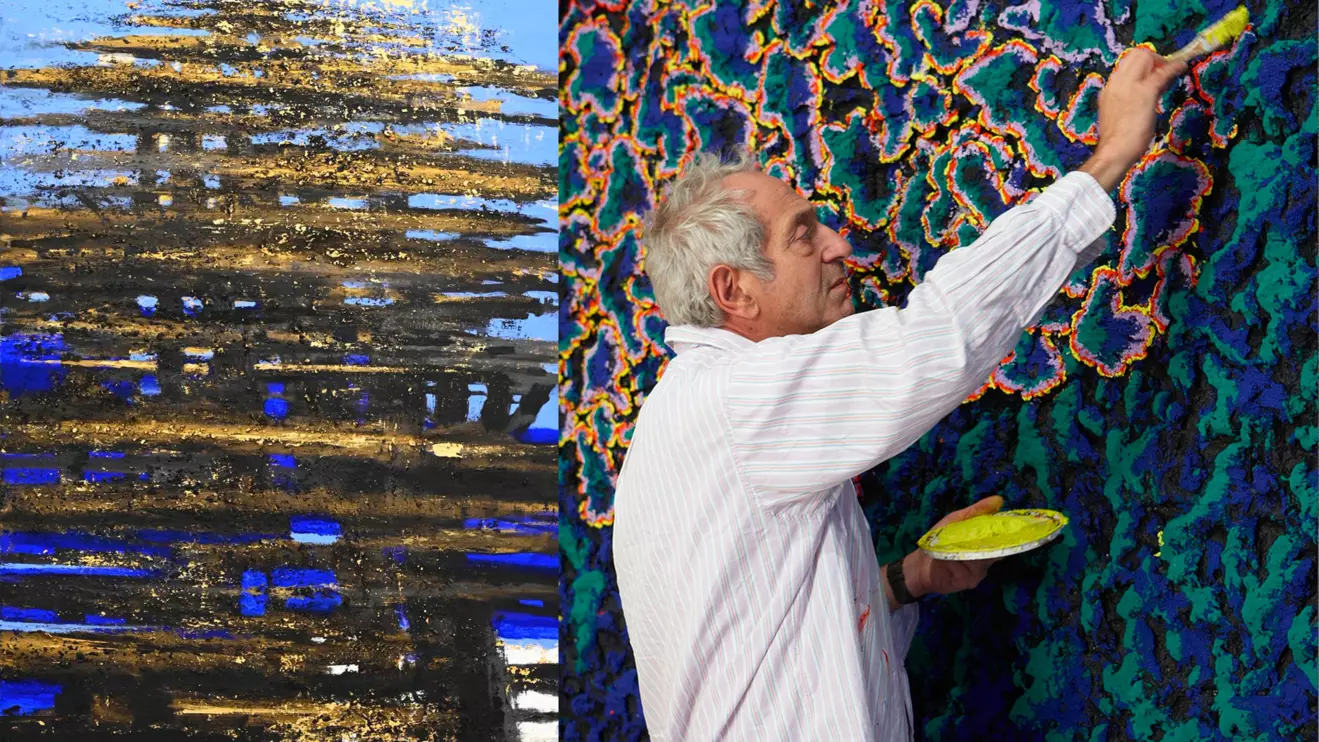
Among the stands that stop you in your tracks is that of Tanit, the Beirut-based gallery, where a single work commands the room: a cedar, symbol of Lebanon, painted by Nabil Nahas. In a fair filled with noise and colour, it arrives with the quiet authority of something that has earned its place.
Born in Beirut in 1949, Nahas earned his MFA at Yale in 1973 and has since divided his time between New York and Beirut, two cities whose creative energies he has spent a lifetime synthesising into something entirely his own.
His work draws from the decorative geometry of Islamic art and the expansive ambition of American abstract painting of the mid-twentieth century, but it belongs to neither tradition. It inhabits the space between them.
What makes Nahas's practice immediately recognisable is his use of organic materials, seashells, starfish, cast in acrylic paint and mounted on canvas. The result is a surface that seems to breathe, to grow, to organise itself according to the logic of nature rather than the logic of the studio. His compositions suggest biological expansion, the patterning of coral reefs and forest floors, the quiet persistence of living things.
In his more recent work, Lebanon has entered more explicitly, its trees, its plant-life, its landscape carrying the weight of everything the country has lived through. The cedar at the Tanner stand is not merely a botanical reference. It is a declaration.
From Beirut to Venice
The timing of Nahas's presence at Art Paris carries particular resonance: he has been selected to represent Lebanon at the 2026 Venice Biennale, one of the most prestigious platforms in the contemporary art world.
His work is already held in collections that speak for themselves: the Tate Modern in London, The Metropolitan Museum of Art, in New York, the Museum of Fine Arts in Boston, the Guggenheim Abu Dhabi, Mathaf in Doha, and many others across the globe. Venice will add another chapter to a career that has been building, with great patience and great conviction, for half a century.
At Art Paris, standing before his cedar, it is easy to understand why. The tree holds its ground. So does the artist.