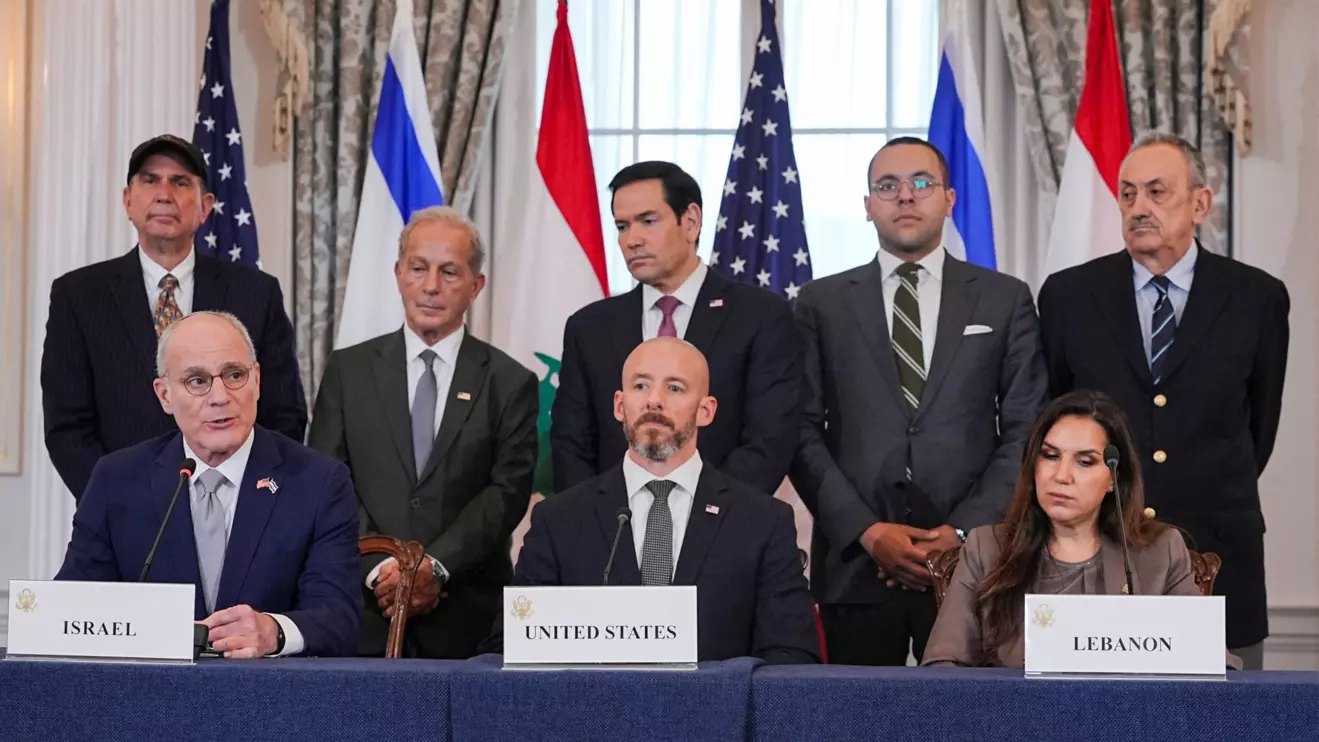
Israel and Lebanon signed a framework agreement in Washington on Friday following several days of talks to secure an end to fighting between Israel and Iran-backed Hezbollah militants, though both sides framed the deal as an initial step.
Lebanese Ambassador Nada Moawad and her Israeli counterpart Yechiel Leiter signed the trilateral document with the U.S. at the State Department in Washington, providing few details.
Israeli Prime Minister Benjamin Netanyahu said the agreement allows Israeli forces to continue to occupy southern Lebanon if Hezbollah does not disarm.
"Today we've taken the first step in what will be a difficult journey, without a doubt, but an important and an essential and a necessary one," U.S. Secretary of State Marco Rubio said before the agreement was inked.
In a later statement he said that the U.S. would facilitate the implementation of the deal through a trilateral "Military Coordination Group for Lebanon" and that Washington would commit significant resources, including an immediate $100 million in humanitarian assistance in coordination with the U.N.
Rubio added that the U.S. reaffirmed its intent to improve the capabilities of the Lebanese Armed Forces "to more effectively establish sovereignty throughout Lebanese territory" with more than $30 million in funds under existing U.S. authorities and appropriations.
The conflict between Israel and Hezbollah broke out when the armed group fired at Israel on March 2, days after the U.S. and Israel attacked Iran. The Hezbollah attacks triggered Israeli air and ground attacks that have killed more than 4,000 people in Lebanon and displaced more than a million.
Lebanon's Moawad also called it a "first step" on the road to restoring Lebanese sovereignty.
"Iran is out, Hezbollah is out, and the road to peace between Israel and Lebanon is in," Leiter said.
'PILOT ZONES'
Netanyahu said in a statement that the deal would also allow the Lebanese army "to begin organizing to take control of territory," starting with what he described as two "pilot zones" from which Israeli troops would withdraw from land they occupied during the war.
Israel describes that territory as a "security zone" or "buffer zone" where its troops can thwart Hezbollah attacks on northern Israel.
Lebanese President Joseph Aoun said the agreement should allow Lebanese to return to "fully liberated" land and rebuilt homes with "no partner" in its sovereignty.
Israel's death toll from this round of hostilities with Hezbollah includes at least 32 soldiers and four Israeli civilians. Hezbollah does not release figures on its war dead. Reuters reported on May 4 that several thousand Hezbollah fighters had been killed in the war.
A State Department official told Reuters on Thursday that Israel had agreed to pull back from some of the territory it has occupied, something Israeli and Lebanese officials denied.
Before the talks resumed this week, Israel and Hezbollah agreed to halt fire even as Israel kept troops in southern Lebanon.
Violence has persisted since the ceasefire, with Israel saying on Friday its troops had struck and killed what the military described as seven Hezbollah members who were operating near the territory it is occupying. Reuters could not confirm this.
"To the degree that the Lebanese army performs in dismantling and disarming Hezbollah, we will proceed with additional pilot zones and the ultimate determination of an internationally recognized, secure, and agreed upon border," Leiter told reporters after the signing.
Hezbollah lawmaker Hassan Fadlallah said Lebanese authorities would not be able to enforce the agreement unless, with U.S. support, "they go to civil war," pro-Iranian broadcaster Al Mayadeen reported.
Hezbollah would confront any measure taken by Lebanese authorities and would hold on to its weapons even more, adding that the group's opposition was "serious" and would not allow authorities to implement their commitments on the ground, Fadlallah said.
ISRAEL DROPS LEAFLETS ORDERING LEBANESE RESIDENTS TO FLEE
Israeli forces dropped leaflets over the southern Lebanese town of Mansouri on Friday ordering residents to leave, Lebanese state media reported, the first such order issued since the latest ceasefire between Israel and Hezbollah took effect.
A senior Lebanese military official said Israel had recently added Mansouri to its occupation zone. The official said Lebanese farmers had continued to enter and leave the town, but had not been living there.
An Israeli military spokesperson said the military issued what it described as a "reminder" to the civilian population that "the area is within the security zone in which (Israeli) soldiers operate. It's a reminder not to be in the area so they won't be harmed."
______
TRILATERAL FRAMEWORK BETWEEN THE UNITED STATES OF AMERICA, THE STATE OF ISRAEL, AND THE REPUBLIC OF LEBANON
The Government of Israel and the Government of Lebanon, with the full support of the United States under President Donald J. Trump, affirm their shared goal of achieving lasting peace and security. As reflected in this Trilateral Framework (“Framework”), and through future agreements, the two countries declare their ambition to end conflict between them, ensure the sovereignty and security of both countries, and establish peaceful neighborly relations between the two countries.
1. Israel and Lebanon affirm the right of each state to exist in peace, and their mutual desire to live in security as neighboring sovereign states. Israel and Lebanon hereby declare their intent to conclusively end the conflict, address its underlying causes, and to therewith formally conclude any state of war between them. This Framework, reached after multiple rounds of direct negotiations between the parties, builds upon previous successful agreements and understandings, and expresses a determination to make irreversible progress towards the comprehensive resolution of all issues between the two countries. Both countries affirm their intention to resolve these issues as sovereign states through direct bilateral negotiations, with the mediation and support of the United States.
2. The Government of Israel and the Government of Lebanon commit to a reciprocal, sequenced process, with clear conditions, whereby the LAF will restore effective sovereign authority over all Lebanese territory, pending the verified disarmament of non-state armed groups and dismantlement of associated infrastructure, enabling the Israel Defense Forces (IDF) to progressively redeploy out of the Lebanese territory. The components of this process will be detailed in a Security Annex, developed with the full support of the United States, that will complement this Framework. The Framework will set out the requisite measures, security arrangements, and verification mechanisms to advance this process. Successful implementation of this Framework will pave the way for a stable and peaceful relationship between the two countries and will enable the IDF to redeploy out of the Lebanese territory.
3. Pursuant to the Security Annex, and as part of the broader effort toward the Lebanese state’s monopoly of arms and sovereign territorial control, the LAF will gradually assume full and effective security responsibility in pilot zones, which will serve as the mechanism for phased and verified redeployments of the IDF and the deployments of the LAF. Two initial zones have been agreed to by the IDF and the LAF, and future pilot zones will also be agreed upon by mutual consent. Upon the confirmation of successful disarmament of non-state armed groups and dismantlement of their infrastructure in these zones, the LAF will assume full and effective security responsibility in these zones, internationally supported reconstruction efforts will begin, and Lebanese civilians will be able to safely return to these areas under the exclusive control of Lebanese state authorities. The United States intends to work closely with both countries to verify and support this process.
4. The Government of Lebanon reaffirms its resolute and irreversible commitment to restoring and exercising full sovereignty over all its territory. The Government of Lebanon will rebuild the State's monopoly on the use of force, achieve the complete and verified disarmament of all non-state armed groups, and ensure that such groups will have no military or security role and no armed capabilities anywhere in Lebanon. The Government of Lebanon herewith requests the support of international and particularly Arab partners, under the leadership of the United States, to achieve this outcome.
5. The Government of Israel stresses that its military actions in Lebanon are solely a consequence of the attacks, threat posed by, and hostile intent of non-state armed groups, particularly Hizballah. The Government of Israel underscores that the termination of this threat, through the disarmament and dismantlement of such groups in all of Lebanon and additional security arrangements to be agreed upon between the two countries, will eliminate any future need for IDF military action or presence in Lebanon. Pursuant to the above, the Government of Israel declares that it has no territorial ambitions in Lebanon.
6. The Government of Lebanon, in accordance with the Charter of the United Nations and in exercise of its sovereign authority, reaffirms that its security forces hold exclusive responsibility for Lebanon’s security and defense and that the Government of Lebanon holds the exclusive sovereign authority to make war and peace. The Government of Lebanon rejects the claims of any state or non-state actor to use force on its behalf without its explicit authorization, and reiterates that any claim by any state or non-state actor to exercise a military or security role is illegal per the decisions of the Lebanese Government and contrary to Lebanese national interests.
7. The Government of Lebanon and the Government of Israel affirm that nothing in this Framework prevents them from exercising their inherent right to defend themselves, as recognized in the Charter of the United Nations and consistent with applicable international law, reaffirming that no third party may exercise that right on their behalf. Both governments commit to establishing a military coordination group, with U.S. support and participation, to ensure overall implementation of this Framework.
8. The two countries affirm that they share the objective of a secure, rebuilt Lebanon, under full Lebanese state sovereignty, in which no non-state armed group poses a threat to Israel, Lebanon, or citizens of either country. Furthermore, the two countries recognize that the restoration of security in South Lebanon through the deployment of the LAF, the safe return of its civilian population, and the security of Israel’s northern communities, are essential to long-term stability and peace.
9. The Government of Lebanon commits to a rigorous, performance-based program to enable the capacity of the LAF to assert full military and security control within Lebanon in accordance with security arrangements, agreed upon within the framework of negotiations, and to implement the disarmament of all non-state armed groups and exercise effective authority across Lebanon. The Government of Lebanon welcomes the readiness of the United States to support such efforts, recognizing that any new U.S. assistance will be strictly conditioned on verifiable milestones, full transparency, demonstrated results, and ongoing oversight. This effort will enable the safe and orderly re-establishment of Lebanese sovereignty, also contributing to the broader stability and security of the entire Middle East.
10. Separately, and simultaneously, the United States will rally international partners to actively support the Government of Lebanon in rebuilding the country, repairing infrastructure, restoring the economy, and creating opportunities for prosperity. This is expected to include mobilizing substantial reconstruction and humanitarian assistance for Lebanon, economic recovery programs, and investment initiatives so that Lebanon can recover from years of conflict and provide a better future for all its citizens.
11. Lebanon and the United States commit to preventing funds from flowing to any entity, organization, or individual affiliated with non-state armed groups and to take available legal measures to proscribe the activity of any such entity, organization or individual. The Government of Lebanon explicitly commits to prevent reconstruction funds from flowing to non-state armed groups and connected entities.
12. Upon the signing of this Framework, the two countries will work to establish working groups to draft the full comprehensive peace and security agreement. Moreover, to achieve the goals of the Framework, the two governments will immediately establish complementary tracks of ongoing direct engagement, facilitated by the United States. The two governments commit to proceeding in good faith until a full and lasting peace is achieved, bringing security, stability, and prosperity to the people of Israel and Lebanon.
13. In line with their shared goals to establish stable and peaceful relations, Israel and Lebanon commit to take good faith measures that demonstrate positive intent, including the cessation of all hostile or adverse actions in international political or legal fora, and pledge to work towards the search for and return of remains and the release of detainees.
14. The two governments acknowledge the role of the United States in supporting their efforts to end decades of conflict and establish lasting stability and comprehensive peace between the two countries and express their deep appreciation for the vision and leadership of President Donald J. Trump.
Signed at Washington D.C. on the 26th of June, 2026, in three originals, in the English language.