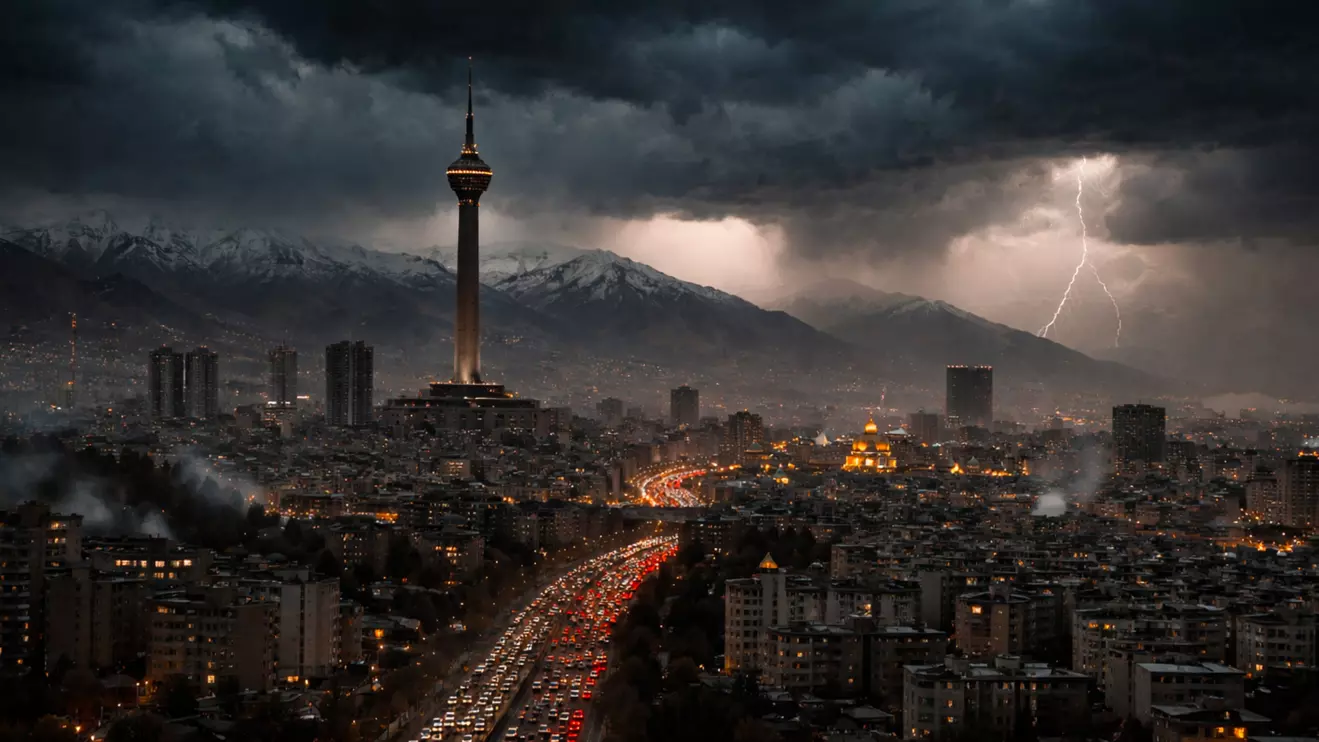
The Middle East rarely falls into war because of one bomb, one speech, one headline. It falls into war when pressures align and every player decides that acting first is safer than waiting.
That is what the last forty eight hours have looked like: Washington and Jerusalem hardening the public line on Iran, a major U.S. fighter jet move reinforcing that line, and Tehran entering the kind of economic panic that makes regimes both fragile and reckless.
On December 29, President Donald Trump hosted Prime Minister Benjamin Netanyahu at Mar a Lago and publicly warned Iran against rebuilding key capabilities, saying the United States could support another major strike if Iran resumes nuclear or ballistic missile activity.
The significance was not only the threat. It was the tone: the return of blunt deterrence as a political identity, not a quiet policy tool.
Then came the hardware. The Pentagon announced an $8.6 billion Boeing contract tied to the F 15 Israel program, including 25 new F 15IA fighter jets with an option for 25 more, with work stretching into the next decade. In this region, that is not just a procurement story. It is a message about endurance: Israel’s long range capacity is being fortified, and the alliance is being signaled in public.
At the same time, Iran’s domestic picture is deteriorating in ways the region has seen before, but never treats casually.
Reuters reported that Iran’s government offered dialogue with protest leaders after demonstrations and bazaar closures triggered by the rial’s collapse to around 1,390,000 per U.S. dollar on the open market. When the Grand Bazaar moves, it is not a normal protest. It is a warning light from the commercial bloodstream of the country.
And that is where the paradox becomes lethal.
A regime facing a currency meltdown is not simply “weaker.” It is less predictable. When money stops meaning anything, people stop believing promises.
When the cost of living becomes disastrous, despair becomes collective. And when a government cannot govern normally but also cannot retreat gracefully, it starts searching for leverage that is not economic. That is usually where foreign confrontation enters the room, not as strategy, but as survival instinct.
Trump is trying to brand himself as this era’s Reagan: no ambiguity, no apologies, no weakness. In his worldview, deterrence is not a posture, it is a performance.
The arms package, the fighter jets, the public warning to Tehran :it’s all one message: America is back in the business of drawing lines and enforcing them. That may restore fear in adversaries. It may also shrink the room for quiet de-escalation, because once “no weakness” becomes the brand, backing down becomes political suicide.
From Tehran’s perspective, this week looks like coordinated pressure at the exact moment Iran is bleeding internally.
This week should be read as a warning, not a prophecy
That can produce two opposite reactions, both dangerous. One is caution: avoid giving Israel and the U.S. a trigger while the economy is on fire. The other is escalation: manufacture an external crisis that forces unity, justifies repression, and shifts blame outward. The second temptation is not theoretical. It is a classic authoritarian move, and the Middle East has paid for it repeatedly.
Israel’s logic is different but just as unforgiving. Israeli security thinking treats Iranian “rebuild” as a countdown. If Iran restores air defenses, disperses assets, and regenerates missile production, the future cost of action rises sharply.
So Israel tends to prefer preemption over patience, especially when it believes time is working against it. The U.S. fighter jet pipeline strengthens Israel’s confidence. It also strengthens Iran’s suspicion that waiting is surrender.
This is how the security dilemma becomes a trap: one side calls it defense, the other calls it preparation. One side calls it deterrence, the other calls it encirclement. And because the region rewards toughness and punishes restraint, leaders often choose the move that looks strongest on television, even if it is weakest strategically.
So why does this region’s crisis refuse to end. Because it is not a series of separate conflicts. It is a system of feedback loops.
Domestic weakness gets exported outward. External threats get used to tighten internal control. Arms sales become political statements. And diplomacy keeps managing episodes while the incentives underneath remain intact. Nobody wants to appear weak, because weakness here is not a reputation problem. It is a survival problem.
Many outside observers are tempted to see Iran’s economic spiral and conclude that “the moment the civilized world has been waiting for” is arriving: the regime is finally crumbling.
Maybe. But betting on collapse is not policy. It can even be a recipe for miscalculation, because regimes that fear collapse do not become reasonable. They become desperate. And desperate regimes do not always choose the option that makes sense to outsiders. They choose the option that keeps them alive one more season.
This week should be read as a warning, not a prophecy.
A warning that when Washington projects no weakness, Jerusalem feels empowered to move early, and Tehran feels cornered at home, the space for error gets very small. Matchsticks do not ignite themselves. But the air right now is dry, and the hands holding the matches are under pressure.