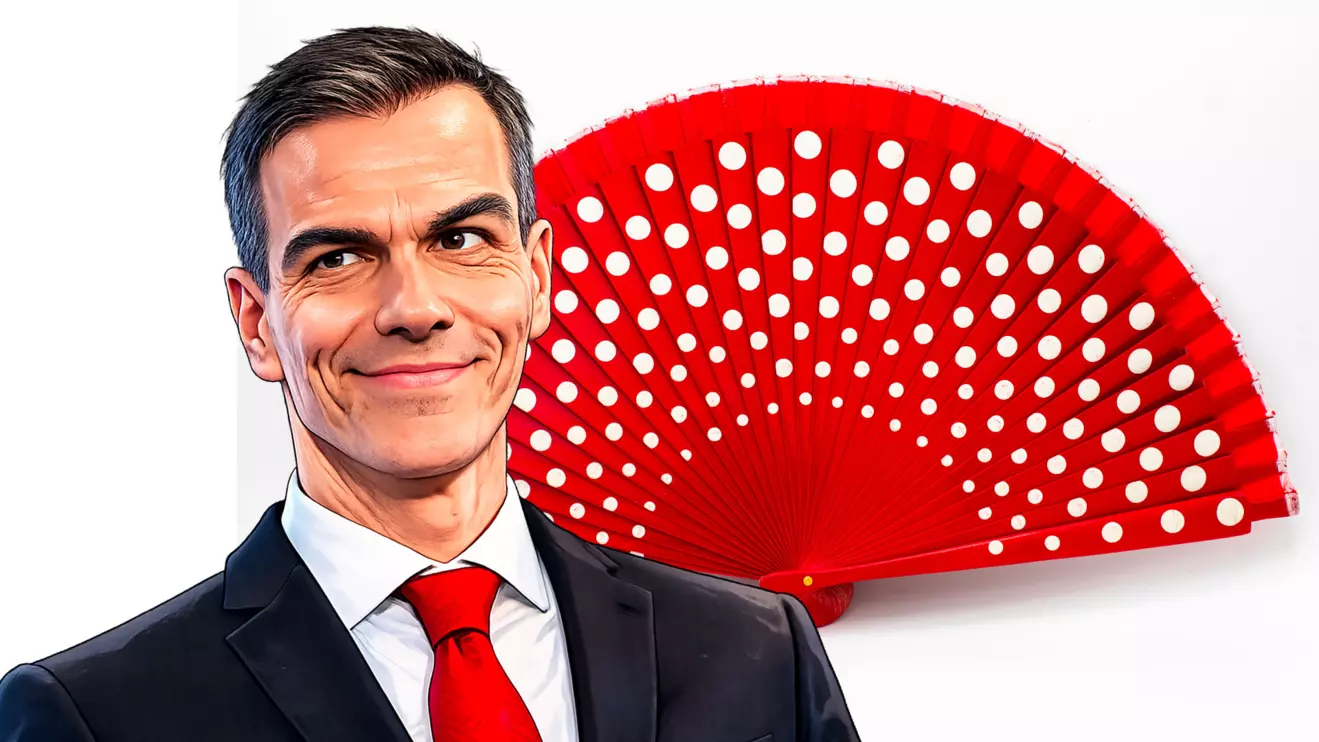
Spanish Prime Minister Pedro Sánchez announced Sunday that Madrid will formally ask the European Union on Tuesday to suspend its association agreement with Israel, accusing Jerusalem of violating international law.
It is, by any measure, a masterclass in selective outrage from a leader whose moral compass appears to point in only one direction, and it is not toward consistency.
Let us be clear about one thing: Sánchez's hostility toward Israel did not begin on October 7, 2023. It predates the Hamas massacres, predates the Gaza offensive, predates any event he could plausibly cite as justification.
This is not a principled response to a specific conflict. It is an ideological obsession dressed up as human rights advocacy.
The EU-Israel association agreement has been in force since 2000 and includes a human rights clause. Sánchez rediscovered this clause at a moment of maximum political convenience, first raising it in February 2024 in a joint letter with the Irish Prime Minister, and now escalating it into a full diplomatic offensive.
The Man Who Loves Iran, Hamas and Hezbollah
Here is the question nobody in the European press seems eager to ask: where is Sánchez's outrage about Iran, a theocracy that hangs dissidents from cranes?
Where is his EU association review for Hamas, an organisation that massacred, raped and kidnapped civilians in cold blood on October 7? Where is his condemnation of Hezbollah, a militia that has dragged Lebanon into yet another devastating war?
The answer, of course, is nowhere. Because Sánchez and his ultra-left coalition partners are not interested in human rights. They are interested in ideology. And in that ideology, Israel is always guilty, and its enemies are always victims, regardless of what those enemies actually do.
Trump, Israel and the Perfect Storm of Sánchez's Obsessions
Add to this cocktail a visceral, almost pathological opposition to everything associated with Donald Trump, whose support for Israel is unambiguous, and you begin to understand the full picture. Sánchez's foreign policy is not driven by principle.
It is driven by the intersection of far-left ideology, anti-American sentiment and a desperate need to appear relevant on a stage where he is increasingly ignored.
And that is perhaps the most telling detail of all. Pedro Sánchez, self-appointed guardian of European moral standards, is deeply unpopular in his own country, clinging to power through a fragile coalition of regional nationalists and radical leftists.
He has lost credibility with Spanish voters, with European partners and with anyone paying close attention to the contradictions in his foreign policy.
He can lecture Israel all he wants from the podium in Brussels. But when a leader has lost the confidence of his own people, his moral authority on the world stage is worth precisely nothing.
Pedro Sánchez still has Spain. For now.