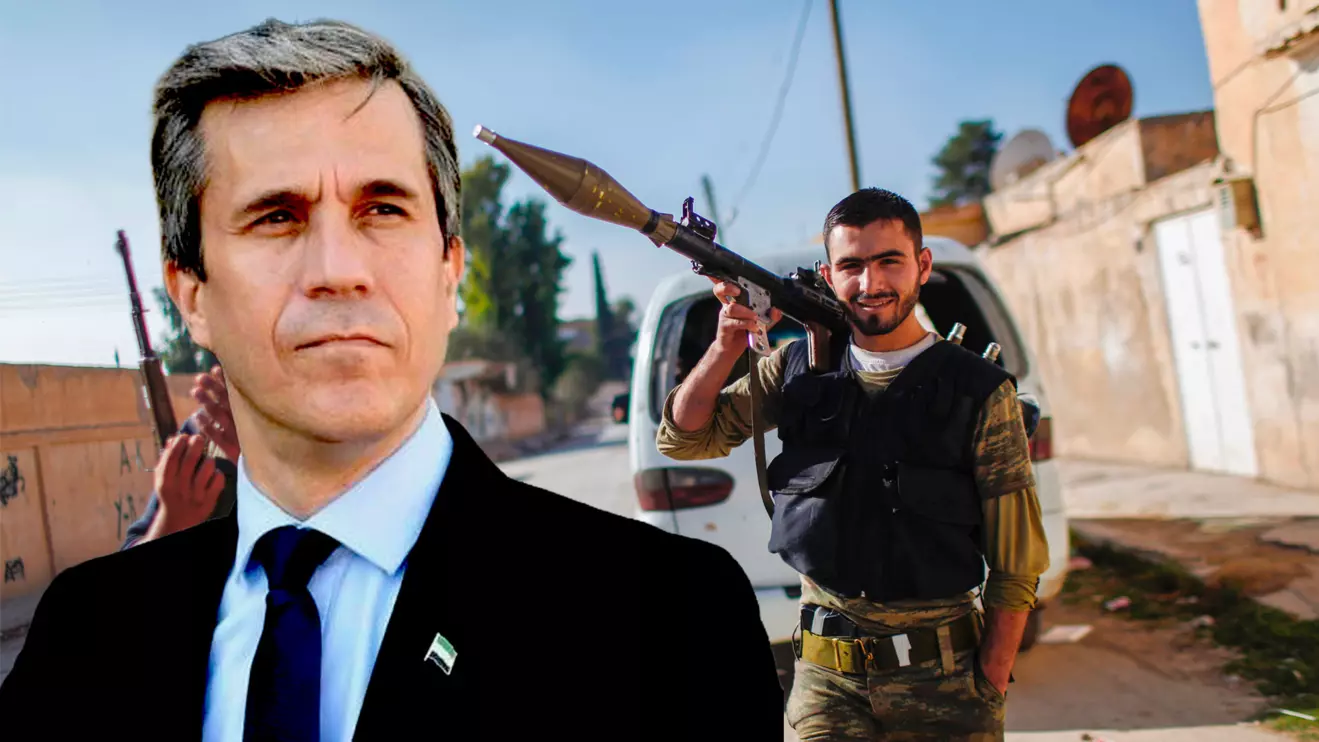
I will answer three essential questions using the logic of reason, the supreme national interest, and the shared strategic interests of the countries and peoples of the region and the influential international powers.
These questions impose themselves forcefully a year after the fall of Assad regime: What has been achieved after Assad’s departure? What has been avoided or overcome? And what is expected from the new authorities?
I will answer, knowing that everyone is aware I am not a supporter of political Islam or Islamism.
Only those who are ill-minded will fail to see or understand the significance of exceptional achievements that have been made in Syria since Assad fled on December 8, 2024—achievements that, by the logic of reason and interests, are undoubtedly a political miracle by all standards.
The new Syrian leadership possessed important experience in administration gained in Idlib, and it had a trained, organized, and remarkably disciplined military force. It was the only actor capable of confronting Iranian influence and its proxies, and securing borders and internal stability.
Most observers and experts thought that Syria would enter a civil war that might last for many years. But that did not happen.
Instead, Syrians surprised the world when they accepted the phrase “Go, you are free,” spoken out by members and leaders of the change movement to soldiers of Assad’s army—soldiers who, just the day before, had raised their guns against them. History will record this phrase. Undoubtedly forgiveness does not negate victims’ rights to transitional justice.
The Assad regime, which had weighed on the chests of Syrians for more than half a century, finally fell.
The war ended and a long chain of war crimes and crimes against humanity stopped. The shelling of Syrian cities stopped, along with the displacement and terrifying of millions of civilians. This war resulted in more than one million Syrians killed, more than half a million detained or forcibly disappeared, and more than ten million refugees and internally displaced.
Assad fell, and tens of thousands of detainees were released from prisons. The world witnessed the horrors inside Assad’s detention centres, chief among them Saydnaya, and discovered the enormity of mass graves containing tens of thousands of Syrian corpses.
With Assad’s fall, the most important pillar of Iran’s regional influence collapsed. More than 63 Iranian-aligned militias evaporated, militias that had used Syria as a base for terrorizing Syrians and destabilizing regional security.
Russian influence in Syria receded to its lowest levels. The corridor for smuggling weapons and ammunition into neighbouring states was blocked. Drug production and trafficking declined to their lowest levels, reducing the threat of narcotics across the region.
Two key regional patrons of the new Syrian state—the Kingdom of Saudi Arabia and the Republic of Turkey, along with the exceptional efforts of the Hashemite Kingdom of Jordan, played a decisive role in enabling Syria to dismantle partition and Balkanization schemes, lift U.S., European, and international sanctions, and restore Syria from the Iranian sphere back to its natural Arab haven, shifting from Iran’s “Axis of Evil,” the axis of backwardness, terrorism and extremism into an axis of openness and modernization.
Who would have believed a year ago that Syria would become a member of the International Coalition Against Terrorism? Or that the Syrian president would be a guest of the U.S. president, who never spares no opportunity to express his admiration for the Syrian President and his character—joking with him and even spraying perfume on him?
Some see President Ahmad Al-Shar’a’s jihadi past as a flaw, while the U.S. president sees it as a strength, an exceptional expertise in jihadist groups, especially since we are entering a phase in which all political-Islam organizations, Sunni and Shia alike, are coming to an end.
This also means the subsequent end of Iran’s “Wilayat al-Faqih” regime and its regional proxies. It will also lead to the fall of extremist rule in Israel and the collapse of Netanyahu’s government.
The Syrian people have moved from an isolated society to the heart of the world. After decades of economic stagnation, Syria has returned to the global economy.
A year after Assad’s fall, an active diplomatic movement has restored Syria’s prominence, and Syrians have regained their dignity and respect. Today, on Syrian state television, and for the first time in the country’s history, we can hear and watch political debates no one ever imagined to be possible on official media. The dream of having a passport has now become true.
Life has gradually begun to return to Syria, and foreign diplomatic missions have started returning to Damascus to discuss relations and mutual interests.
Despite all the significant and exceptional achievements, mistakes and wrongful practices did occur, but they are undoubtedly far less than what could be expected from a new leadership taking over a state that had failed by every measure, plagued by corruption, bankrupt, and multiple external blundering hands, faced with enormous challenges, dangers, tragedies, problems, disasters, and destruction.
The Assad family did not flee Syria until they had created a monster under every stone in the country.
Internal and Regional Challenges
The new Syrian leadership succeeded in overcoming several serious challenges and in obtaining international legitimacy.
Today, there is no alternative to President Ahmad Al-Shar’a in leading this phase, and no alternative to Syria in the Fertile Crescent—given that Lebanon remains under Hezbollah’s dominance and arms. Iraq remains penetrated by Iranian-aligned militias, and Syria, once a land corridor for Iranian weapons and extremism, has exited the Iranian sphere.
Many challenges now confront the Syrian leadership, on top of which is security challenge and border control, especially the borders with Lebanon and Iraq.
A recent Reuters report tells about preparation of thousands of former Assad-army soldiers in Lebanon and the Syrian coast for military activities against the Syrian Government. Iran’s persistent efforts to smuggle weapons through Syria prove that the country must reinforce and secure its borders with Lebanon. The same applies to the Iraqi border, where Iranian-aligned militias continue to pose a threat.
Internally, three key issues form major security challenges:
• The problem of Syrian Democratic Forces SDF procrastinating implementing the March 10 agreement which is a Turkish-Syrian security concern.
• Security challenges in the coastal region, which witnessed difficult days due to attempts by Iran and Hezbollah, alongside former Assad soldiers, to separate the coast from Syria—resulting in crimes and casualties among civilians. This requires swift accountability for all perpetrators, regardless of affiliation.
• The events in Sweida, which also turned into a victim to non-national agendas.
Another major challenge is achieving transitional justice, and building the army and security institutions on a national doctrine and professional foundations.
This is in addition to forming an effective government that reflects genuine national partnership, reforming the political and administrative systems and reviewing laws and regulations. Doing all these requires accelerating the formation of the temporary legislative council to reform the legal system.
There is also the economic challenge, i.e. reconstruction and enabling refugees and displaced people to return to their areas.
Another challenge is the security agreement with Israel and Israel’s interventions in Syrian internal affairs.
Ensuring the success of the transitional phase is not a luxury but a national, regional and international necessity. Its failure would mean failure to all parties and everyone will pay the price.
Israel’s Strategic Mistakes in Syria
Israeli Prime Minister Benjamin Netanyahu made several strategic mistakes in Syria while claiming that his actions were meant to ensure Israel’s security. In reality, however, he had two primary objectives:
- Weakening the new Syrian state as much as possible, to force it into submission, keeping the Golan Heights outside any negotiation framework and ensuring that any negotiations would only be under Israel’s terms of conditions concerning territories Israel occupied after Assad’s fall. To achieve this pressure, Netanyahu used the Druze as scapegoats—whether in Syria, the occupied Golan, or Israel.
- Strengthening his internal political front, amid the challenges facing his government, which is living its final days.
This is despite repeated official declarations by the Syrian leadership that Syria will not pose any threat to Israel, or allow attacks against Israel from Syrian territory, and that it is committed to a policy of resolving disputes with neighbours and the world.
Although Syria has entered direct dialogue with Israel to reach a security agreement, Netanyahu still fails to grasp the danger of weakening the nascent Syrian state. His policies only strengthen Hezbollah and support Iran, ISIS, and other terrorist organizations.
Netanyahu should have seized the golden opportunity presented by the public jubilation in Syria and Lebanon after the killing of Hezbollah’s leadership, the “Bager” operation, and the fall of the Assad regime, to achieve rapprochement and build real peace.
But he still does not understand that the key to regional peace is in Damascus, and that investing in weakening the Syrian state only serves Iran and the enemies of peace.