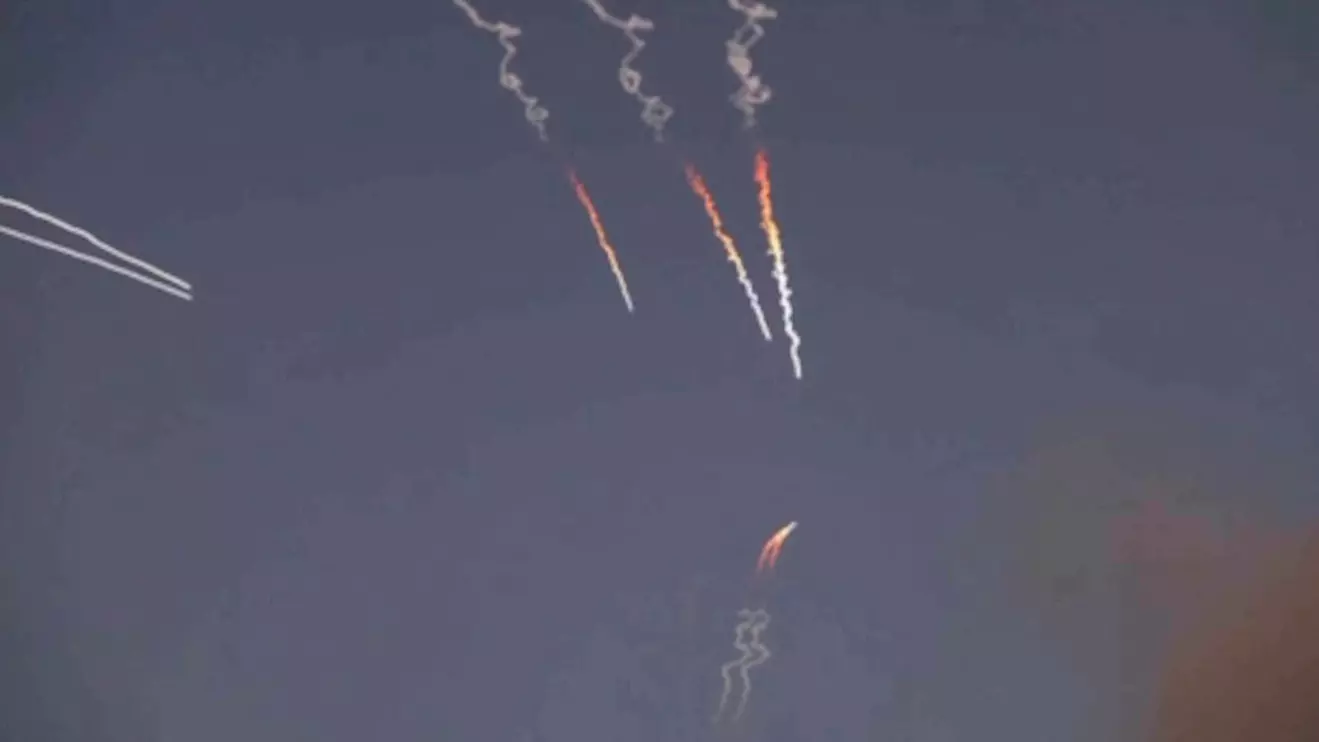
Iran's Revolutionary Guards said they had carried out missile and drone attacks on U.S. military bases in Jordan, Kuwait and Bahrain on Wednesday in retaliation for American strikes on Iranian targets around the Strait of Hormuz.
The clashes mark one of the biggest exchanges in hostilities since the two countries agreed to a ceasefire in April and came after U.S. President Donald Trump said Iran had downed a U.S. Apache helicopter near the strait on Tuesday.
"I believe the response should be very strong, very powerful, and that's what this one is," Trump told ABC News on Tuesday.
The escalation in violence deepens doubts about the prospects for a deal to end the war that started on February 28 with joint U.S.-Israeli strikes against Iran. Tehran responded by firing on Gulf neighbours that host U.S. bases and all but choked off the strait, a vital conduit for oil and gas.
The latest U.S. strikes targeted Iranian air defence, ground control stations and surveillance radar sites, according to the U.S. military. They lasted around four hours before the U.S. Central Command posted just before 9 p.m. ET (0100 GMT Wednesday) that they had ended. A U.S. official said almost 20 Iranian targets had been struck.
The Islamic Revolutionary Guard Corps (IRGC) said Qeshm island and the port city of Sirik in the Strait of Hormuz came under attack, while explosions were heard in Bandar Abbas and later near Jask at the entrance to the strait, Iranian media reported, citing local sources and residents.
The IRGC said it had attacked U.S. military bases in Bahrain, Kuwait and Jordan with drones, and missiles in response to the new "U.S. aggression".
Four sites were targeted at the U.S. al-Azraq base in Jordan using long-range missiles, including F-35 fighter jet hangars and a command-and-control centre, and the IRGC warned it was ready to deliver a "crushing and decisive" response to any further U.S. attack.
Jordan's military said on Wednesday it had intercepted and shot down five missiles launched from Iran toward al-Azraq. Debris from the interception operation fell on Jordanian territory but caused no injuries or material damage, it added.
The Kuwaiti army said its air defence systems were engaging hostile aerial targets and urged the public to follow official safety instructions, while Bahrain's air defences had repelled Iranian attacks, a media adviser to Bahrain's king said in a post on X.
In a statement, Iran's Foreign Ministry condemned U.S. strikes in the country's south, saying Tehran acted in self-defence, and warned Gulf states they would face consequences if their territory was used by U.S. or Israeli forces, vowing to target the sources of any future attacks.
A U.S. official, speaking on condition of anonymity, said initial assessments showed nearly all missiles and drones launched by Iran were intercepted and they were not immediately aware of any reports of harm to U.S. personnel or damage to U.S. locations.
The Pentagon did not immediately respond to a request for comment. Reuters could not immediately verify the battlefield reports.
Oil prices climbed about 1% in Asian trade on Wednesday following the escalation in hostilities.
NOT A BIG DEAL?
On Tuesday, a U.S. Apache helicopter was brought down by a one-way Iranian attack drone, according to a U.S. official who spoke on condition of anonymity. Two U.S. pilots involved in the helicopter incident were uninjured, Trump said.
Iran's state media cited a military source as saying that no offensive air military operations had been conducted in the Strait of Hormuz in the previous 24 hours.
A U.S. Navy surface drone found and rescued the two crew, the U.S. military said, after the U.S. Army attack helicopter went down in waters near Oman's coast while on patrol at around 3 a.m. on Tuesday (2300 GMT on Monday).
The U.S. military's Central Command gave no reason for the crash. It said the two crew were rescued after two hours and said they were in stable condition - a more cautious assessment than Trump's description.
Iran's Foreign Minister Abbas Araqchi did not directly address the helicopter incident, but said in a post on X that foreign forces in the region risked being involved in accidents or crossfire.
"To reduce risk, best solution is for them to leave," he wrote.
Trump told The Wall Street Journal during a phone call on Tuesday that the helicopter incident "wasn’t a big deal" and stressed that “the pilot is fine."
However, the episode could well add further strain to efforts to broker a peace deal to end the wider Middle East war and reopen Hormuz.
Trump has repeatedly said Iran and the United States are close to an agreement, though there have been few signs of progress since a tenuous ceasefire took effect in early April.
Fighting between Israel and Iran-backed Hezbollah militants in Lebanon has continued, and Tehran has maintained its restrictions on most shipping through the Strait of Hormuz, which before the war carried a fifth of the world's crude oil and liquefied natural gas. Washington has imposed its own blockade of Iranian ports.
U.S. Energy Secretary Chris Wright said on Tuesday that ship traffic through Hormuz is rising "very meaningfully," but added it would take many months to get back to normal flows of energy once the war is over.
Trump has said any peace deal must ensure Iran cannot develop a nuclear weapon. Iran denies any such ambitions.
Iran's demands include the lifting of international sanctions, the release of billions of dollars in frozen assets and recognition of its control of the strait.