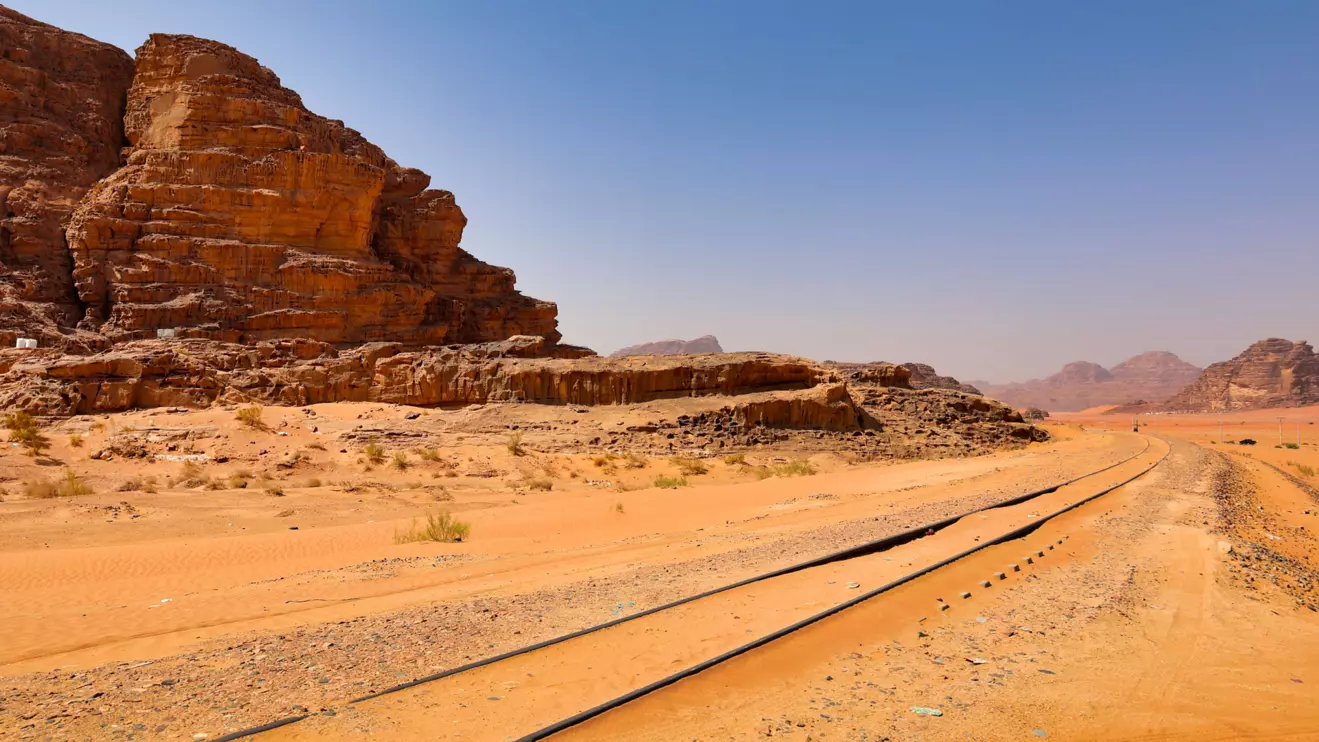
Amman and Abu Dhabi signed an agreement on Wednesday for a railway project in Jordan that will connect the port of Aqaba on the Red Sea to the mining provinces of Karak and Maan, with the United Arab Emirates investing $2.3 billion.
The project aims to boost the kingdom’s export capacities, according to an official source.
The Emirati investment will "connect the port of Aqaba (328 kilometers south of Amman) to the mining areas of Shidiya (in Maan province, 212 kilometers south of Amman) and Ghor al-Safi (in Karak province, 118 kilometers south of Amman)," Jordanian Prime Minister Bisher al-Khasawneh stated, as quoted by the official Jordanian news agency Petra.
Speaking at the signing ceremony in Aqaba, attended by UAE Investment Minister Mohamed Hassan Alsuwaidi, the Prime Minister noted that "it will take five years to begin the effective operation of the railway, which is set to start in 2030."
Meanwhile, necessary studies will be conducted, and tenders will be launched at the beginning of 2026, he added. "The construction of this line will significantly increase our logistical and export capacities, with an initial volume of 16 million tons of phosphate and potash products, including 13 million tons of phosphate and 3 million tons of potash products."
The Emirati minister emphasized that "this agreement reflects the UAE's commitment to deploying our joint efforts to stimulate economic growth and strengthen economic resilience and diversification" in both countries.
This project is part of a larger investment package, estimated at around $5.5 billion, signed by Jordan and the UAE at the end of 2023, in the presence of King Abdullah II of Jordan and the UAE President, Sheikh Mohammed bin Zayed Al Nahyan.
Jordan is one of the world's largest producers of phosphate and potash. The kingdom's phosphate reserves are estimated at approximately 3.7 billion tons, making it the fifth-largest in the world.
The Jordan Phosphate Mines Company is the second-largest exporter and the sixth-largest producer of phosphate globally. In 2019, Jordan was ranked as the seventh-largest producer of potash worldwide.