
Israel
Gaza envelope population tops pre-October 7 levels
Thousands of newcomers are joining returning evacuees, a quiet verdict on who won the southern front.

Speaking before the United Nations General Assembly on Tuesday, King Abdullah II of Jordan urged the release of hostages held by Hamas and called for an immediate ceasefire in Gaza, while refraining from explicitly demanding the dismantling of armed groups operating in the enclave.
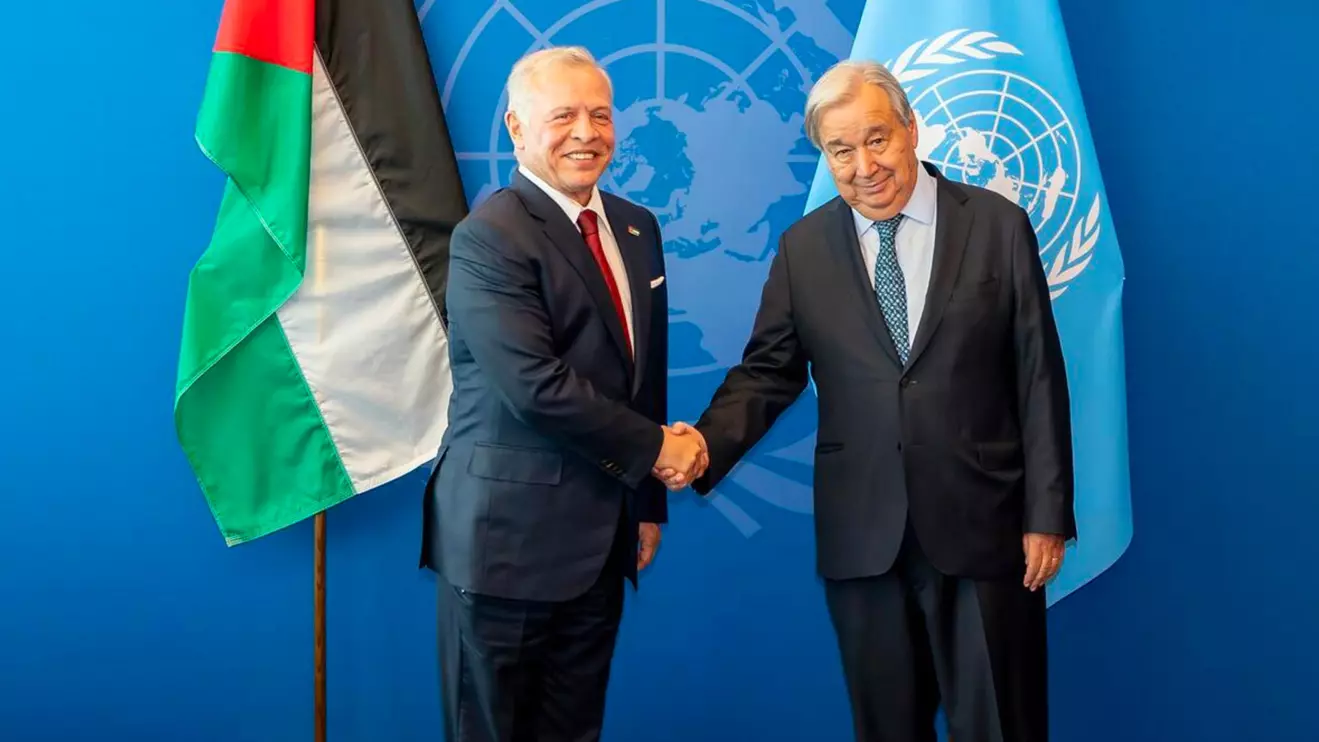
United Nations Secretary-General Antonio Guterres meets with King Abdullah II on Tuesday in New York © Laura Jarriel/UN
Speaking before the United Nations General Assembly on Tuesday, King Abdullah II of Jordan urged the release of hostages held by Hamas and called for an immediate ceasefire in Gaza, while refraining from explicitly demanding the dismantling of armed groups operating in the enclave.
The Jordanian monarch warned that the cycle of conflict risks shaping future generations. “Repeated wars are teaching generations of Israelis and Palestinians that their only recourse is the gun,” he said. He underscored that true security will only be achieved when Israel and Palestine coexist side by side.
Reiterating a longstanding regional stance, King Abdullah emphasized that the two-state solution, based on UN resolutions, remains the only viable path to peace. This framework envisions an independent Palestinian state with East Jerusalem as its capital, living alongside a secure Israel.
He recalled that this vision has been central to the Arab Peace Initiative for nearly 25 years, highlighting that no alternative has proven capable of addressing the root causes of the conflict.
Abdullah also appealed to the moral responsibility of the international community. “The world’s conscience is stirring with the courage of ordinary people. Raising their voices as one, they declare ‘it has been too long,’” he said.
He urged the United Nations not only to echo this call but also to act upon it, stressing that peace must become more than a distant aspiration: “The UN must act on that call until peace is a reality.”
While the King’s words reiterated Jordan’s consistent position in favor of coexistence and a negotiated peace, his speech also conveyed urgency in the face of the ongoing conflict. For Abdullah II, the path to peace lies in compromise and recognition, not in perpetuating cycles of violence.
Thousands of newcomers are joining returning evacuees, a quiet verdict on who won the southern front.
Turkish President Tayyip Erdogan said it was unrealistic to expect all countries to make the same progress on climate policy while inequalities in access to financing and technology persisted, adding he expected support from all nations for Turkey's COP31 Climate Summit action agenda.
Turkey and Iraq agreed on Wednesday for Turkish forces to hand over a military camp in northern Iraq to the Iraqi government gradually, they said after talks in New York, adding they also agreed to end the presence of "outlawed armed elements" in northern Iraq.
To make this website run properly and to improve your experience, we use cookies. For more detailed information, please check our Cookie Policy.
Necessary cookies enable core functionality. The website cannot function properly without these cookies, and can only be disabled by changing your browser preferences.