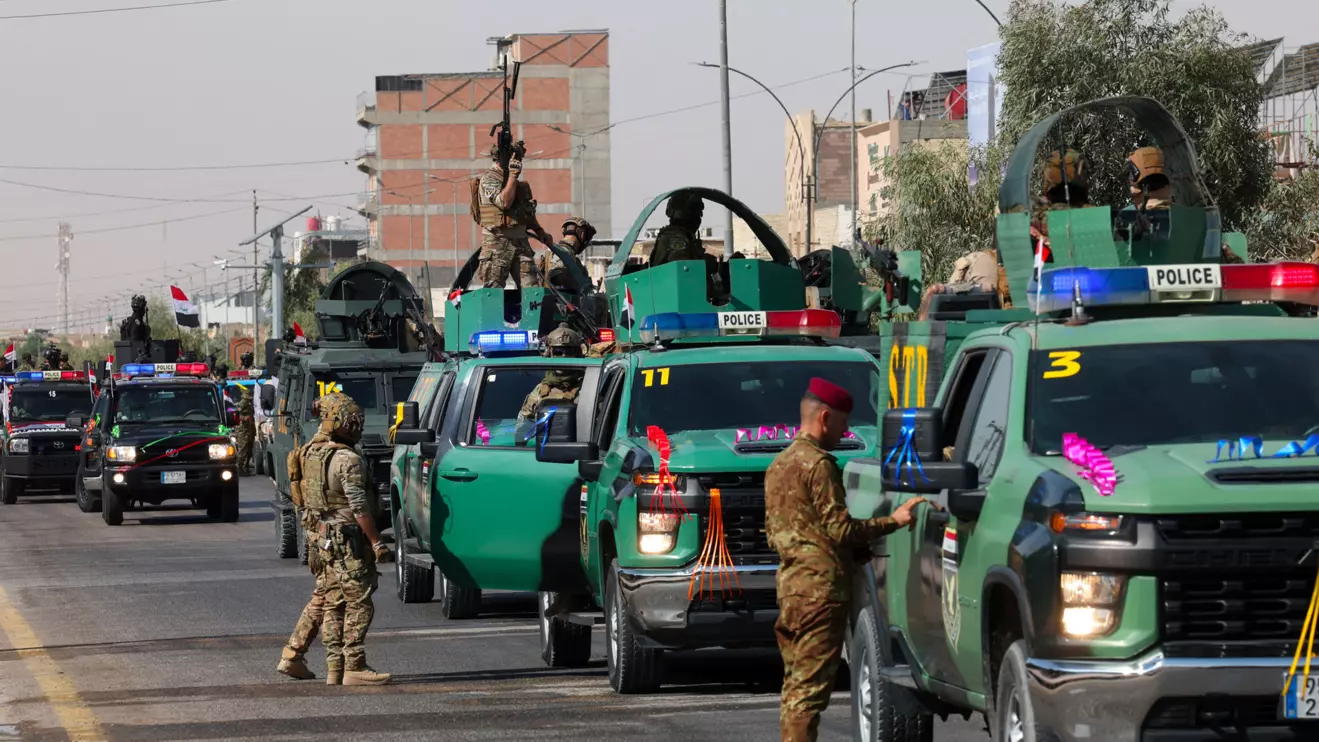
US forces ended their mission in Iraq on Wednesday after more than two decades of war there, raising fears of a security vacuum that would embolden Iranian-backed Shi'ite militias and allow Islamic State to regroup.
The withdrawal of the final troops, mainly from an airbase in Erbil in the semi-autonomous Kurdish region, was celebrated as a victory by Tehran and its allies, although many Iraqis were concerned that their own security forces were unprepared.
The pullout was agreed in 2024 under President Joe Biden and carried out by Donald Trump's administration even as it wages war against Iran next door.
It comes 23 years after US-led forces toppled Saddam Hussein, triggering years of upheaval and chaos. US troops initially left at the end of 2011 but came back less than three years later after Islamic State fighters seized a third of Iraq.
More than 4,500 US troops died in America's biggest war of this century, around twice as many as in the parallel war in Afghanistan. The Iraq Body Count project says more than 200,000 Iraqi civilians were killed.
The Pentagon said the United States and its coalition partners formally concluded "Operation Inherent Resolve" and that the Pentagon will continue to provide targeted training and intelligence support to Iraqi partners.
The Iraqis are expected to lead the effort to secure the country, an ally of both Washington and Tehran, and keep the remnants of Islamic State suppressed.
“The end of the international coalition’s mission does not mean the end of our battle against terrorism, but rather Iraq’s transition to a phase in which it assumes full responsibility for its security and stability," said Iraqi Prime Minister Ali Faleh al-Zaidi in a statement.
Tehran has steadily entrenched itself through proxies in Iraq since the fall of Saddam.
While the departure of US forces is broadly popular among Iraqis, some worry that security forces trained and funded by the United States still can't protect the country.
"The lesson from the past two decades is that security vacuums can be extremely dangerous," said Jassim al-Bahadli, an Iraqi analyst who advises the security forces.
Adil Salman, 45, a high school English teacher, said Iraqis "should not rush to celebrate" the withdrawal.
"Militias still operate outside the state's control and (Islamic State) still has not disappeared," he said. "I'm concerned that the US departure could lead to a new period of instability. In the end, people will judge this decision by one thing: whether security remains stable in the coming years."
With US forces present alongside armed groups allied to Iran, Iraq has been caught up in this year's war.
Of the 18 US service members listed as killed since Trump launched "Operation Epic Fury" alongside Israel in February, seven died in Iraq. The last was an army sergeant who died during the controlled detonation of a drone at a base near Erbil in July.
IRAN, ALLIES ARE THE WINNERS
Iran, which says its ultimate aim is to force American forces to leave the entire Middle East, casts the US pullout from Iraq as a triumph for its "axis of resistance" of allied armed groups across the region.
The withdrawal raises "the possibility that Iran's proxies will feel increasingly empowered in the absence of a Western military presence. These groups may attempt to expand their role in shaping state policies and consolidating their presence within key institutions," said Baghdad-based political analyst Ahmed Younis.
Some Iraqi security officials, both in the federal government and the semi-autonomous northern Kurdish region, say the US pullout also risks giving new life to Islamic State fighters, who, despite the defeat of their self-proclaimed caliphate nearly a decade ago, retain a sleeper cell network.
The last time the US withdrew, the Iraqi army proved no match for Islamic State: soldiers took off their uniforms and fled when the group captured Mosul, Iraq's second-largest city, in 2014.
Since Islamic State's self-proclaimed caliphate was defeated in 2017, US troops have been providing Iraqi security forces with critical intelligence on the group's movements, aerial surveillance and reconnaissance.
"The most important question now is whether Iraq's security institutions have prepared a viable Plan B for the post-coalition phase," said retired Iraqi Army General Mohammed al-Jubouri, who led a brigade in the war against Islamic State.
"One of the worst-case scenarios would be Islamic State obtaining armed drones or improvised explosive drones at a time when Iraq still lacks sufficient air defense capabilities to counter such threats effectively."