Libya factions remain on Tripoli streets as withdrawal plan announced

1 min Mena Today

Major armed factions remained visible on the streets of Libya's capital Tripoli on Thursday after the Government of National Unity said they had agreed to withdraw from checkpoints and stop patrols over the coming weeks.

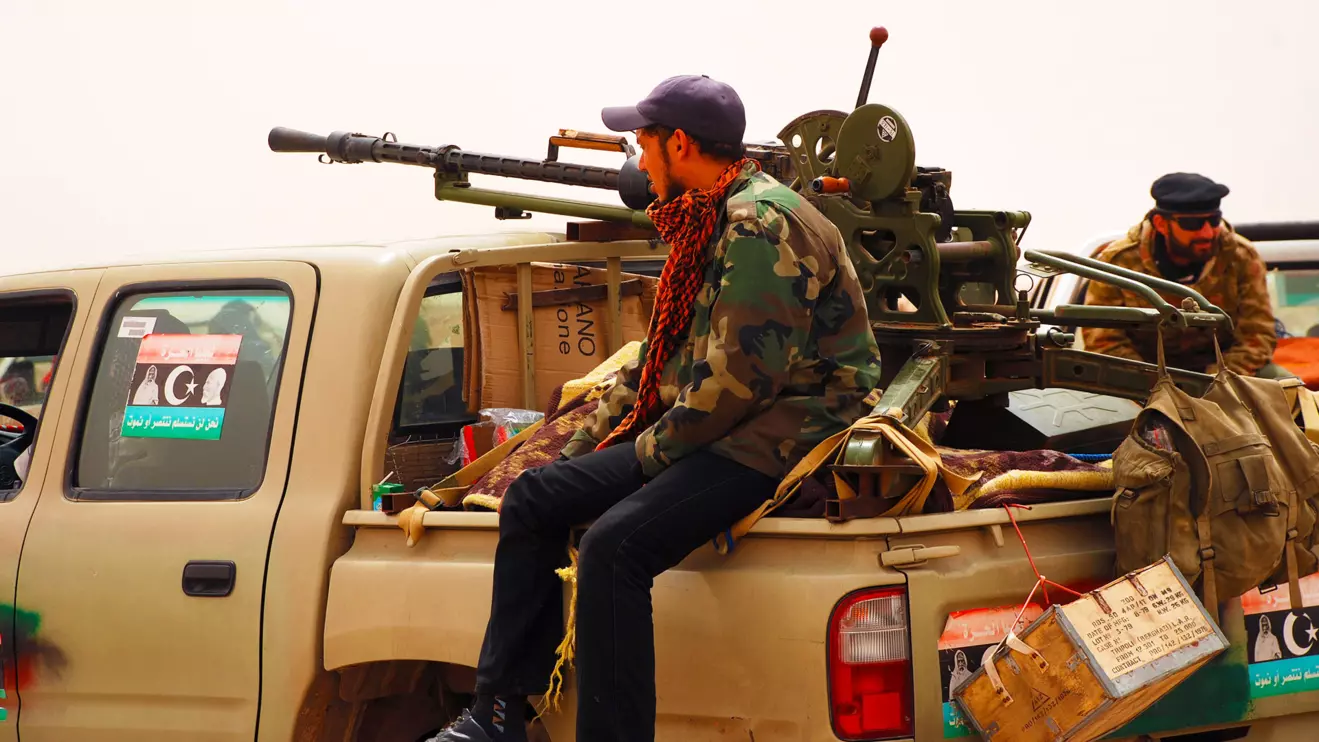
Most of the main factions in Tripoli retain bases inside the city and they have periodically clashed in recent years © Mena Today 

Most of the main factions in Tripoli retain bases inside the city and they have periodically clashed in recent years © Mena Today 

Major armed factions remained visible on the streets of Libya's capital Tripoli on Thursday after the Government of National Unity said they had agreed to withdraw from checkpoints and stop patrols over the coming weeks.

Myriad armed forces have jostled for position in Tripoli since a 2011 NATO-backed uprising that unseated long-time ruler Muammar Gaddafi and led to years of chaos, warfare and insecurity.

Interior Minister Emad Trabulsi announced on Wednesday that the main armed factions operating in Tripoli had agreed to remove their forces before the end of the Muslim fasting month of Ramadan, which is expected around April 10.

"The plan is a little complicated," Trabulsi said, adding that "all the commanders of the brigades and security services are ready for the success of the work of the Security Directorate."

However, even if armed factions become less visible on the streets, any substantive withdrawal is seen as unlikely without broader agreements on Libya's long-term political future.

Most of the main factions in Tripoli retain bases inside the city and they have periodically clashed in recent years during deadly bouts of street fighting, sometimes caused by local disputes and sometimes by Libya's fractious national politics.

Long convoys of military vehicles with mounted heavy weapons frequently patrol key streets in central Tripoli, setting checkpoints at traffic intersections and sometimes triggering gunfights with rival forces.

Most of the main factions have gained official or semi- official status with a budget from the government and Trabulsi named several of the most powerful as having agreed to remove their forces.

Civil units including the police will maintain a street presence, he said.

Reporting by Libya Reuters newsroom, writing by Angus McDowall; Editing by Bernadette Baum

Related

Morocco

Egypt backs Morocco's Sahara plan

Morocco and Egypt have taken their bilateral relationship to a new level, holding the first session of a joint coordination and monitoring committee in Egypt's new administrative capital on Monday, with Western Sahara firmly at the centre of the agenda.

Sudan

Yassir al-Atta named Sudan's new military Chief of Staff

Sudan has appointed General Yassir al-Atta, a member of the country's Sovereign Council and assistant to the commander-in-chief Abdel Fattah al-Burhan, chief of staff of the country's Armed Forces, a military spokesman told Reuters on Thursday.  

Egypt

Kremlin receives Egyptian FM

Russian President Vladimir Putin will meet Egyptian Foreign Minister Badr Abdelatty on Thursday in Moscow, with discussions expected to centre on the ongoing war involving Iran and the broader situation across the Middle East, Kremlin spokesman Dmitry Peskov confirmed.

Subscribe to our newsletter

Mena banner 4

To make this website run properly and to improve your experience, we use cookies. For more detailed information, please check our Cookie Policy.

  • Necessary cookies enable core functionality. The website cannot function properly without these cookies, and can only be disabled by changing your browser preferences.