Luxor showcases new pharaonic treasures and restored royal tombs

1 min Mena Today

Egyptian authorities on Thursday exhibited a plaster blocking wall of King Tutankhamun's tomb in Luxor and unveiled two restored ancient tombs on the West Bank of the city that date back to the New Kingdom and contain scenes of daily life and funerary rituals. 

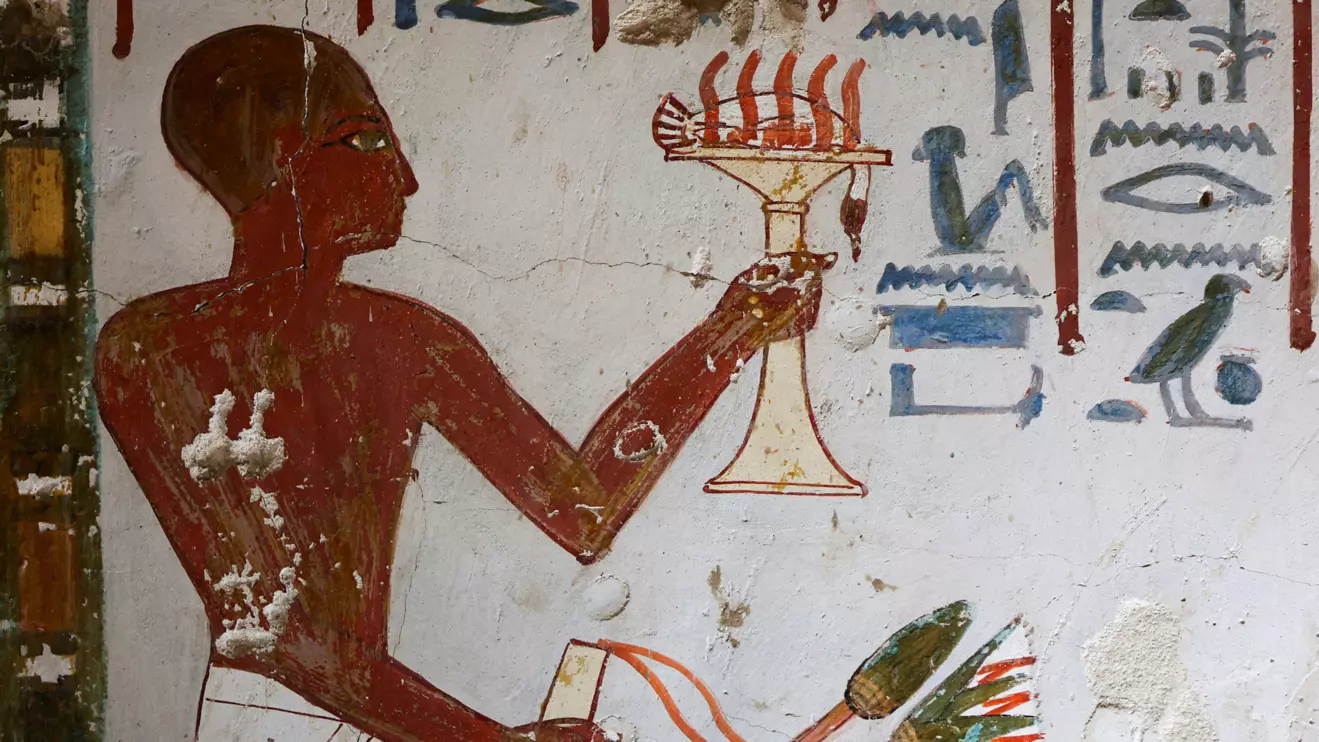
Ancient Egyptian paintings adorn the newly restored tomb wall, inside the recently restored ancient "Amenhotep Rabuia" (TT416) in the El-Khokha necropolis on the west bank of the Nile in Luxor, where Egyptian authorities have announced the completion of restoration work on two 18th Dynasty tombs belonging to Amenhotep Rabuia and his son Samut, dating back to the reigns of Pharaohs Thutmose III and Thutmose IV, that contain scenes illustrating daily life, funerary practices, and religious imagery from ancient Egypt, in Egypt, May 14, 2026. Reuters/Mohamed Abd El Ghany

Ancient Egyptian paintings adorn the newly restored tomb wall, inside the recently restored ancient "Amenhotep Rabuia" (TT416) in the El-Khokha necropolis on the west bank of the Nile in Luxor, where Egyptian authorities have announced the completion of restoration work on two 18th Dynasty tombs belonging to Amenhotep Rabuia and his son Samut, dating back to the reigns of Pharaohs Thutmose III and Thutmose IV, that contain scenes illustrating daily life, funerary practices, and religious imagery from ancient Egypt, in Egypt, May 14, 2026. Reuters/Mohamed Abd El Ghany

Egyptian authorities on Thursday exhibited a plaster blocking wall of King Tutankhamun's tomb in Luxor and unveiled two restored ancient tombs on the West Bank of the city that date back to the New Kingdom and contain scenes of daily life and funerary rituals. 

Abdelghaffar Wagdy, director-general of Luxor Antiquities, said the wall is a unique artifact that has never been replicated in Egypt or anywhere else in the world, because almost all Pharaonic tombs were looted.

"Therefore, it is a one-of-a-kind artifact — the only one currently on display more than 100 years after the discovery of Tutankhamun's Tomb," he said at an exhibition in Luxor. "It is the only surviving artifact of Tutankhamun that the world had never seen before. Recently, an Egyptian team reconstructed it."

The original plaster blocking wall of the tomb of King Tutankhamun is considered among the most prominent elements associated with the sealing of the tomb discovered in 1922 by the British archaeologist Howard Carter, said the Egyptian Ministry of Tourism and Antiquities.

The wall, displayed to the public for the first time at the Luxor Museum, was used to secure the entrances of the burial chamber and bore official stamps reflecting funerary rituals and the administrative authority associated with the king's burial, said the ministry.

The wall bears seals belonging to Tutankhamun as well as those of the necropolis guards charged with keeping the tombs safe and protecting them from theft, Wagdy said.

The West Bank of the River Nile at Luxor is home to the Valley of the Kings, where pharaohs and nobles of the New Kingdom were buried in tombs carved into the rock. 

Among the many New Kingdom pharaohs buried there was Tutankhamun - popularly known as King Tut - whose 14th-century B.C. tomb and its full contents were unearthed in 1922.  

The tombs that were opened are those of Rabuya and his son Samut from the 18th Dynasty, the first of the New Kingdom dynasties. Rabuya and Samut served as door keepers of the deity Amun, the ministry said.

"Today we are inaugurating two very important tombs that were discovered by chance in 2015," said Hisham El-Leithy, secretary-general of Egypt's Supreme Council of Antiquities.

The tombs contain scenes of activities including agriculture, harvest, crafts, bread, pottery and wine production. 

By Sayed Sheasha

Tags

Related

Egypt

A new home for an old dream

Egyptian President Abdel Fattah Al-Sissi received French President Emmanuel Macron on Saturday in New Borg El-Arab City for the inauguration of Senghor University's new headquarters, an occasion that also served as the backdrop for substantive bilateral talks covering the Middle East's most pressing crises.

Sudan

Sudan war enters fourth year: What to know

On April 15, 2026, the war in Sudan entered its fourth year, a grim milestone that passed largely unnoticed, overshadowed by conflicts elsewhere. Yet the United Nations has called it unequivocally the world's worst humanitarian crisis. 

Subscribe to our newsletter

Mena banner 4

To make this website run properly and to improve your experience, we use cookies. For more detailed information, please check our Cookie Policy.

  • Necessary cookies enable core functionality. The website cannot function properly without these cookies, and can only be disabled by changing your browser preferences.