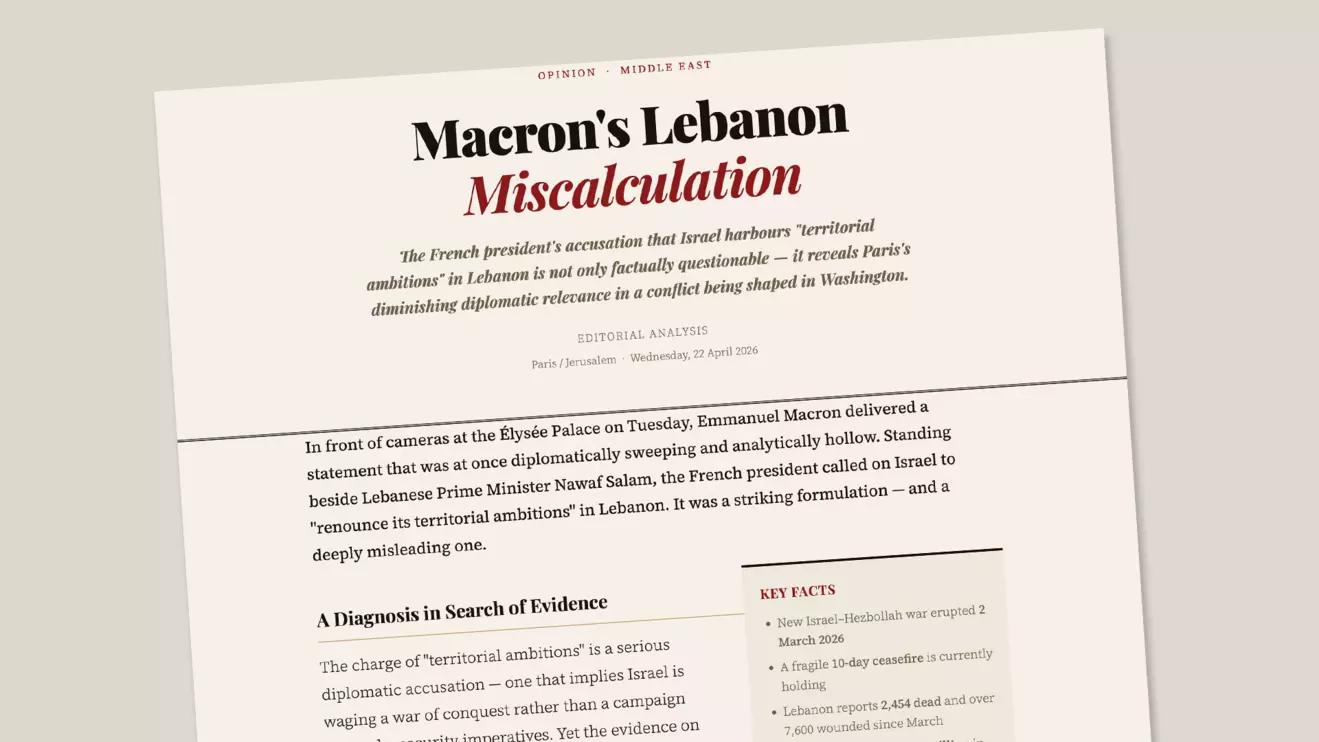
In front of cameras at the Élysée Palace on Tuesday, Emmanuel Macron delivered a statement that was at once diplomatically sweeping and analytically hollow. Standing beside Lebanese Prime Minister Nawaf Salam, the French president called on Israel to "renounce its territorial ambitions" in Lebanon. It was a striking formulation, and a deeply misleading one.
The charge of "territorial ambitions" is a serious diplomatic accusation, one that implies Israel is waging a war of conquest rather than a campaign driven by security imperatives. Yet the evidence on the ground points to a different conclusion.
Israel's military operations in southern Lebanon have been consistently framed around one objective: establishing a buffer zone along the border to prevent Hezbollah from positioning forces for attacks on Israeli towns and communities.
This is not a novel concept in the history of the conflict. Israel withdrew unilaterally from Lebanon in 2000, and again accepted a ceasefire framework in 2006 precisely because it sought security arrangements, not annexation. The pattern is consistent. A state seeking territorial expansion does not repeatedly withdraw from occupied land. A state seeking security does.
The Security Buffer: A Legitimate Concern Dismissed
Since Hezbollah relaunched its offensive on 2 March, Lebanon has recorded over 2,450 dead and thousands of wounded. The conflict is devastating, but it did not begin in a vacuum. The Iran-backed group has operated for years along the Lebanese-Israeli border in direct violation of UN Security Council Resolution 1701, which was supposed to disarm non-state militias south of the Litani River. That resolution was never enforced, including by UNIFIL, the French-supported UN peacekeeping force that stood by for two decades as Hezbollah entrenched itself.
Against that backdrop, Israel's insistence on a security perimeter is not territorial adventurism. It is the predictable response of a state that watched international guarantees dissolve in real time. Macron, whose country commands a significant contingent of those very peacekeepers, might reflect on why those guarantees failed before lecturing Israel about ambition.
Who Is Actually Driving Diplomacy?
The French president's timing is also revealing. Macron spoke on Tuesday as Washington was independently arranging direct Israel–Lebanon talks set to take place in the American capital later this week.
A ceasefire extension was announced not through European channels but at the initiative of the United States, with President Trump confirming the extension at Pakistan's request. The diplomatic architecture being constructed is American-led, with regional actors playing supporting roles.
Paris, meanwhile, has faced documented resistance from both Israel and the United States in its attempts to secure a seat at the negotiating table. Reuters reported Tuesday that Macron himself acknowledged it was "secondary" for France to be present at the talks, recognising that what mattered was supporting Lebanon's position, an implicit concession that France is advising from the sidelines rather than shaping the outcome.
Macron's press conference, then, reads less as diplomacy and more as positioning, an attempt to remain visible in a crisis where France's leverage has, in practice, been limited.
The EU Association Agreement Gambit
The French president went further, warning that suspending the EU–Israel Association Agreement would become a "legitimate question" if Israel continued its current policies. This is not a new threat in European political discourse, but it is a blunt instrument with limited strategic utility at a moment when the parties involved are, for the first time in weeks, actually talking.
Threatening economic consequences just days into a fragile ceasefire, as Macron himself conceded, risks hardening Israeli positions rather than incentivising flexibility. Effective diplomacy requires leverage, credibility, and timing. Wielding the EU trade card at this juncture arguably undermines all three.
What Macron Got Right
To be fair, Macron's broader message is not without merit. Calling for a political agreement that guarantees the security of both Israel and Lebanon, and that addresses Lebanon's territorial integrity, is a reasonable framework.
His insistence that Hezbollah must cease firing into Israeli territory and be disarmed, crucially, "by the Lebanese themselves », reflects a realistic understanding that external forces cannot impose disarmament on a deeply embedded political-military organisation without catastrophic cost. These points deserve acknowledgment.
But reasonable conclusions are undermined when the premises are faulty. Framing the conflict as one driven by Israeli "territorial ambitions" poisons the well of any constructive analysis. It feeds a narrative that absolves Hezbollah of its role in provoking and sustaining this conflict, and it misrepresents Israel's stated strategic objectives, however one may judge the proportionality of the means used to pursue them.
Emmanuel Macron's voice in this crisis matters, France has deep historical ties with Lebanon, a significant troop presence through UNIFIL, and genuine interest in regional stability. But diplomatic credibility is not built by reaching for the most inflammatory framing available. It is built through precision, consistency, and influence over outcomes.
On all three counts, Tuesday's press conference fell short. The ceasefire holding today was not brokered in Paris. The talks scheduled for Washington this week were not convened by France.
And the characterisation of Israeli operations as territorially motivated is not supported by the available evidence. That is not a minor rhetorical slip. In the fragile architecture of an emerging peace process, words at this level matter enormously, and Macron's words, on this occasion, were ill-chosen.