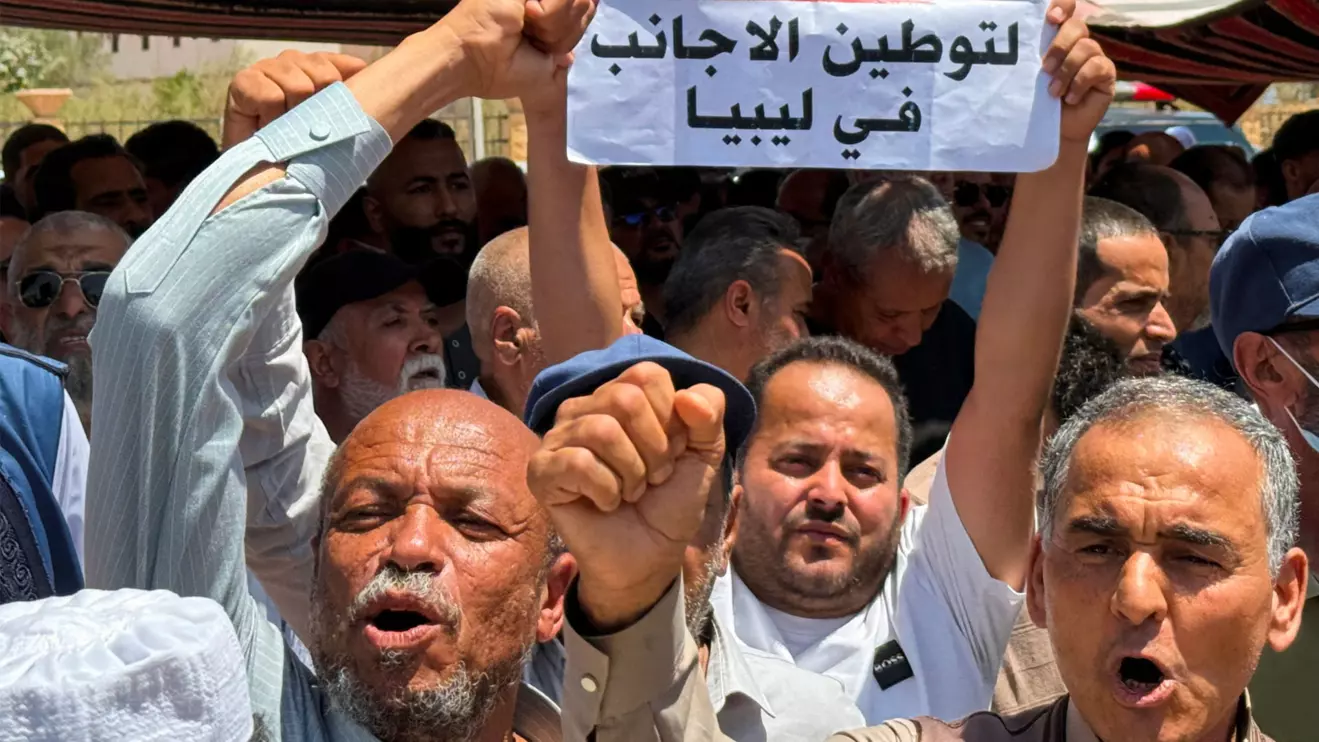
Hundreds of Libyan demonstrators blocked off the office of the U.N. refugee agency in the capital Tripoli on Thursday during a protest against migrants who have travelled to the country in search of work or passage to Europe.
The demonstrators gathered in front of UNHCR's main office in Tripoli's Sarraj neighbourhood, chanting slogans such as "No, No to settlement, Libya only for Libyans" and "Get out of Libya,
take them all out of Libya."
They erected tents then brought a truck full of sand and closed the main gate of the building with a barrier, shouting, "The Libyan people have said their word", and carrying signs reading "No to intruders in our country, take them out."
Since a NATO-backed uprising in 2011, Libya has become a North African transit route for hundreds of thousands of migrants fleeing conflict and poverty, often in sub-Saharan Africa, with many risking dangerous journeys across the desert or the Mediterranean.
The oil-dependent Libyan economy is also a draw for migrants seeking work, and many do menial jobs in sectors including cleaning and construction that Libyans are reluctant to fill.
Thursday's was the largest of several recent demonstrations against migrants, who are blamed by some Libyans for social and economic problems that have become more visible during 15 years of conflict and political division in the North African country.
Some demonstrators later marched to the office of the U.N. mission in Libya.
The United Nations Support Mission in Libya said it affirmed Libyans' right to peaceful expression based on accurate information and condemned any incitement to violence against U.N. staff or premises.
It said there is no U.N. resettlement programme in Libya. It added that UNHCR works to help people fleeing war with solutions outside Libya, including evacuation to third countries and voluntary return when conditions allow.
UNHCR did not respond to a request for comment.
Libya, with an estimated total population of about 7 million, harbours well over 900,000 migrants, according to the U.N.
One of the demonstrators, Ahmad al-Ghasa, said he blamed migrants for break-ins and assaults, and complained that they slept in the streets. "These phenomena were not present in Libyan society before," he said.
On Wednesday, the acting foreign minister in Libya's internationally recognised government, Taher al-Baour, said in a TV interview that there was no project "to settle migrants in Libya".
"Libya is not capable of handling these numbers," he told the Libya Alahrar channel, adding that Libyans should not blame others for political and security problems leading to higher migrant numbers.
Reporting by Ahmed Elumami and Ayman Sahely