The United States' top diplomat sought backing from sceptical Gulf allies on Wednesday for President Donald Trump's deal with Iran to end their war, while in another challenge to the accord, Israel insisted it would keep troops in southern Lebanon.
The U.S. and Iran signed an initial accord last week to end a war that has upended the Middle East and pressured global economies with the closure of the Strait of Hormuz, a transit point for a fifth of global oil and liquefied natural gas supplies. Under the deal, the strait is now slowly reopening and on Wednesday benchmark oil prices fell more than $3 to their lowest level since before the war started as supply concerns eased further.
But conflicting accounts have emerged over elements of the deal, which has prompted criticism of Trump at home and in the Middle East. Financial incentives for Iran, control of the Strait of Hormuz and Israel's parallel war in Lebanon have all been disputed, highlighting the fragility of the accord.
"We're winning by a lot. Iran is making very big concessions," Trump told reporters on Wednesday.
Speaking in Kuwait City, the second stopover in a tour of three Gulf nations, Secretary of State Marco Rubio said the U.S. was "completely aligned with our partners in the Gulf".
"We're not going to do anything that undermines the security of our allies, our longstanding allies in the region," he told reporters before heading to Bahrain.
Rubio also reiterated the Trump administration's opposition to Iran's demand to charge tolls on shipping through the Strait of Hormuz, something also opposed by Washington's Gulf allies.
REGIONAL SCEPTICISM
The proposed peace deal has been met with scepticism in the Middle East, where many states came under attack from Iran during the war and view the accord as too generous to Tehran, including a $300 billion fund and the waiver of some sanctions.
Washington's Gulf allies fear the reconstruction fund could help Iran to rebuild its military, while the accord also does not address Tehran's ballistic missile capacity.
Meanwhile, Israeli Prime Minister Benjamin Netanyahu and Defence Minister Israel Katz both stressed again on Wednesday that Israel would not pull troops out of southern Lebanon, where they say they have created a security zone to protect residents of northern Israel.
"The IDF is prepared ... and we are not retreating. We announced that in any case we are not withdrawing, and as of this moment — and this is a political achievement — there is no American demand for Israel to withdraw from Lebanon," Katz said in an onstage interview at a conference in Tel Aviv.
He made his comments as Lebanon and Israel discuss a U.S.-backed proposal at talks in Washington for Israeli forces to pull out of some of the territory it invaded in the war and hand it to Lebanese-army control.
Israel has been battling Hezbollah in Lebanon since the militant group attacked Israel on March 2 in support of Iran, and Tehran has made a cessation of hostilities there a central tenet of its demands in any peace deal with the U.S.
"For us, a ceasefire in Lebanon is as important as a ceasefire in Iran, and further, an end to the war in Lebanon is as important as an end to the war in Iran," Iran's parliament speaker Mohammad Baqer Qalibaf said on Wednesday.
An Israeli drone strike on a car in southern Lebanon killed at least two people on Wednesday, Lebanese security and medical sources told Reuters.
The Israeli military told Reuters it was checking the reports. Earlier, it said its air force had struck two armed Hezbollah fighters near a zone controlled by Israeli troops in southern Lebanon. It was not immediately clear if the incidents were the same.
IRAN SLAMS U.S. 'MILITARISM'
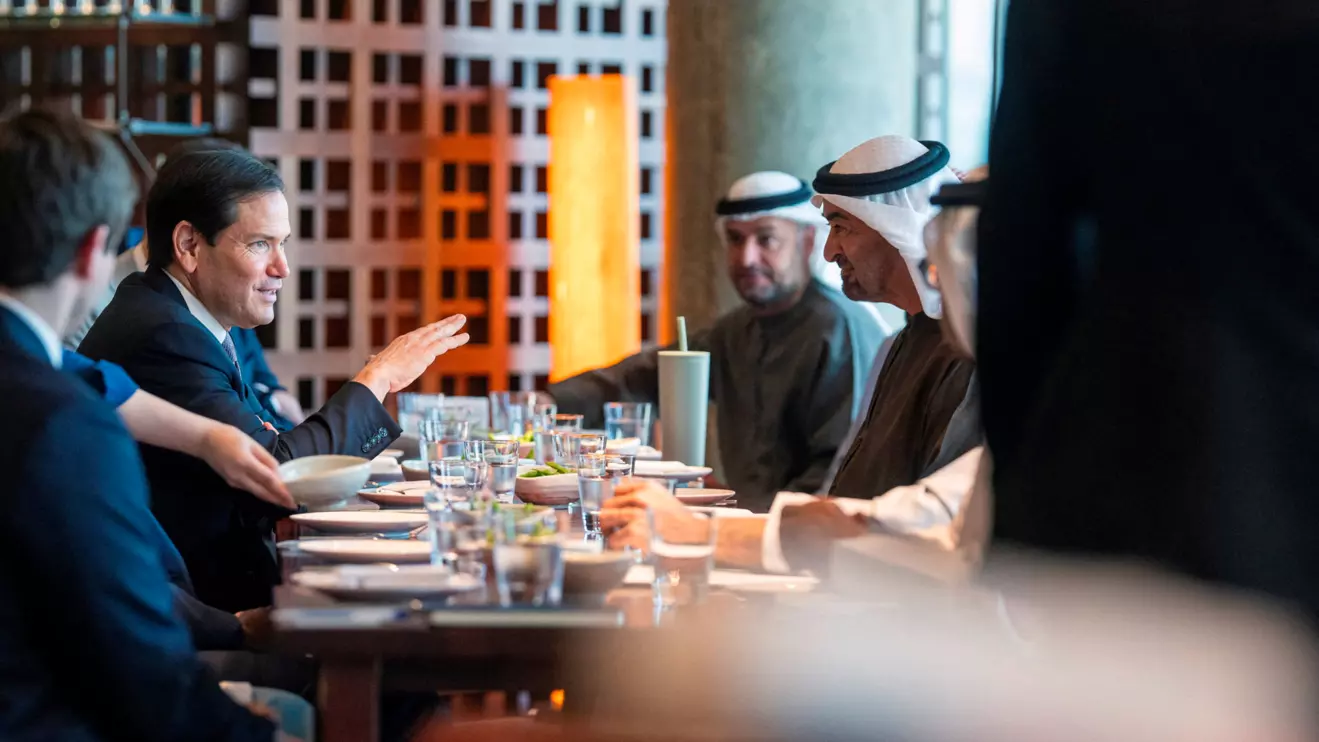
Rubio held a working lunch on Wednesday with United Arab Emirates President Sheikh Mohammed bin Zayed Al Nahyan before moving on to Kuwait. He was also due to visit Bahrain.
Kuwait and Bahrain host strategic U.S. military bases, and both were hit by an onslaught of Iranian missiles, resulting in civilian deaths and a heavy economic toll.
Responding to Rubio's comments in Kuwait, Iran's foreign ministry spokesperson Esmaeil Baghaei said on X: "We can't have a peaceful region so long as American militarism and interventionism persist, and their occupying proxy (Israel) continues, with absolute impunity, to inflict endless wars across the region and perpetrate genocide..."
The interim accord signed by the U.S. and Iran paved the way for 60 days of talks aimed at hammering out thornier details, including issues related to Iran's nuclear programme.
A first round of talks between high-ranking U.S. and Iranian officials in Switzerland ended on Monday. Rubio said on Wednesday that technical negotiators would resume their talks at the end of the month, most likely also in Switzerland.
Divergent reports have emerged on agreed provisions relating to Iran's nuclear programme. Trump said preventing Tehran from building a nuclear weapon was the central reason for starting the war on February 28. Iran has said it has no plans to do so.
Iran pushed back again on Wednesday after Trump said it had agreed to nuclear inspections into "infinity" as part of the initial accord.
Iranian Deputy Foreign Minister Kazem Gharibabadi reiterated on X that no meeting was held in Switzerland with International Atomic Energy Agency chief Rafael Grossi, despite Grossi's request, and said there were currently no plans to grant access to nuclear facilities that had been attacked or to nuclear materials.
He said such issues would be considered only within the framework of a final agreement and after the U.S. took practical steps to lift all sanctions on Iran.