
Lebanon
EU to train Lebanese army in new mission
The European Union announced on Monday that it will set up a mission to train the Lebanese army and security forces, separate from the UN peacekeeping force UNIFIL.

Lebanese President Joseph Aoun on Monday welcomed the US-Iran memorandum of understanding, praising what he described as its respect for Lebanon's "specificity" and expressing hope that it would lead to "concrete measures putting a definitive end to the cycle of violence."
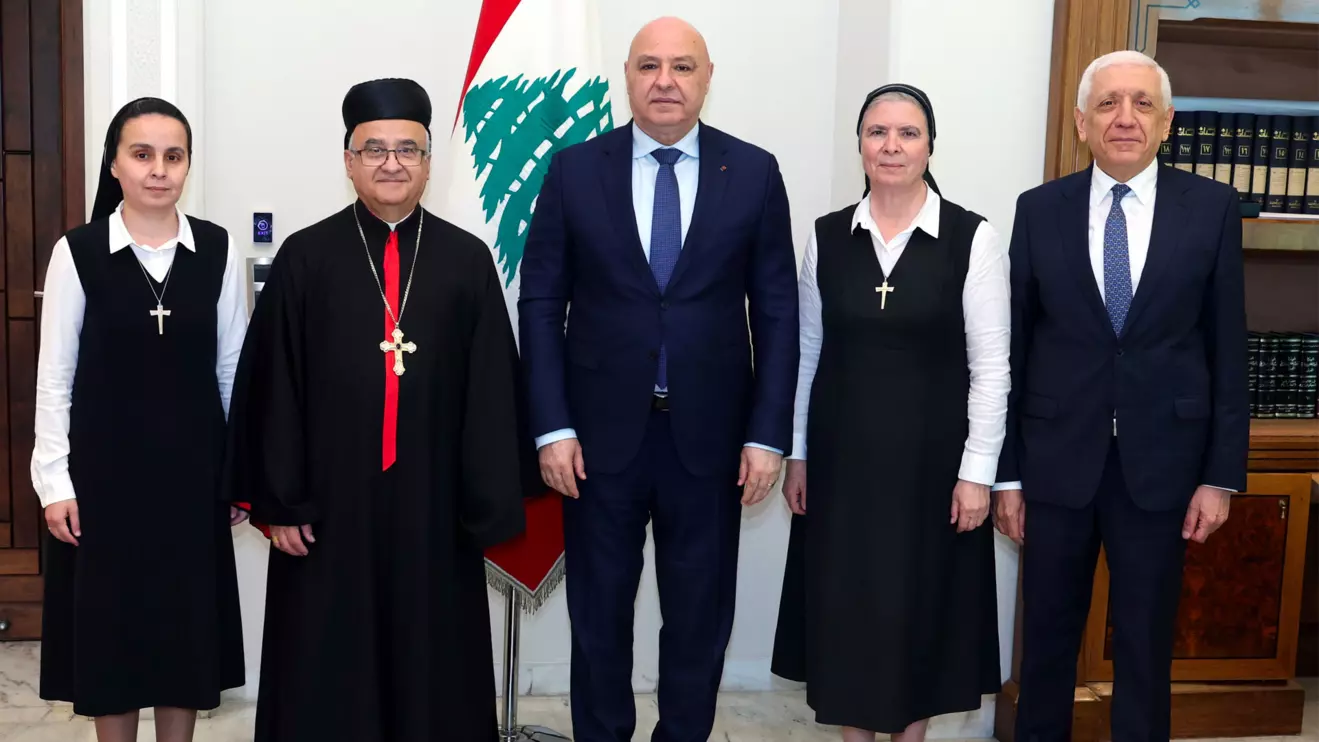
Lebanese President on Monday in Beirut with Maronite religious leaders © X
Lebanese President Joseph Aoun on Monday welcomed the US-Iran memorandum of understanding, praising what he described as its respect for Lebanon's "specificity" and expressing hope that it would lead to "concrete measures putting a definitive end to the cycle of violence."
"I welcome what this memorandum contains in terms of respecting Lebanon's specificity and recognising that Lebanon's stability and security are an integral part of any serious effort to establish regional stability," Aoun wrote on X.
There is, however, a significant problem with that statement: the memorandum of understanding contains no such thing.
A careful reading of the US-Iran framework reveals no mention of Lebanon. No reference to Lebanese sovereignty. No acknowledgement of Lebanon's "specificity." And - most critically - no requirement for Iran to demand, encourage or facilitate the disarmament of Hezbollah, the militia it created, funds, arms and directs from Tehran.
The document that President Aoun is welcoming as a recognition of Lebanon's interests is, in fact, silent on Lebanon entirely.
A Diplomatic Courtesy That Obscures a Hard Truth
One can understand the impulse behind Aoun's statement. Lebanon is exhausted by war, its people desperate for any signal that the violence may be ending. A Lebanese president welcoming a ceasefire framework - however imperfect - is playing a delicate diplomatic game, seeking to extract whatever legitimacy he can from an agreement his country had no part in shaping.
But the gap between Aoun's characterisation of the MOU and its actual contents is striking. Lebanon was not consulted. Lebanon was not represented. And the single most important issue for Lebanon's future - the disarmament of Hezbollah - was left entirely unaddressed.
There is, in short, very little in this memorandum for President Aoun to celebrate. The hope that it will translate into concrete measures ending the cycle of violence is understandable. But hope is not a guarantee, and in Lebanon's bitter experience, paper agreements without enforceable commitments have a long history of meaning very little.
The European Union announced on Monday that it will set up a mission to train the Lebanese army and security forces, separate from the UN peacekeeping force UNIFIL.
British Prime Minister Andy Burnham said on Monday that a suspected plot targeting the RAF Fairford air base in Britain was "highly likely" to have been coordinated in Iran, and almost certainly directed by the Islamic Revolutionary Guard Corps.
Iran is still reviewing a US response to its proposal regarding the reopening of the Strait of Hormuz and will reply to Washington via intermediaries when the review is over, foreign ministry spokesperson Esmaeil Baghaei said on Monday.
To make this website run properly and to improve your experience, we use cookies. For more detailed information, please check our Cookie Policy.
Necessary cookies enable core functionality. The website cannot function properly without these cookies, and can only be disabled by changing your browser preferences.