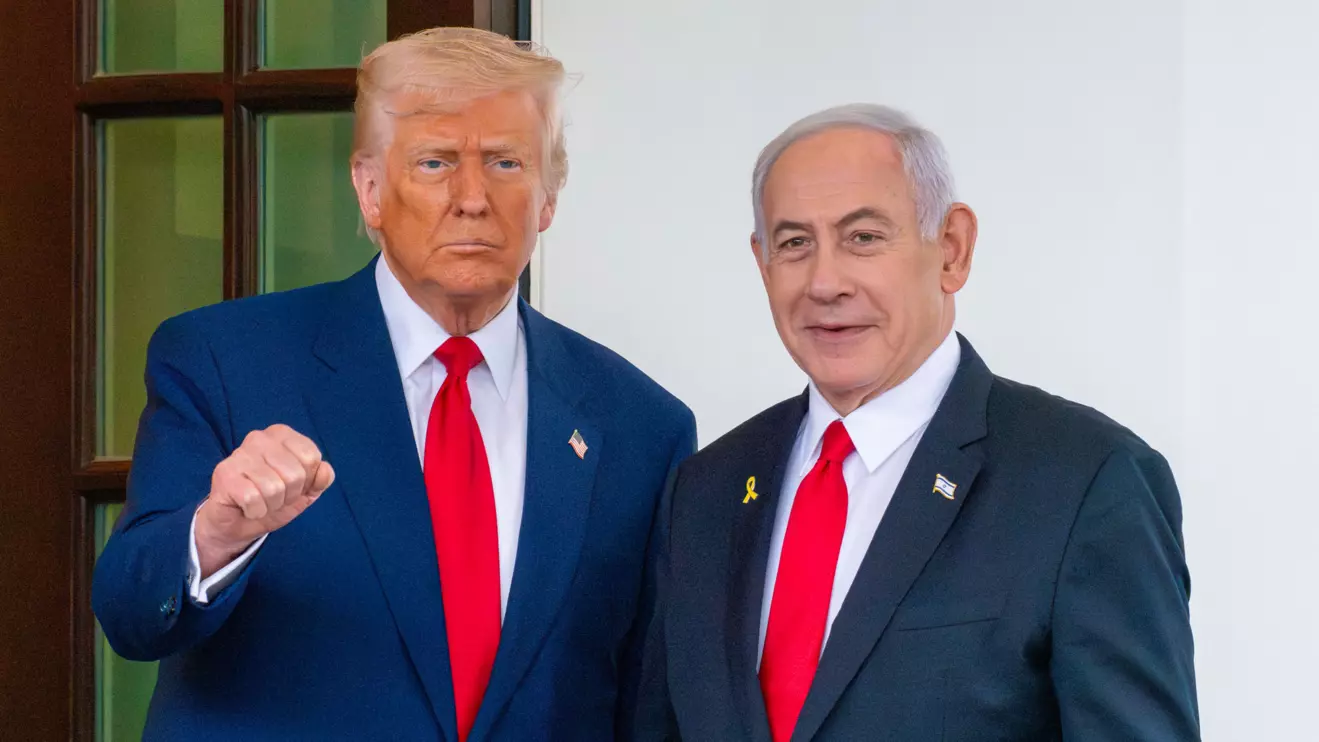
When Prime Minister Benjamin Netanyahu meets President Donald Trump on Wednesday, the agenda will be formally “Iran.”
In reality, the meeting is about whether the United States and Israel can align on a strategy that treats Iran as a single, integrated threat system: “nuclear capability, ballistic delivery systems, and a proxy network designed to impose costs without triggering decisive retaliation”.
Trump comes into this moment with unusually strong political capital in Israel, and with a near-term political-symbolic milestone: he is expected to visit Israel in April 2026 to receive the Israel Prize, after Israeli leaders publicly announced the decision.
That matters less as ceremony than as context. Once a leader is publicly embraced at that level, ambiguity becomes harder to sustain. Israel’s expectations rise. So does the reputational cost of a U.S. approach perceived in Jerusalem as insufficient.
Two paths, both costly
Washington is signaling a preference for diplomacy while emphasizing it retains military options. But diplomacy is only as strong as its scope and enforcement. The current friction point is familiar and decisive: the U.S. wants a broader agenda that includes missiles; Iran insists negotiations should focus narrowly on the nuclear file.
If the U.S. tilts toward escalation, Israel could face a multi-front problem driven by Iran’s proxy architecture and Tehran’s incentive to widen the theater while preserving plausible deniability.
If the U.S. tilts toward negotiations that do not constrain missiles and regional force projection, Israel risks waking up to a stable agreement that slows enrichment timelines while leaving the most operationally relevant capabilities intact.
For foreign policy professionals, the key point is this: a nuclear program and a missile program are not separable policy problems.
Missiles are not a side issue; they are the delivery mechanism that turns nuclear latency into coercive power. Even in a non-nuclear scenario, Iran’s missile force already alters escalation dynamics across the region by compressing decision time and increasing the probability of miscalculation.
The ballistic missile trajectory changes U.S. stakes
Iran already fields one of the Middle East’s largest and most advanced ballistic missile arsenals, with systems assessed as capable of reaching up to roughly 2,500 km.
That range anchors the regional threat. But what shifts the strategic frame for Washington is the long-term trajectory: continued advances in propulsion, guidance, materials, and space-launch–adjacent know-how can reduce the technical distance to longer-range systems over time. Congressional research has repeatedly emphasized why Iran’s missile development is a persistent focus of sanctions, reporting requirements, and policy debate.
In plain terms: if Iran’s missile development continues unchecked, it is not hard to see a future in which Iran’s posture is designed not only to deter Israel and Gulf states, but also to create direct or near-direct risk to the U.S. and its deployed forces, raising the cost of American intervention and weakening extended deterrence.
China and Russia are not spectators
Iran does not develop in a vacuum. One of the quiet strategic problems for the U.S. is that Iran’s deterrent growth intersects with great-power competition.
Beijing and Moscow both benefit from any dynamic that ties down U.S. forces, strains alliance coordination, and shifts attention away from Europe and the Indo-Pacific. Reuters reporting on Iran’s missile advances notes foreign assistance and external links as part of the broader ecosystem surrounding Iranian capabilities.
This is why the Iran file is increasingly a test of U.S. global credibility, not just Middle East posture: adversaries watch whether Washington can enforce red lines, sustain allied confidence, and prevent “compartmentalized” deals that leave coercive capabilities untouched.
What Netanyahu needs to accomplish in the room
Netanyahu’s comparative advantage is not rhetoric. It is his ability to translate Israeli red lines into U.S. strategic language and to force clarity on first principles. For this meeting to matter, three deliverables are essential:
1. Define success as integrated constraints: nuclear restraints plus meaningful limits on ballistic missiles and proxy enablement, not an agreement that treats these as separate “future conversations.”
2. Make enforcement the centerpiece: verification, snapback mechanisms, and consequences that are credible even amid political transitions. Without enforcement, diplomacy becomes time-buying for the party that is already advancing.
3. Reduce ambiguity that invites miscalculation: mixed signals are not stabilizing in this environment; they encourage risk-taking by Tehran and overconfidence by proxies.
This meeting will not “solve” Iran. But it can set the governing logic for the next phase: whether the U.S. pursues a strategy that constrains Iran’s full coercive toolkit or accepts a narrower nuclear framework while Iran’s missile power and proxy leverage continue to mature.
Trump’s popularity in Israel, and the planned April 2026 Israel Prize visit, increase the political salience of the choices he makes now. For Israel, the risk is existential.
For the United States, the risk is strategic: a future in which Iran’s missile trajectory and regional architecture raise the cost of American power projection and hand China and Russia a long-term advantage at a discount.
What happens next will not be determined by slogans about “war” or “deal.” It will be determined by whether Washington insists that missiles, nuclear capability, and proxies are one file, and acts accordingly.