They feared persecution. Then they went back

1 min Mena Today

The Iranian women's national soccer team crossed the Turkish-Iranian border Wednesday, completing a fraught journey home from Australia after five of the six players who had sought asylum subsequently withdrew their claims.

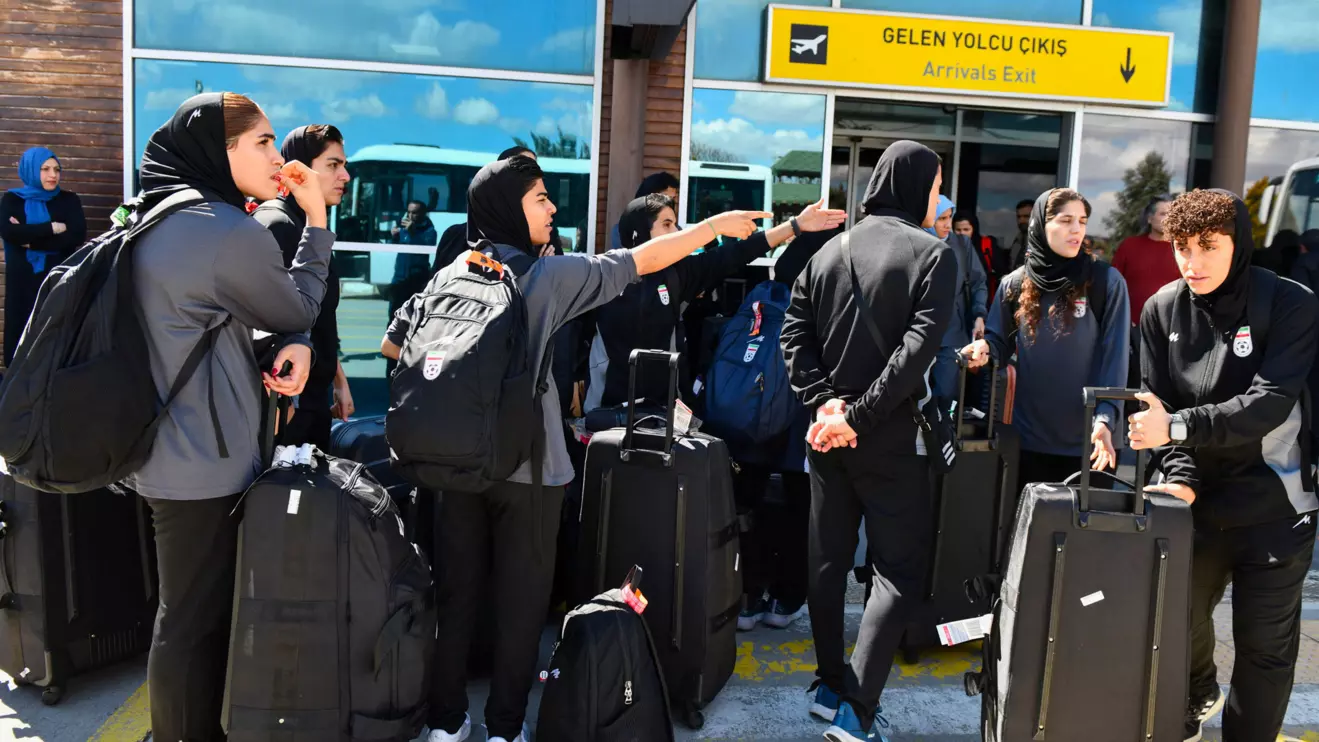
Members of the Iranian women's national soccer team outside the airport after they arrived in the eastern Turkish city of Igdir, as they travel to their home country after five players withdrew the asylum claims they had lodged in Australia over safety concerns about returning home due to not singing the national anthem at a women's Asian Cup match earlier this month, in Turkey, March 18, 2026. Reuters/Ali Ihsan Ozturk

Members of the Iranian women's national soccer team outside the airport after they arrived in the eastern Turkish city of Igdir, as they travel to their home country after five players withdrew the asylum claims they had lodged in Australia over safety concerns about returning home due to not singing the national anthem at a women's Asian Cup match earlier this month, in Turkey, March 18, 2026. Reuters/Ali Ihsan Ozturk

The Iranian women's national soccer team crossed the Turkish-Iranian border Wednesday, completing a fraught journey home from Australia after five of the six players who had sought asylum subsequently withdrew their claims.

The players flew from Kuala Lumpur to Istanbul, then to Igdir in eastern Turkey, before boarding a bus to the Gurbulak border crossing and entering Iran. One player briefly smiled and waved at a camera before departure,  a fleeting, ambiguous gesture that said everything and nothing.

Australia had granted humanitarian visas to six players and one support staff member who feared persecution upon returning to Iran, fears triggered after several players refused to sing the national anthem during an Asian Cup match, days after the US-Israeli strikes on Iran killed Supreme Leader Ali Khamenei. Iranian state television wasted no time labelling them "wartime traitors."

Yet five of the six asylum seekers reversed course and returned home. The official explanation - a desire to be "embraced by families and homeland" according to the Iranian Football Association - barely conceals the more likely reality: the regime applied pressure on the players' families inside Iran, a well-documented tactic used to force dissidents and athletes abroad to return. When the choice is between your own freedom and your family's safety, the decision is rarely truly free.

Two players remain in Australia and have been pictured training with a local A-League club,  suggesting that for some, the fear of returning outweighs even the pressure on those left behind.

Their fate, and the fate of those who returned, will be closely watched.

In Iran's current wartime climate, being labelled a traitor is not a minor accusation. It is a life-altering one.

By Ramin Razavi and Reuters 

Tags

Related

Iran

Israel kills Iran's intelligence Minister

Israel announced Wednesday it had killed Intelligence Minister Esmail Khatib,  the second elimination of a top Iranian leadership figure in as many days, and revealed that the Israeli military had been given blanket authorisation to target any senior Iranian official without requiring additional political approval.

Subscribe to our newsletter

Mena banner 4

To make this website run properly and to improve your experience, we use cookies. For more detailed information, please check our Cookie Policy.

  • Necessary cookies enable core functionality. The website cannot function properly without these cookies, and can only be disabled by changing your browser preferences.