Two Supreme Court judges shot dead in Tehran, Iranian judiciary says

1 min Mena Today

Two senior Iranian Supreme Court judges involved in handling espionage and terrorism cases were shot dead in the capital Tehran on Saturday, Iran's judiciary said.

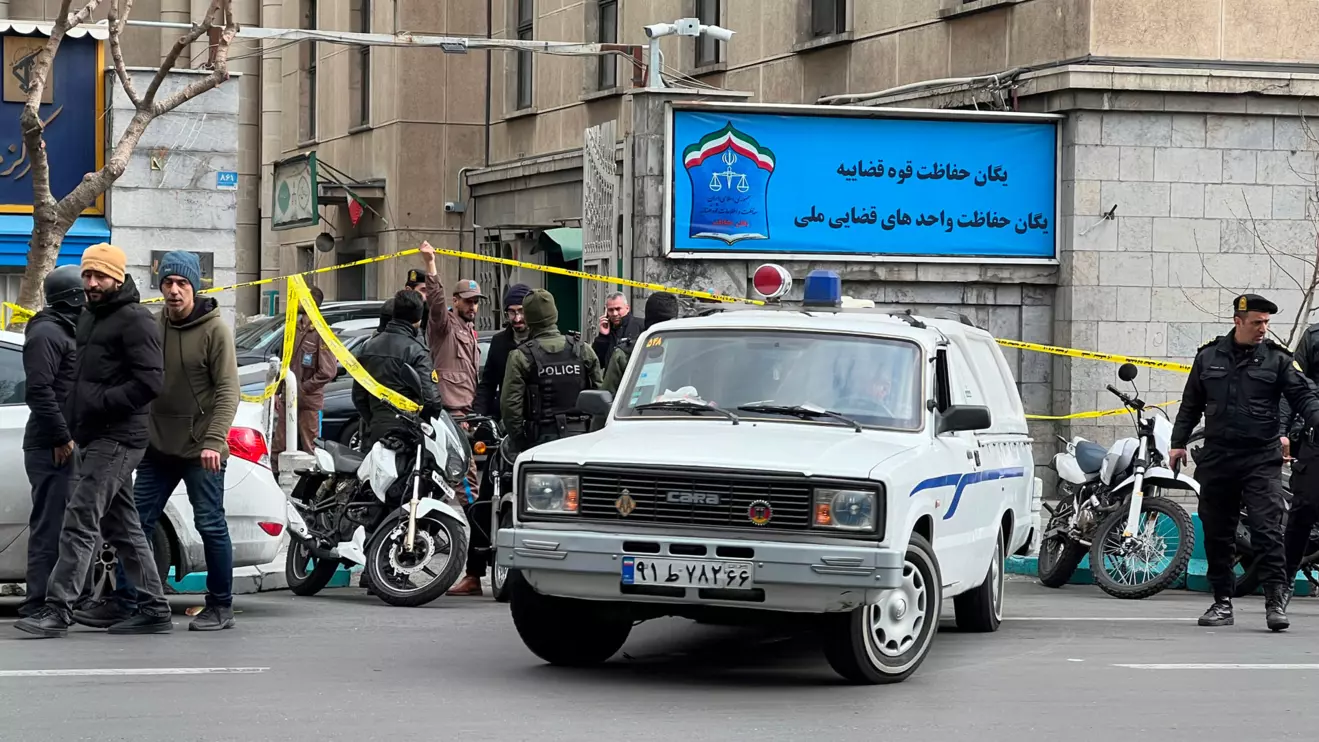
Members of the police stand in front of the judiciary building after the assassination of the Supreme Court Judges Mohammad Moghiseh and Ali Razini in Tehran, Iran, January 18, 2025. WANA (West Asia News Agency) via Reuters

Members of the police stand in front of the judiciary building after the assassination of the Supreme Court Judges Mohammad Moghiseh and Ali Razini in Tehran, Iran, January 18, 2025. WANA (West Asia News Agency) via Reuters

Two senior Iranian Supreme Court judges involved in handling espionage and terrorism cases were shot dead in the capital Tehran on Saturday, Iran's judiciary said.

It said the attacker killed himself after opening fire at the judges inside the Supreme Court, and that a bodyguard of one of the judges was wounded.

The judiciary identified the judges who were killed as mid-ranking Shi'ite Muslim clerics Mohammad Moghiseh and Ali Razini.

While the motive for the assassination was still unclear, judiciary spokesperson Asghar Jahangir told state television that the two judges had long been involved in "national security cases, including espionage and terrorism".

"In the past year, the judiciary has undertaken extensive efforts to identify spies and terrorist groups, a move that has sparked anger and resentment among the enemies," he said.

State TV said these cases were related to individuals linked to Israel and the Iranian opposition supported by the United States. It did not elaborate.

Opposition websites have in the past said Moghiseh was involved in trials of people they described as political prisoners.

Razini was a target of an assassination attempt in 1998.

Editing by Timothy Heritage and Mark Heinrich

Related

Hezbollah

Hezbollah gets $200 million from Iran, sources say

Hezbollah has received $200 million from Iran to help Lebanese displaced by this year’s war with Israel, two people with direct knowledge of the transfer said, the first significant aid from the group to supporters who bore the brunt of the conflict.

Iran

Talks with Tehran, but who is at the table?

US Vice President JD Vance said in an exclusive interview with Reuters that Iran must make a “meaningful” reduction in its nuclear enrichment capacity to satisfy US demands and end the countries’ seven-month war, even as Washington was unsure how Tehran makes decisions in negotiations.

Subscribe to our newsletter

Mena banner 4

To make this website run properly and to improve your experience, we use cookies. For more detailed information, please check our Cookie Policy.

  • Necessary cookies enable core functionality. The website cannot function properly without these cookies, and can only be disabled by changing your browser preferences.