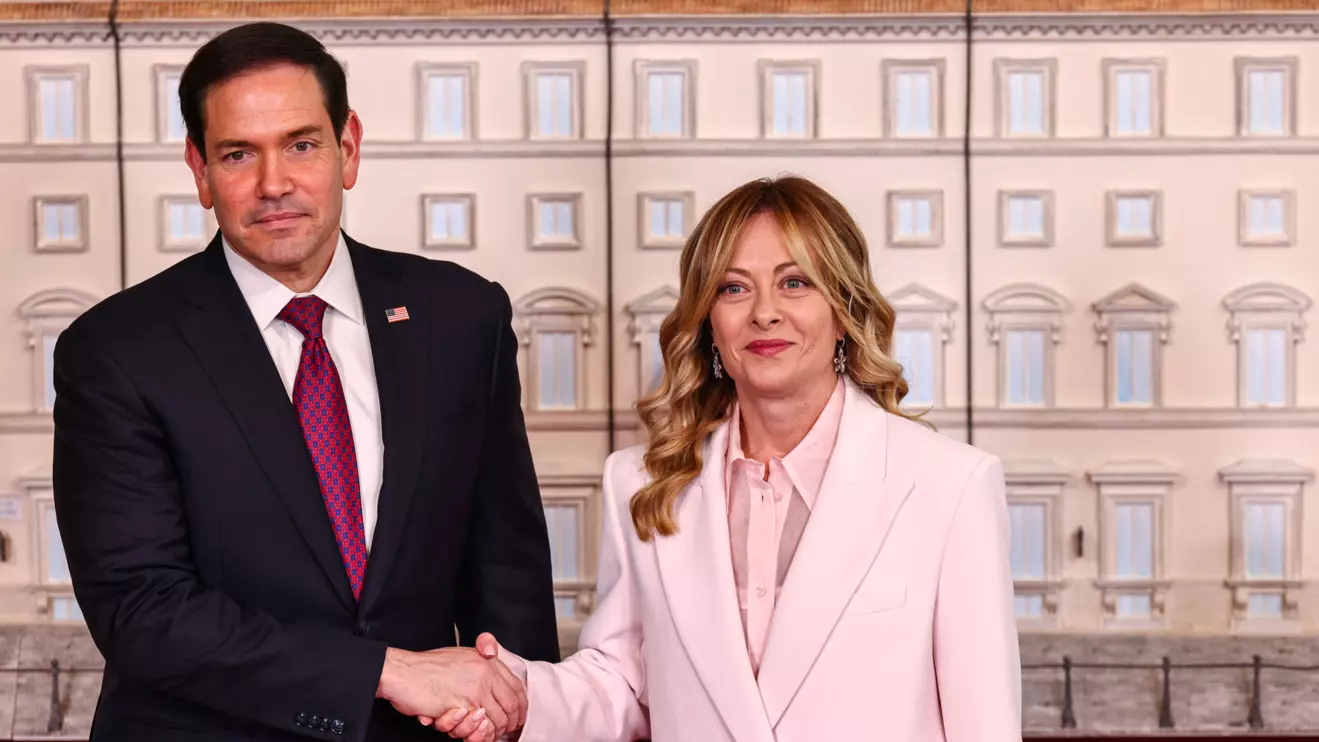
U.S. Secretary of State Marco Rubio met Prime Minister Giorgia Meloni on Friday and afterwards questioned why allies including Italy were not backing Washington's efforts to confront Iran and re-open the Strait of Hormuz.
"I don't understand why anybody would not be supportive," Rubio told reporters, adding that countries needed "something more than just strongly worded statements" if they opposed Iran's actions.
Rubio was wrapping up a two-day trip aimed at easing ties with Pope Leo after attacks on the pontiff by President Donald Trump, while also addressing Washington's frustration over Italy's refusal to support the U.S.-Israeli war on Iran.
Meloni had been one of Trump's firmest allies in Europe, cultivating close ties with him and presenting herself as a natural bridge between Washington and other EU states that had no natural political affinity with the Republican U.S. leader.
But that alignment has come under increasing strain in recent months, as the Iran war has forced her to balance loyalty to the United States against Italian public animosity to the war and the growing economic cost of the conflict.
Meloni and Rubio met for 1-1/2 hours, in what she described in a post on social media platform X as "an extensive and constructive discussion", saying the talks included the Middle East, Libya and the peace processes in Lebanon and Ukraine.
"It was a frank dialogue between allies who defend their own national interests while fully recognizing the value of western unity," Meloni said.
Rubio declined to give full details. However, he warned that Tehran's claim to control access to Hormuz risked setting a dangerous precedent.
"The fundamental question every country, not just Italy ... needs to ask themselves is, are you going to normalise a country claiming to control an international waterway? Because if you normalise that, you've set a precedent that's going to get repeated in a dozen other places," he said.
'THE UNITED STATES NEEDS EUROPE AND ITALY'
Italy and other European allies have said they would be willing to help keep the strait open once there was a lasting ceasefire or the conflict ends, but have refused to be drawn into direct confrontation with Iran.
Before seeing Meloni, Rubio met Italy's Foreign Minister Antonio Tajani, who said he hoped the visit had helped calm tensions with the United States.
"I am convinced Europe needs America, Italy needs America, but also that the United States needs Europe and Italy," Tajani told reporters.
Besides the war in the Gulf, Meloni and Rubio had also been expected to discuss Russia's war on Ukraine, U.S. tariffs on European goods and the outlook for Cuba, which Washington is seeking to isolate both diplomatically and economically.
The Italians were also keen for a readout on Rubio's meetings at the Vatican. Trump's recent attacks on Pope Leo crossed a sensitive line in overwhelmingly Catholic Italy and prompted Meloni to call them "unacceptable."
Her criticism in turn drew a sharp rebuke from Trump, who said she lacked courage. He subsequently threatened to withdraw U.S. troops from Italy.
Rubio said he didn't get into specifics about U.S. bases, saying it was a decision for Trump to make.
Italy last month refused to allow U.S. aircraft to use the Sigonella air base in Sicily for combat operations linked to the Iran conflict. Italian officials said Washington had not sought prior authorisation from Rome for the use of the site.
Rubio did not mention this incident, but pointed to Spain's decision not to allow its bases or airspace to be used to attack Iran. He said one of the main attractions of NATO for the U.S. was to have forces in Europe that could be swiftly deployed elsewhere.
"Now that's no longer the case, at least when it comes to some NATO members, that's a problem and has to be examined," he said.