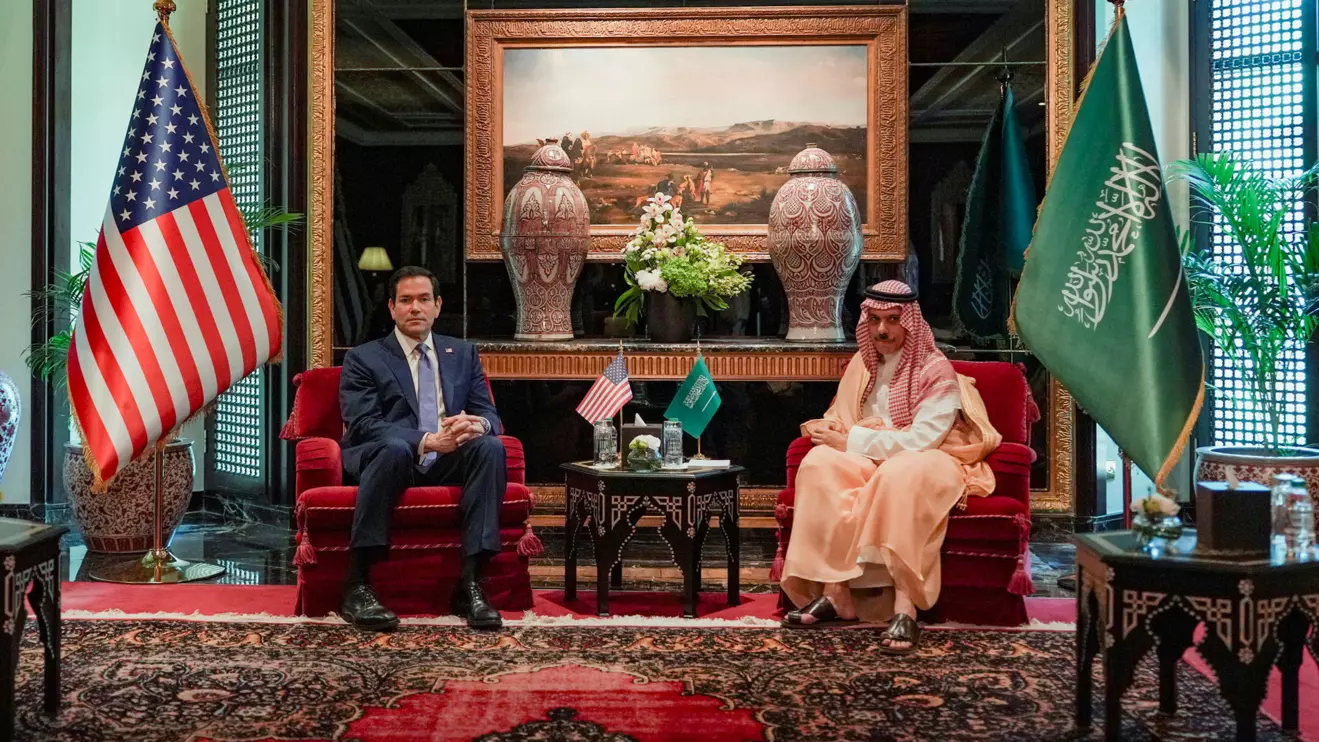
U.S. Secretary of State Marco Rubio will meet with Bahrain officials on Thursday on the final leg of a trip to the Middle East where he has sought to sell the Trump administration's preliminary Iran accord to skeptical Gulf Arab allies.
Rubio has acknowledged his delicate mission in pitching the peace deal to Gulf Arab leaders who fear excessive concessions will strengthen Tehran and reshape the region's security balance and oil flows.
Arriving on Wednesday night in Bahrain's capital Manama, which hosts the headquarters of the U.S. Navy's Fifth Fleet, Rubio will also meet with the Gulf Cooperation Council, or GCC, a grouping of six Sunni monarchies that also includes Saudi Arabia, Qatar and Oman, the United Arab Emirates, and Kuwait.
His three-day tour of the oil-rich Gulf is the first high-level diplomatic mission since the U.S.-Iran framework agreement last week to end the conflict.
At his previous stops in the UAE and Kuwait, Rubio sought to assure officials that the proposed deal was not overly favorable to Iran, which struck several Gulf states during the U.S.-Israeli war.
"We're not going to do anything that undermines the security of our allies, our longstanding allies in the region," he told reporters in Kuwait.
U.S. President Donald Trump said on Tuesday that Iran had agreed to nuclear inspections into "infinity," while Tehran said it had made no such concession in negotiations, raising questions about the viability of their fragile peace deal.
The two countries, which ended a first round of negotiations in Switzerland on Monday, have also offered conflicting accounts about financial incentives for Iran, control of the Strait of Hormuz, and Israel's parallel war in Lebanon.
All six GCC nations are strategic U.S. allies that offered some degree of logistical support to Washington during the war, and all were buffeted by Iranian airstrikes as a result.
Together, they make up the backbone of America's security architecture in the Middle East, and any countries rethinking their security relationship with the U.S. could have a significant impact on U.S. military strategy in the region.
The draft U.S.-Iran agreement includes no limits on Iran's ballistic missiles, a proposed $300 billion reconstruction fund and provisions that could expand Tehran's regional influence and control over critical oil shipping lanes.
Rubio has said he would not be asking regional allies to contribute to any reconstruction fund during the trip, even as the MoU with Iran suggests that countries in the region would at least be partially responsible for footing the bill.
Some U.S. Gulf allies are privately feeling disappointed over the interim deal that could open the door to U.S. normalization with Iran, a predominantly Shi'ite country that most Sunni-led GCC states consider their main adversary.
Bahrain's Shi'ite majority is ruled by a Sunni monarchy concerned that a financially liberated Tehran could foment unrest.