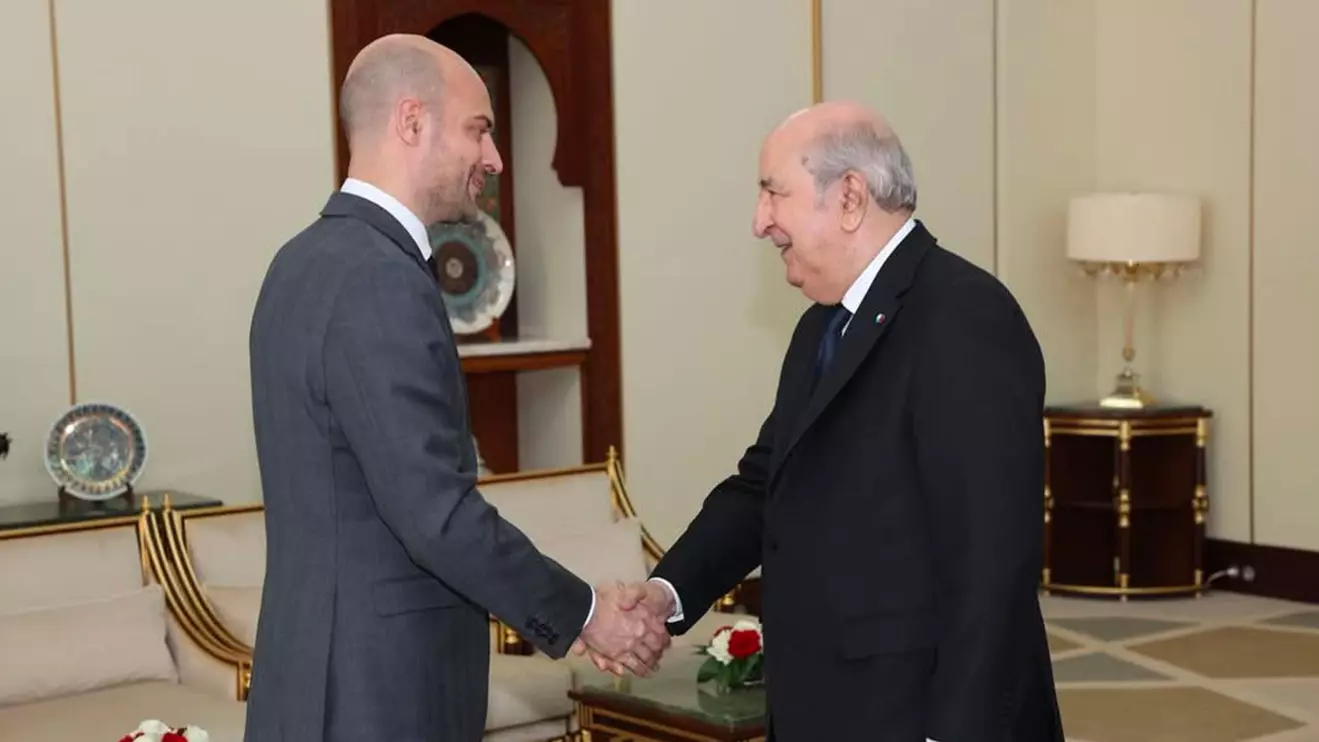
France's foreign minister said on Sunday that ties with Algeria were back to normal after he held 2 1/2 hours of talks with Algeria's president following months of bickering that have hurt Paris' economic and security interests in its former colony.
Ties between Paris and Algiers have been complicated for decades, but took a turn for the worse last July when Macron angered Algeria by recognising a plan for autonomy for the Western Sahara region under Moroccan sovereignty.
A poor relationship has major security, economic and social repercussions: trade is extensive and some 10% of France's 68 million population has links to Algeria, according to French officials.
"We are reactivating as of today all the mechanisms of cooperation in all sectors. We are going back to normal and to repeat the words of President (Abdelmadjid) Tebboune: 'the curtain is lifted'," Jean-Noel Barrot said in a statement at the presidential palace in Algiers after 2 1/2 hours of talks.
His visit comes after a call between President Emmanuel Macron and his counterpart Tebboune on March 31, during which the two agreed to a broad roadmap to calm tensions.
French officials say Algiers had put obstacles to administrative authorisations and new financing for French firms operating in the country.
Nowhere was that felt more than in wheat imports. Traders say the diplomatic rift led Algerian grains agency OAIC to tacitly exclude French wheat and firms in its import tenders since October. OAIC has said it treats all suppliers fairly, applying technical requirements.
Barrot said he had specifically brought up the difficulties regarding economic exchanges, notably in the agrobusiness, automobile and maritime transport sectors.
"President Tebboune reassured me of his will to give them new impetus," Barrot said.
AUTHOR ARRESTED
Beyond business, the relationship has also soured to the point where security cooperation, including over Islamist militancy, stopped. The detention by Algiers in November of 80-year-old Franco-Algerian author Boualem Sansal also worsened the relationship.
He has since been sentenced to five years in prison. Barrot said he hoped a gesture of "humanity" could be made by Algiers given his age and health.
With Macron's government under pressure to toughen immigration policies, the spat has fed into domestic politics in both countries.
Interior Minister Bruno Retailleau has called for a 1968 pact between the two countries that makes it easier for Algerians to settle in France to be reviewed, after Algiers refused to take back some of its citizens who were ordered to leave France under the "OQTF" (obligation to leave French territory) deportation regime.
Barrot said Retailleau would soon go to Algiers and that the two sides would resume cooperation on judicial issues.
The relationship between the two countries is scarred by the trauma of the 1954-1962 war in which the North African country, which had a large settler population and was treated as an integral part of France under colonial rule, won independence.