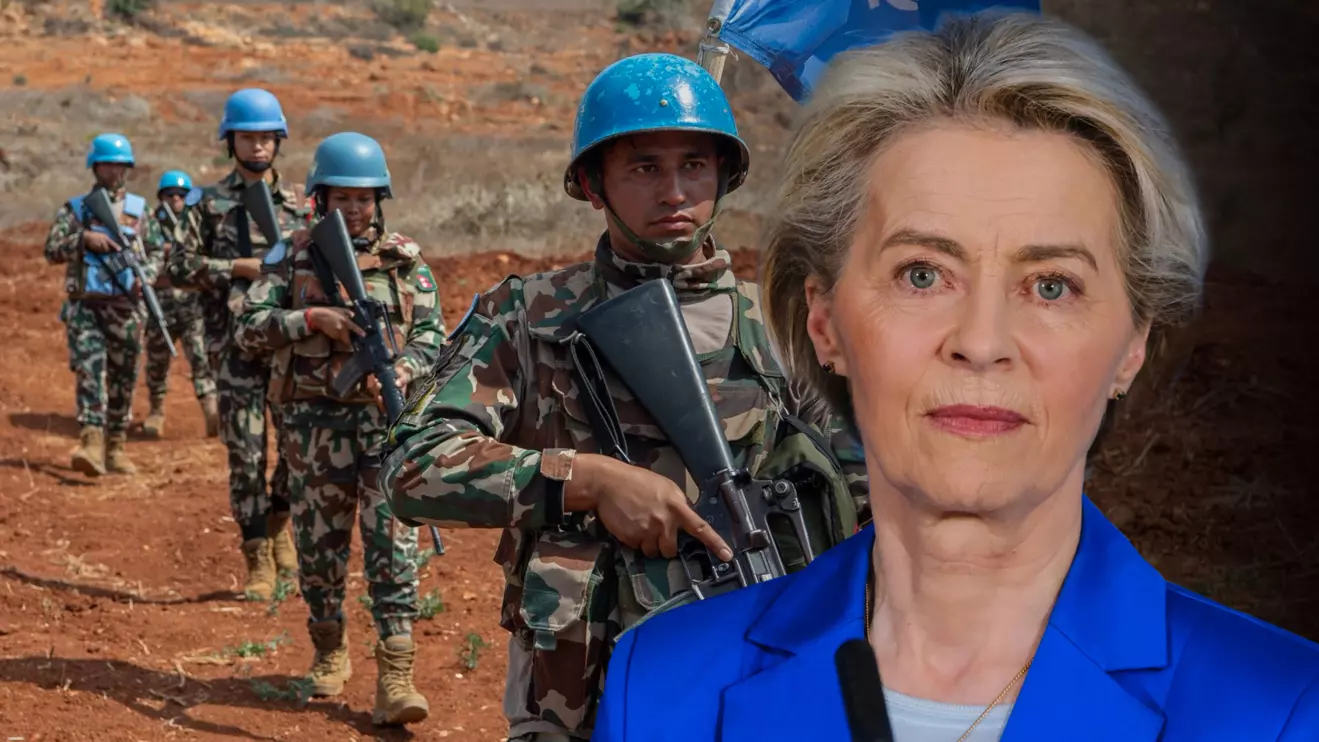
European Commission President Ursula von der Leyen and European Council President Antonio Costa arrived in Beirut on Friday, greeted at the airport by Prime Minister Nawaf Salam, who made a telling plea: maintain an international force in southern Lebanon with strong European participation.
The request itself reveals the fundamental problem plaguing Lebanon for decades, the country remains unable to secure its own territory without foreign assistance, primarily because an Iranian-backed militia controls much of its sovereign space.
During the meeting at Beirut International Airport, Salam presented the reforms launched since his government's formation nearly a year ago, including efforts to restore the state's monopoly on weapons and reassert authority across Lebanese territory, objectives that highlight just how thoroughly Hezbollah has usurped state power.
Discussions focused on European Union support for the Lebanese army and the post-UNIFIL phase, as the UN Interim Force in Lebanon's mandate nears its end. Salam emphasized "the need to maintain a United Nations force in the South, even if reduced, as well as the importance of European countries' participation in this force."
Yet here's the uncomfortable truth European leaders must confront: UNIFIL has demonstrated for years its complete inability to prevent Hezbollah from establishing itself in southern Lebanon.
The UN force, deployed since 1978 and reinforced after the 2006 war, has watched passively as Hezbollah built an extensive military infrastructure, stockpiled tens of thousands of rockets, and constructed tunnels and fortifications, all in direct violation of UN Security Council Resolution 1701.
UNIFIL became an expensive observer mission, providing diplomatic cover for Hezbollah's military buildup while accomplishing nothing of strategic value. The blue helmets patrolled, filed reports, and held meetings, while Iranian weapons flowed freely and Hezbollah transformed southern Lebanon into a forward military base aimed at Israel.
Israel Did What UNIFIL Couldn't
The recent Israeli offensive achieved what years of UNIFIL presence could not: it significantly reduced Hezbollah's influence and military capability in the south.
Israeli forces destroyed weapons caches, tunnel networks, and military infrastructure that had existed for years under UNIFIL's nose, or more accurately, with UNIFIL looking the other way.
Yet even after this military setback, Hezbollah's capacity for harm remains substantial. The threat will only disappear when the Shiite militia permanently loses its military wing throughout Lebanon, not just in the south, but across the entire country.
This is where European leaders must ask themselves hard questions. What exactly will a continued international presence achieve that UNIFIL failed to accomplish over decades?
How will a "reduced" UN force succeed where a larger one failed spectacularly? And most critically: are European nations prepared to actually confront Hezbollah, or will they simply fund another toothless monitoring mission?
The fundamental problem hasn't changed. Hezbollah remains armed, financed by Iran, and politically powerful within Lebanon's confessional system. The militia has no intention of voluntarily disarming, and Lebanon's fractured political structure, which Hezbollah helped engineer, makes forced disarmament nearly impossible without external pressure or military action.
Salam's government has made genuine efforts toward reform, but recovering the state's monopoly on weapons from an organization that can mobilize thousands of fighters, controls vast arsenals, and enjoys Iranian backing is not a matter of administrative reform, it requires confronting entrenched power backed by a regional hegemon.
Europe's Moment of Truth
European leaders face a stark choice in Beirut. They can repeat past mistakes by funding another ineffectual international presence that provides Hezbollah with breathing room to rebuild, or they can condition their substantial aid on concrete, verifiable steps toward genuine disarmament.
This means:
- No half measures: Hezbollah must disarm completely, not just "integrate" its weapons into state structures or keep them "in reserve."
- Real accountability: Any international force must have teeth—enforcement powers, not just observation rights.
- Sustained pressure on Iran: European support for Lebanon must come with explicit demands that Tehran end its militia sponsorship.
- Support for Lebanese sovereignty: This means backing Salam's government with resources and diplomatic weight to challenge Hezbollah's parallel state.
The pattern is clear: international forces without enforcement mandates accomplish nothing.
Diplomatic initiatives without consequences for non-compliance fail. Aid without conditions perpetuates the status quo.
Von der Leyen and Costa should help Beirut achieve the objective of permanently dismantling Hezbollah's military wing as quickly as possible. This is not optional if Lebanon is to have any future as a sovereign state rather than an Iranian protectorate.
But achieving this requires European leaders to abandon comfortable illusions. UNIFIL's failure wasn't an accident, it was baked into a mandate that prioritized avoiding confrontation over accomplishing its stated mission. Any successor force repeating this approach will produce identical results.
Lebanon needs real support: military assistance for its national army, economic aid conditioned on reform, and diplomatic backing to resist Iranian interference. What it doesn't need is another expensive peacekeeping mission that keeps no peace and allows Hezbollah to regroup.
The question confronting European leaders in Beirut is whether they're prepared to learn from UNIFIL's failure or destined to repeat it. The answer will determine whether Lebanon has a chance at genuine sovereignty or remains trapped as a playground for Iranian ambitions.
Nawaf Salam is asking for help. Europe should provide it, but only if it comes with the resolve to actually solve the problem rather than simply manage it. Anything less is just expensive theater that postpones the inevitable reckoning while Lebanese suffer.