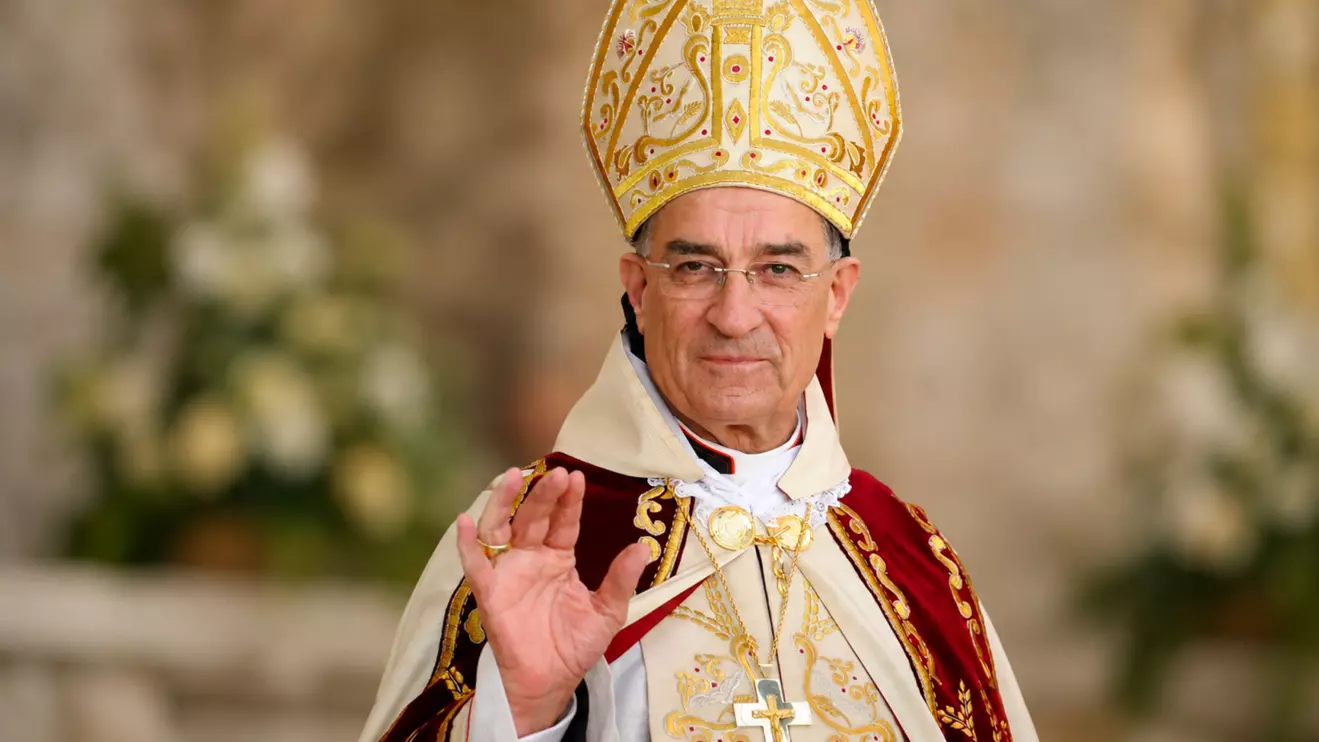
Maronite Patriarch Béchara Raï reiterated his support Sunday for the US-brokered framework agreement signed between Lebanon and Israel in late June, describing it during his Sunday homily as a "national path to resolving outstanding issues, consolidating a just, comprehensive and lasting peace, and preserving the state's sovereignty over its entire territory."
"At this critical juncture, we reaffirm and repeat: we want peace to be a national decision that protects Lebanon and its people, and keeps them away from the flames of war," Raï said, presiding over a festive Mass at Saint George Church in Ehden marking the commemoration of Blessed Patriarch Estéphan Doueihi, according to local media.
The patriarch stressed that "the state is the legitimate reference point for all Lebanese," reaffirming that "unity of decision-making, sovereignty and the monopoly of arms in the hands of legitimate institutions protect the country from chaos and division."
Rejected by Hezbollah, the framework agreement ties a "gradual" Israeli military withdrawal from South Lebanon to the disarmament of the Shiite group. This equation is to be implemented notably through "pilot zones," whose first phase began around ten days ago, covering three villages.
However, two of those villages were not originally occupied by Israel, while Israeli forces remain present on the outskirts of the third. Israel continues to insist it will not withdraw from South Lebanon until Hezbollah is disarmed.
"The nation's salvation begins when politics shifts from a struggle for influence to a service of the common good; when the administration moves from a space of clientelism to a hub of competence; when justice becomes the bastion of fairness; and when the economy becomes the guarantee of families' dignity and the future of the youth," Raï added.
He also expressed solidarity with those displaced by the war, calling for reconstruction efforts to be accelerated. Despite a ceasefire in effect since mid-June, Israel continues to demolish homes and civilian infrastructure across more than sixty Lebanese villages still occupied by its military.
On the Lebanese army, whose anniversary fell on Saturday, the patriarch said "it is our duty to ensure it political, material and moral support, and to shield it from political tensions, as it is the army of all Lebanese, guarantor of their unity and custodian of the land, the people and sovereignty."
The Lebanese army plays a central role in the "pilot zones" plan, tasked with deploying and disarming Hezbollah in the areas concerned.