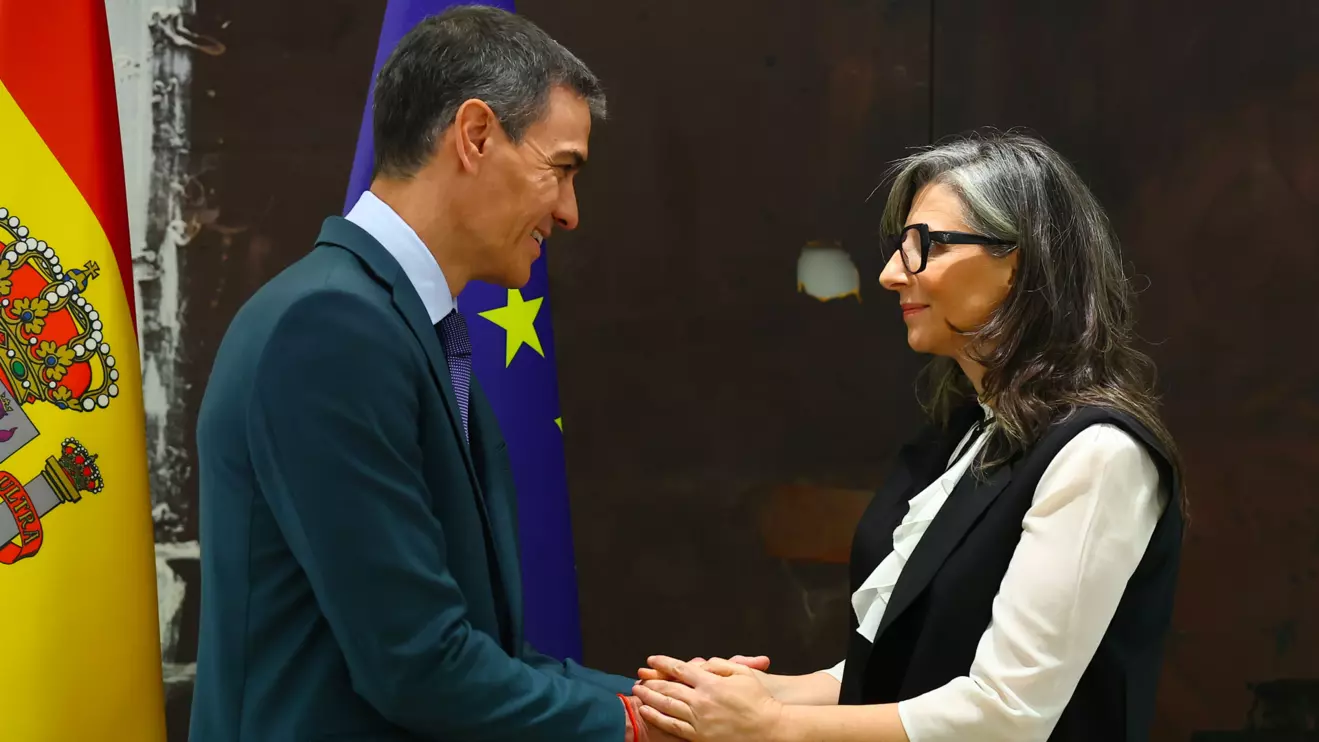
There are gestures that speak louder than policy papers. Pedro Sánchez made one on Thursday.
The Spanish Prime Minister awarded Francesca Albanese, the United Nations Special Rapporteur on human rights in the Palestinian territories, the Order of Civil Merit, one of Spain's highest distinctions. He praised her, with characteristic lack of restraint, as "a voice that supports the conscience of the world."
Nothing less.
It would be tempting to dismiss this as empty symbolism. It is not. It is a deliberate, calculated political statement, and it deserves to be read as such.
Who is Francesca Albanese?
Albanese is not simply a controversial figure. She is a rapporteur whose conduct has been formally condemned by Germany, France, Italy and several other European nations, all of which have called for her resignation.
Israel's permanent mission in Geneva submitted a formal letter to the Human Rights Council president on 15 February, documenting a pattern of statements that "flirt dangerously with antisemitic tropes" and concluding, unambiguously, that "as long as she holds a UN mandate, she fundamentally undermines the credibility and moral authority of the United Nations."
The United States went further. Washington sanctioned Albanese in July for what it described as illegitimate efforts to push the International Criminal Court to act against US and Israeli officials. Her response was to dismiss the sanctions as part of a broader American conspiracy, the reliable deflection of someone who has never demonstrated the impartiality her mandate requires.
The UN should have terminated her mandate long ago. Not because powerful states demand it, but because the integrity and moral authority of an institution already under severe strain cannot survive being weaponised by those who have abandoned any pretence of balance.
Pedro Sánchez has just given this woman Spain's Order of Civil Merit.
A pattern, not an aberration
It would be convenient to see Thursday's ceremony as a one-off provocation. It is not. It fits into a pattern of Spanish foreign policy conduct that has grown increasingly difficult to distinguish from active hostility toward Israel, and by extension toward the United States and the broader Western democratic order.
Spain was among the first European nations to formally recognise a Palestinian state. Sánchez has repeatedly positioned his government as a champion of the Palestinian cause in terms that go well beyond legitimate advocacy, veering into the kind of rhetoric that provides diplomatic cover for groups whose methods are anything but peaceful.
His government has maintained a conspicuous silence on Hezbollah's role in dragging Lebanon into war, on Hamas's October 7 massacre, and on Iran's missile strikes across the Middle East.
In Sánchez's worldview, it appears, the line between defending Palestinian rights and legitimising the organisations that claim to represent them has become dangerously blurred.
There is a domestic explanation for all of this, and it is not flattering. Sánchez leads a coalition that depends on the support of far-left parties whose hostility to Israel is ideological, visceral and non-negotiable. He is a political survivor above all else, and survival, in his current arithmetic, requires feeding the appetite of an ultra-left base for whom anti-Israel posturing has become a central article of faith.
Decorating Albanese is not a foreign policy decision. It is a political manoeuvre, a signal to his coalition partners that he remains one of them, whatever the diplomatic cost.
The diplomatic cost, it should be said, is not trivial. Spain's relationships with Israel, the United States and several European partners have all been damaged by this government's conduct. The European Political Community summit in Nicosia last month was notably awkward for Madrid. And Thursday's ceremony will not have gone unnoticed in Washington, Jerusalem or Brussels.
The line that should not be crossed
Criticism of Israeli government policy is legitimate. Disagreement with specific military decisions is legitimate. Advocacy for Palestinian rights is legitimate.
What is not legitimate is the systematic delegitimisation of Israel's right to exist and defend itself, dressed up in the language of human rights and international law.
What is not legitimate is awarding state honours to a UN official whom multiple democratic governments have formally accused of bias, misconduct and conduct bordering on antisemitism.
Pedro Sánchez crossed that line on Thursday. He did so knowingly, deliberately and with a smile.
The conscience of the world, he called it. One wonders which part of the world he was thinking of, and whether it includes the 1,200 Israelis massacred on 7 October, or the hostages held in Gaza, or the civilians of the Gulf states struck by Iranian missiles, or the Lebanese citizens dragged into a war they never chose.
Perhaps those consciences do not register on Sánchez's moral compass.
That, ultimately, is the most damning thing about Thursday's ceremony. Not the decoration itself. But what it reveals about the man who awarded it.