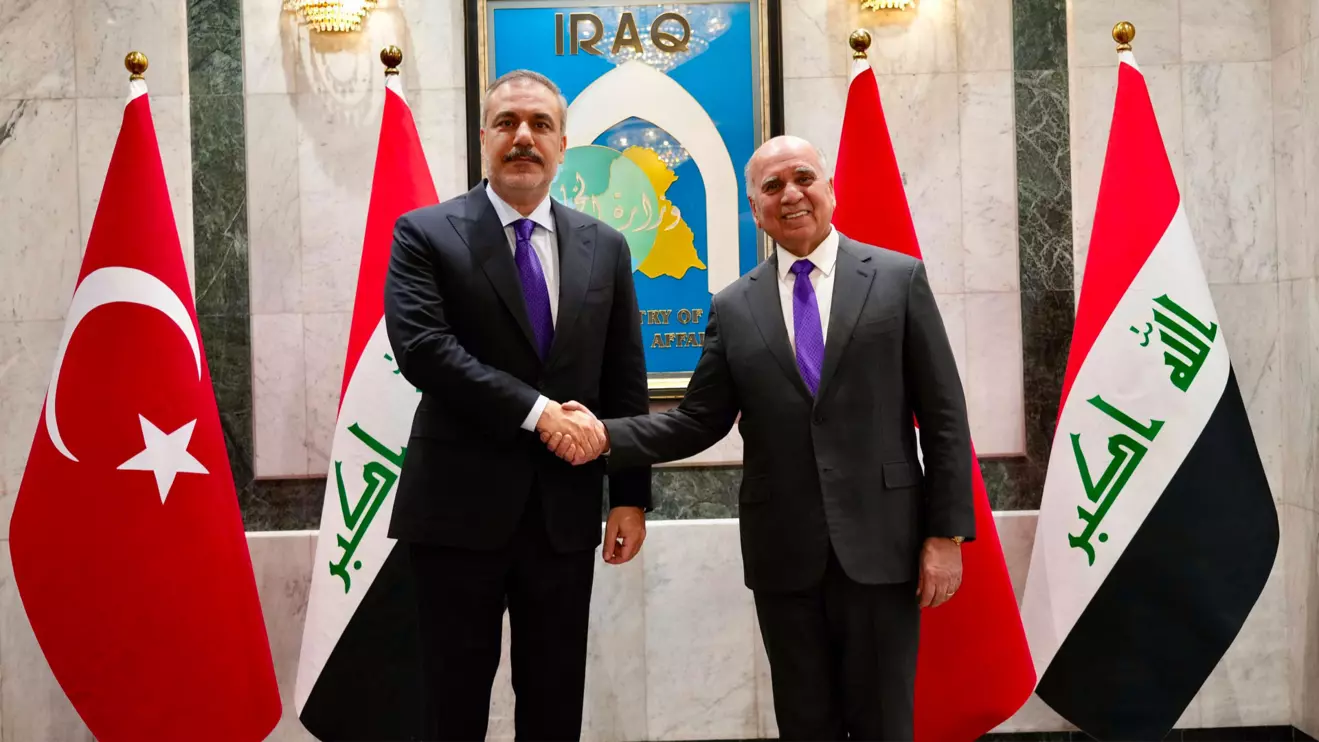
Baghdad hosted a high-level meeting on Sunday as Turkish Foreign Minister Hakan Fidan met with his Iraqi counterpart, Fuad Hussein, to discuss bilateral relations and regional security issues.
The talks come in the wake of significant developments in the region, including the recent fall of the Assad regime in Syria, which has reshaped the geopolitical landscape of the Middle East.
One of the central themes of the meeting was enhancing security cooperation between Turkey and Iraq. Both countries share a strong interest in combating terrorism and maintaining stability in the region.
Specifically, the discussions focused on joint efforts to counter the Kurdistan Workers’ Party (PKK), a Kurdish separatist organization designated as a terrorist group by Turkey, the United States, and the European Union.
The PKK has long been a source of tension between Ankara and Baghdad, as its militants operate from mountainous regions in northern Iraq, launching attacks on Turkish soil. Turkey has conducted cross-border operations in Iraq for years, targeting PKK bases, while Iraq has sought greater cooperation to address the group’s activities within its territory.
"Our discussions emphasized the importance of coordinated action to eliminate terrorism in all its forms," said Turkish Foreign Minister Hakan Fidan during a press briefing. He added that Turkey remains committed to respecting Iraq's sovereignty while addressing security threats emanating from its borders.
Iraqi Foreign Minister Fuad Hussein echoed similar sentiments, stating that "a stable and secure Iraq is vital not only for our country but for the entire region." He underlined the importance of collaboration with Turkey to tackle shared challenges, including terrorism, border security, and organized crime.
A New Regional Context
The fall of the Assad regime has introduced new dynamics to regional politics, prompting neighboring countries to reassess their security strategies and alliances.
Both Turkey and Iraq face the challenge of managing the potential spillover of instability from Syria, as well as the resurgence of terrorist groups and other non-state actors in the power vacuum left behind.
Turkey and Iraq share long borders with Syria and have a mutual interest in ensuring that their territories are not used as safe havens for extremist groups or as conduits for illegal activities.
Beyond security, the two leaders discussed ways to enhance economic cooperation, particularly in energy and trade. Iraq is one of Turkey's key trading partners, and both countries are keen to expand their economic ties.
Discussions included the possibility of reopening and modernizing cross-border trade routes and enhancing energy infrastructure.
Ankara also reiterated its commitment to providing humanitarian assistance to Iraq, particularly in areas affected by conflict and displacement.