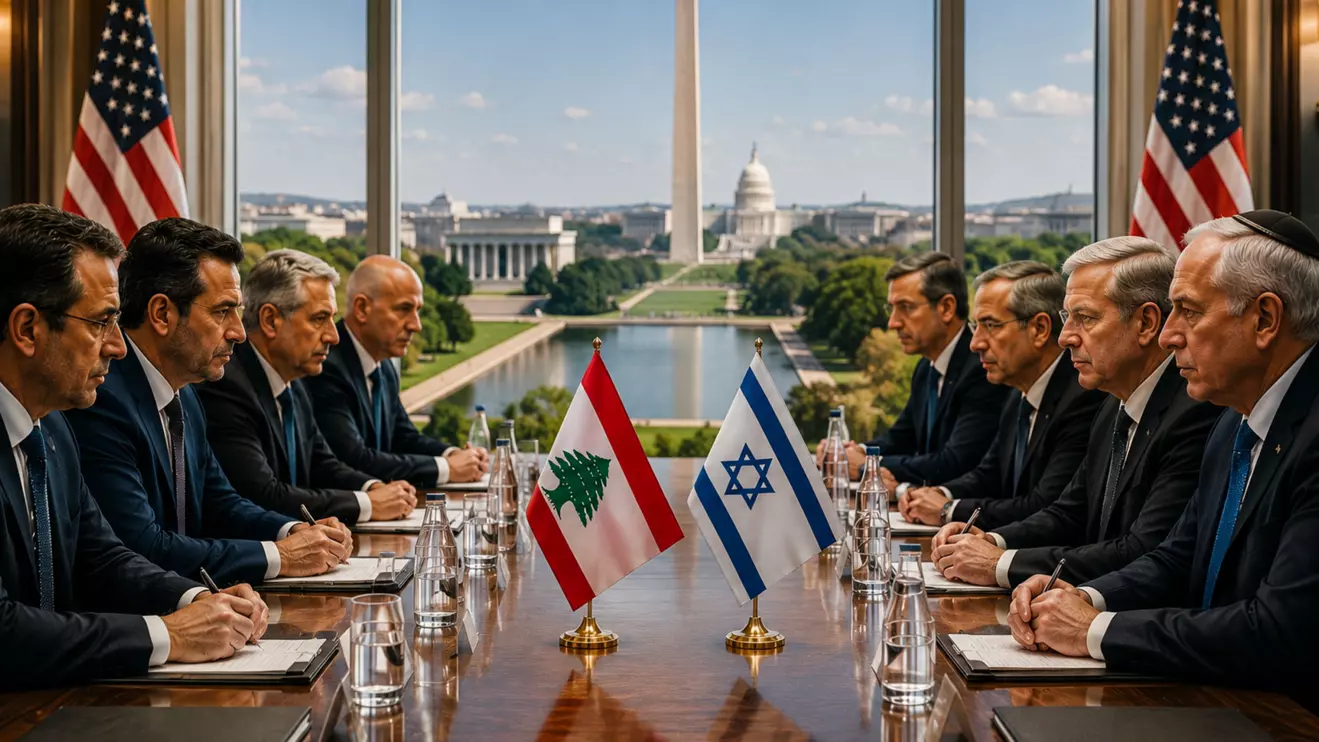
The United States has confirmed that government-level delegations from Israel and Lebanon will hold "intensive and detailed" discussions in Washington on 14 and 15 May, in what represents the most significant direct diplomatic engagement between the two countries in over four decades.
State Department spokesman Thomas Pigott announced the talks in an official communiqué, stating that the two delegations "will engage in detailed discussions aimed at advancing a comprehensive peace and security agreement that substantially addresses the fundamental concerns of both countries."
The language used by the State Department is notably ambitious. Washington explicitly frames the talks as an attempt to "break decisively with the failed approach of the last two decades, which allowed terrorist groups to entrench themselves and grow rich, weakened the authority of the Lebanese state and threatened Israel's northern border."
The objectives set out for the discussions are sweeping: establishing "a framework for durable peace and security arrangements, the full restoration of Lebanese sovereignty over all its territory, border delimitation, and the creation of concrete mechanisms for humanitarian aid and reconstruction in Lebanon."
From ambassadors to government delegations
The 14-15 May talks represent a significant escalation in the diplomatic process. Two previous rounds of discussions were held at ambassadorial level - on 14 and 23 April - producing a ceasefire and its subsequent three-week extension.
Moving to full government delegations signals that both sides are now prepared to engage on the substance of a permanent arrangement, not merely a temporary truce.
Perhaps the most consequential element of the State Department statement is its explicit linkage between a comprehensive peace and the "full disarmament of Hezbollah." Washington leaves no ambiguity: "A comprehensive peace depends on the full restoration of Lebanese state authority as well as the total disarmament of Hezbollah."
For Lebanon, this is both an opportunity and a test. President Joseph Aoun has consistently championed the state's right to negotiate, and consistently been attacked by Hezbollah for doing so.
The 14-15 May talks will reveal whether Lebanon's legitimate institutions can translate diplomatic momentum into a durable settlement, and whether Washington has the leverage to make it stick.