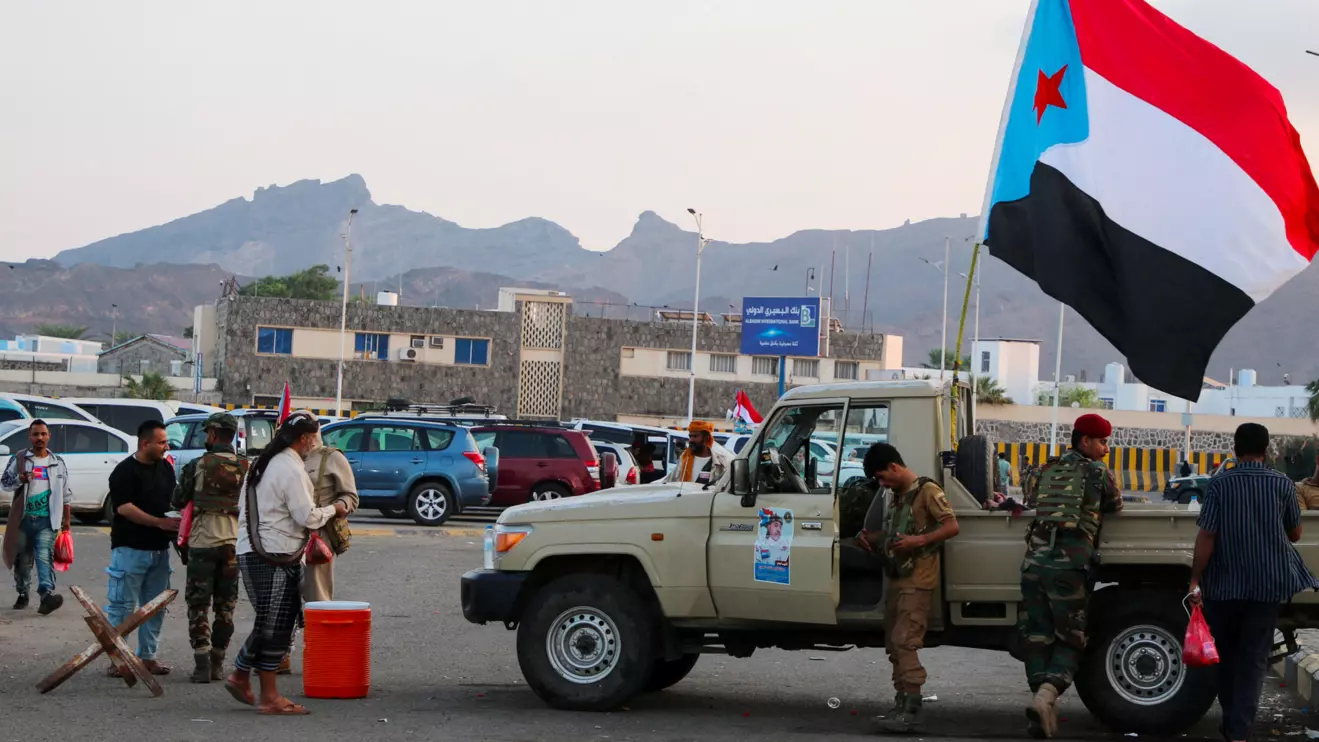
Yemen's Saudi-backed government said it launched an operation on Friday against UAE-backed southern separatists, marking a major escalation in a rift between the two Gulf heavyweights.
Once the twin pillars of regional security, OPEC members Saudi Arabia and the United Arab Emirates have in recent years seen their interests diverge on issues ranging from oil quotas to geopolitics.
A surprise advance by Yemeni separatists in early December shifted power in the country, which has been at war for more than a decade, and laid bare years of divisions between the two Gulf allies.
OPERATION TO 'RESTORE ORDER' IN HADRAMOUT
The internationally recognised Saudi-backed government said in a statement on Friday it had instructed the governor of Yemen's Hadramout province to take control of the "Homeland Shield" forces to restore order after the UAE-backed Southern Transitional Council seized large swathes of southern territory last month.
In a televised address on Yemen TV, Saudi-backed governor Salem Ahmed Saeed al-Khunbashi said the operation was to be peaceful and was not a declaration of war. He said it was to prevent the use of camps to threaten security and to protect Hadramout from sliding into chaos.
Oil-producing Hadramout borders Saudi Arabia and many prominent Saudis trace their origins to the province, lending it cultural and historical significance for the kingdom.
The governor later said his forces had taken control of a military camp in al-Khasha'a, the largest and most important base in the province.
Airstrikes are ongoing at the province's Seiyun airport, a spokesperson for the Saudi-backed Hadramout tribes said.
SAUDI ARABIA MISLED INTERNATIONAL COMMUNITY, STC SAYS
A senior STC official told Reuters the operation had not been peaceful.
"Saudi Arabia knowingly misled the international community by announcing a peaceful operation that they never had any intention to keep peaceful," Amr Al Bidh said in a statement.
"This was evidenced by the fact that they launched seven airstrikes minutes later," he said.
Saudi Arabia did not immediately respond to a request for comment on the airstrikes.
It was unclear if there were any casualties.
The UAE, without directly addressing Friday's developments, said the country had approached the recent escalation with restraint, coordination, and a deliberate commitment to de-escalation.
"The UAE remains committed to dialogue, de-escalation, and internationally supported processes as the only sustainable path to peace," a statement from a UAE government official said.
The STC's Bidh told Reuters that three of the airstrikes targeted the al-Khasha'a military camp.
Three Yemeni sources told Reuters armored vehicles belonging to the Saudi-backed government had been moving towards the camp, which has the capacity to house thousands of troops and was taken over by the STC in December.
TENSIONS REMAIN AFTER UAE TROOP PULLOUT
The UAE last week said it was pulling its remaining forces out of Yemen after Saudi Arabia backed a call for its forces to leave within 24 hours in one of the biggest disagreements between the two Gulf oil powers to ever play out in public.
The move briefly eased tensions but disagreements between the various groups on the ground in Yemen have persisted since then.
A spokesperson for the STC, Mohammed al-Naqeeb, said on Friday that forces were on full alert across the region and warned that it was ready to respond forcefully in a post on X.
Saudi Arabia and the UAE are both major players in the OPEC oil exporters' group, and any disagreements between them could hamper consensus on oil output.
They and six other OPEC+ members meet online on Sunday, and OPEC+ delegates have said they will extend a policy of maintaining first-quarter production unchanged.
ADEN AIRPORT SHUT
Saudi Arabia's ambassador to Yemen also on Friday blamed STC leader Aidarus Al-Zubaidi for refusing to grant landing permission the previous day for a plane carrying a Saudi delegation to Aden.
A halt in flights at Aden international airport on Thursday continued into Friday as both sides traded blame as to who was responsible for the air traffic shutdown.
"For several weeks and until yesterday, the Kingdom sought to make all efforts with the Southern Transitional Council to end the escalation ... but it faced continuous rejection and stubbornness from Aidarus Al-Zubaidi," the Saudi ambassador, Mohammed Al-Jaber, said on X.
Zubaidi issued directives to close air traffic at Aden's airport on Thursday, the ambassador added, saying that a plane carrying a Saudi delegation to Aden aiming to find solutions to the crisis was denied permission to land.
In a statement on Thursday, the STC-controlled Transport Ministry in turn accused Saudi Arabia of imposing an air blockade, saying Riyadh required all flights to go via Saudi Arabia for extra checks.
Aden's international airport is the main gateway for regions of the country outside Houthi control.