Prime Minister Benjamin Netanyahu said on Monday he will discuss Iran's nuclear activities during his visit next week with U.S. President Donald Trump.
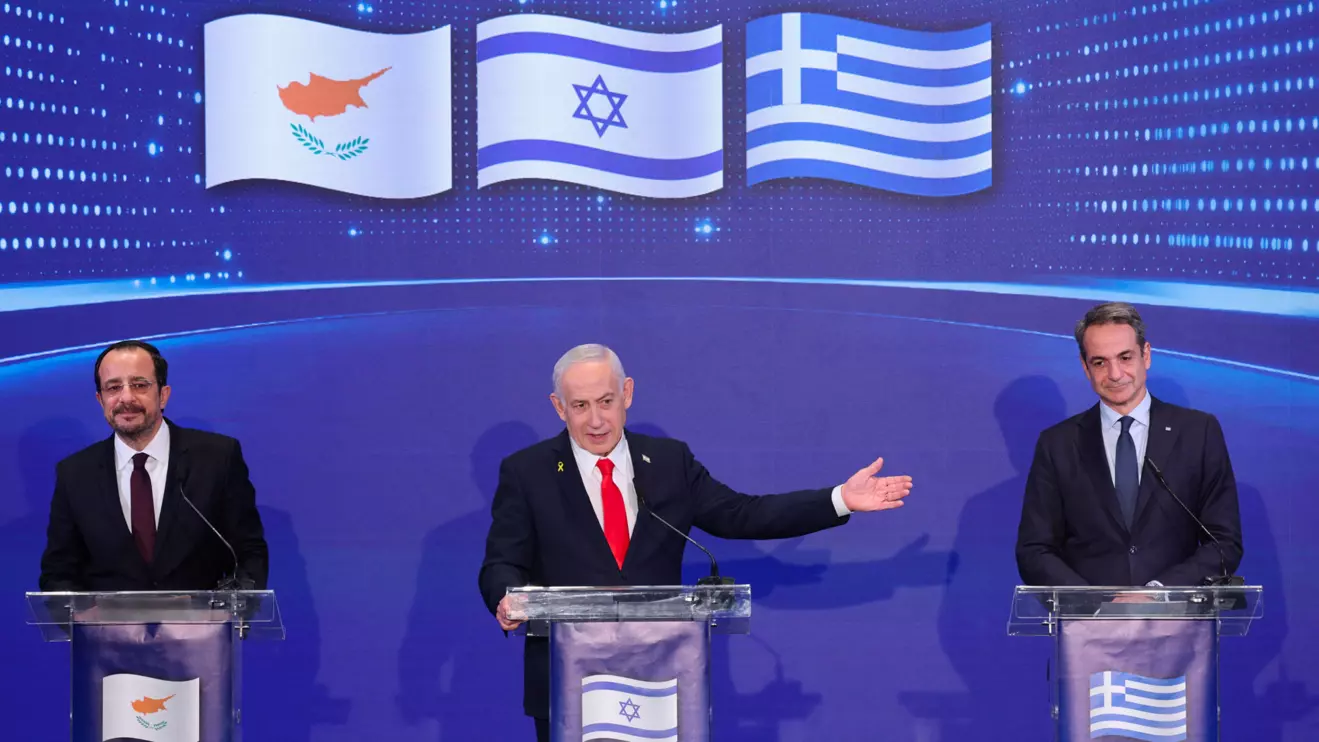
Speaking at a joint press conference with Greek Prime Minister Kyriakos Mitsotakis and Cypriot President Nikos Christodoulides in Jerusalem, Netanyahu said Israel was aware Iran had been conducting "exercises" recently, without elaborating.
Earlier on Monday, Iranian state media reported Iran had held missile drills in various cities during the day, the second such reported exercise in a month.
Western powers regard Iran's ballistic missile arsenal as both a conventional military threat to Middle East stability and a possible delivery mechanism for nuclear weapons should Tehran develop them. It denies any intent to build atomic bombs.
Relations between eastern Mediterranean neighbours Israel, Greece and Cyprus have grown stronger over the past decade, with shared concerns over Turkey's influence in the region.
ISRAEL NOT SEEKING CONFRONTATION: NETANYAHU
Despite "great achievements" during a 12-day war with Iran in June, Netanyahu said basic Israeli and U.S. expectations of Iran were unchanged, including lowering its uranium enrichment level.
"Obviously it will be an item in our discussions," he said of his meeting with Trump next week, adding, "We are not seeking confrontation with" Iran but rather, "stability, prosperity and peace."
Still, Netanyahu said the focus of his discussions with Trump in Washington will be on moving to the next phase of Trump's Gaza plan as well as dealing with Lebanon's Iran-based Hezbollah militants.
He cited Israel's "desire to see a stable sovereign Lebanon" and efforts to prevent the blocking of international shipping by Yemen's Iran-aligned Houthi forces.
Netanyahu, Mitsotakis and Christodoulides agreed to deepen security cooperation, while Netanyahu said the three countries intended to advance an initiative to connect India to Europe via the Middle East by sea and rail.
Christodoulides described the projects as offering a "southeastern gateway connecting Europe with the Middle East and beyond."
The three countries said they would seek to advance an undersea power cable project to integrate their electricity grids with Europe and the Arabian Peninsula.
Mitsotakis said Greece was a gateway for liquefied natural gas. "(It) is a new energy hub in southeastern Europe." Interconnection projects, he said, remained a key priority for the three countries.
Israeli Energy Minister Eli Cohen told Reuters after the press conference the trilateral meeting was important since it comes when there are “countries that are working to uproot regional stability." He did not identify the countries.
By Emily Rose, Michele Kambas and Steven Scheer