Syria
Netanyahu reveals call to Syria's Sharaa
Prime Minister Benjamin Netanyahu has revealed that he phoned Syrian President Ahmed al-Sharaa in July 2025 to demand an end to the killing of Druze in Syria's Sweida province.

U.S. Special Envoy Amos Hochstein said on Monday that a truce in Gaza would not necessarily bring an automatic end to hostilities across Lebanon's southern border and he warned about the risks of an escalation of the conflict.
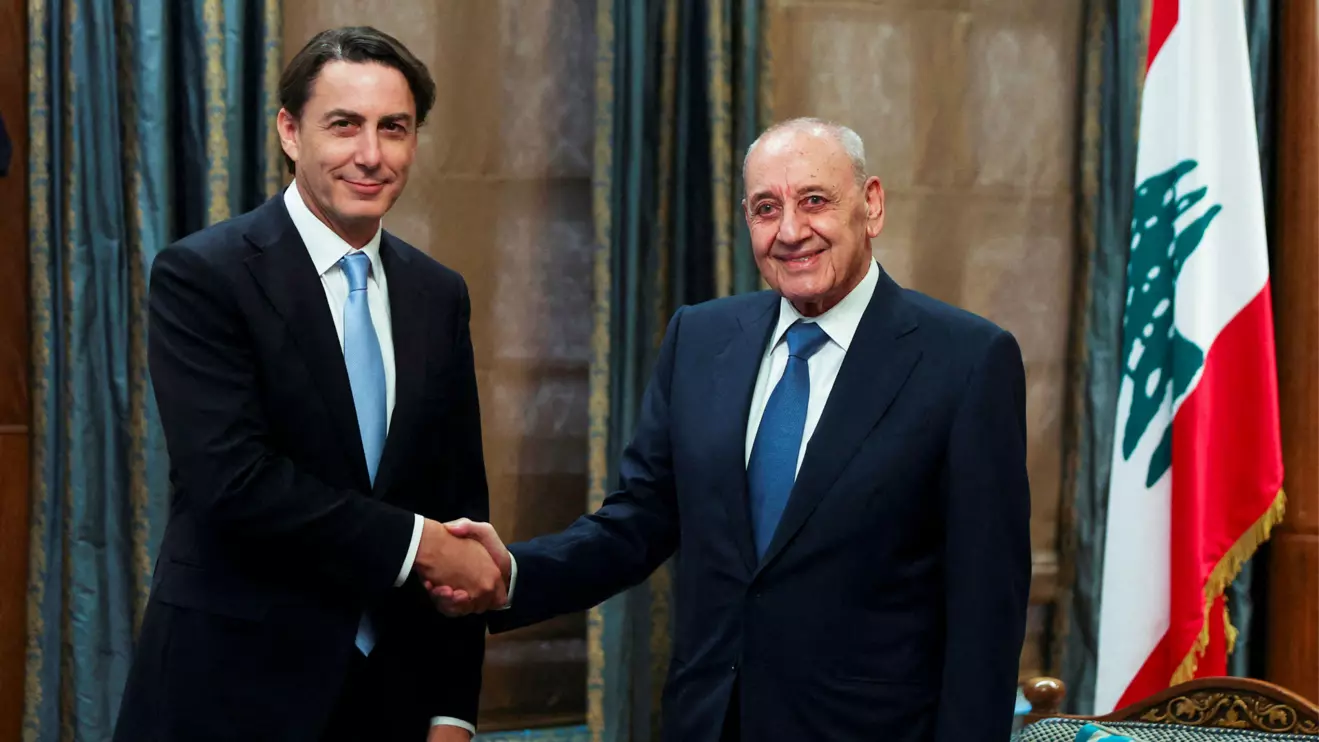
Lebanese Parliament Speaker Nabih Berri shakes hands with U.S. envoy Amos Hochstein in Beirut, Lebanon March 4, 2024. Reuters/Mohamed Azakir
U.S. Special Envoy Amos Hochstein said on Monday that a truce in Gaza would not necessarily bring an automatic end to hostilities across Lebanon's southern border and he warned about the risks of an escalation of the conflict.
Hochstein is visiting Beirut as part of diplomatic efforts to end four months of exchanges of fire between Hezbollah and Israel taking place in parallel to the Gaza war.
It has marked the worst conflict across Lebanon's southern border since the 2006 war, fuelling fears of a bigger confrontation.
"Escalation of violence is in no one's interest, and there is no such thing as a limited war," he told reporters after meeting Lebanon's parliament speaker Nabih Berri, who is close to Hezbollah.
Hochstein said friction on the border had increased in recent weeks.
"A temporary ceasefire is not enough. A limited war is not containable," he said.
Lebanon deputy parliament speaker Elias Bou Saab told Reuters he believed the timing of Hochstein's visit signalled progress in efforts over a Gaza truce.
Hezbollah has publicly indicated that it would halt its attacks on Israel from Lebanon when the Israeli offensive in the Gaza Strip stops, unless Israel kept shelling Lebanon.
But Hochstein said a Gaza truce would not automatically trigger calm in southern Lebanon and said he was "hopeful" for a diplomatic solution to the conflict across that border.
"It does not necessarily happen that when you have a ceasefire in Gaza, it just automatically extends" to Lebanon, he said.
Reporting by Maya Gebeily
Prime Minister Benjamin Netanyahu has revealed that he phoned Syrian President Ahmed al-Sharaa in July 2025 to demand an end to the killing of Druze in Syria's Sweida province.
The United Nations aviation agency has found Lebanon's main airport lacks valid certification, according to a report summary seen by Reuters, in a setback to US President Donald Trump's move to revive direct US-Beirut flights.
A majority of Israelis would prefer a unity government to a repeat election if the October 27 vote fails to produce a clear winner, according to a poll for the daily Maariv. The same poll puts the governing and opposition blocs level, and neither is close to a majority.

To make this website run properly and to improve your experience, we use cookies. For more detailed information, please check our Cookie Policy.
Necessary cookies enable core functionality. The website cannot function properly without these cookies, and can only be disabled by changing your browser preferences.